Into the West
Synopsis
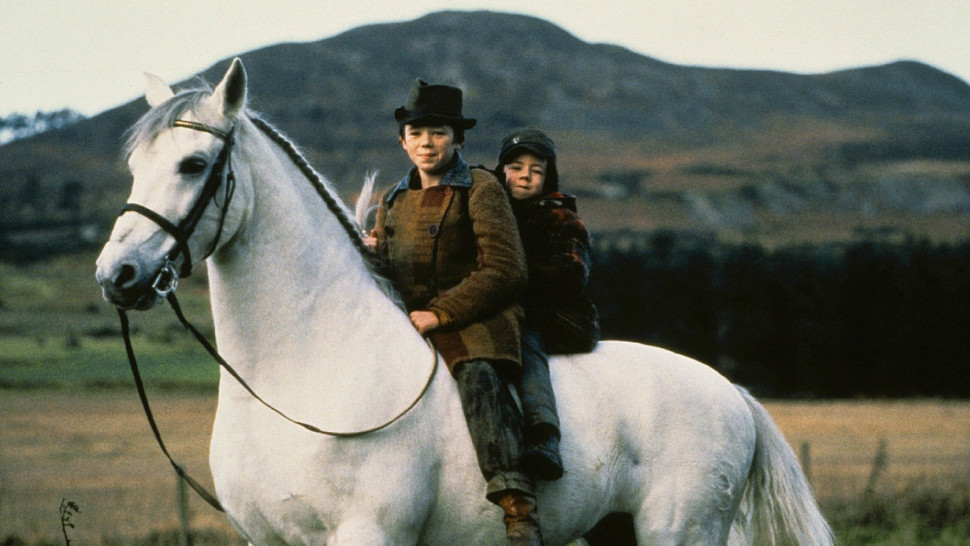
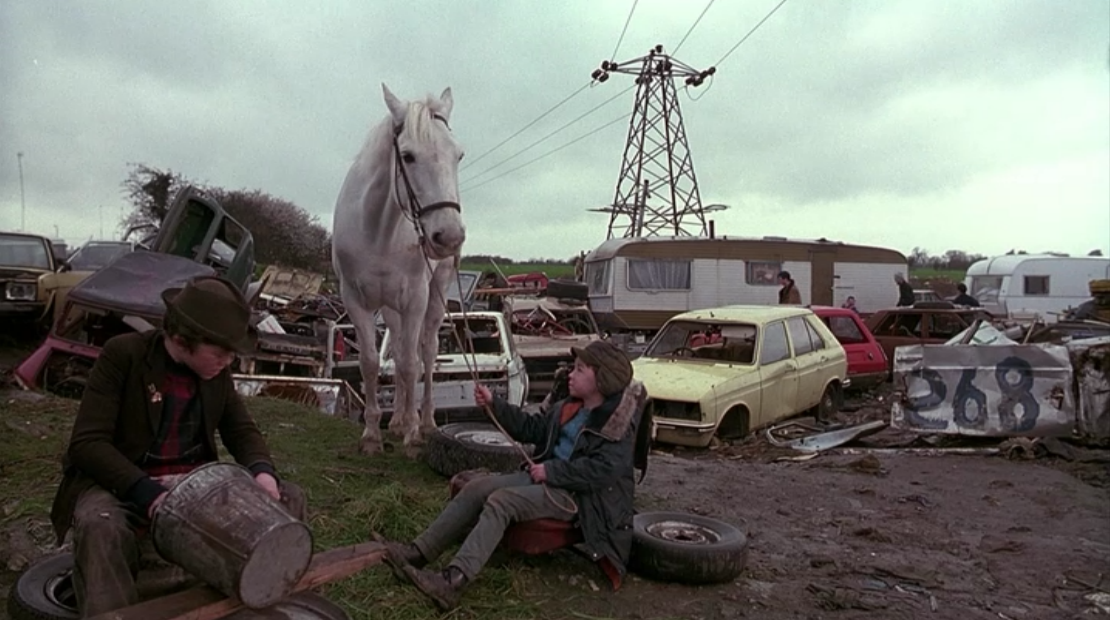
The lives of two young brothers, Tito and Ossie, changed drastically after their mother died giving birth to Ossie. Their father, “Papa” Reilly, once known as the “King of the Travellers,” now struggles to keep his family afloat in a run-down public housing complex of almost 2,000 families in Ballymun, Dublin, where they’ve settled.
A white stallion comes to the boys' grandfather from out of the sea. He's a storyteller in the Traveller community, and he names the horse Tír na NÓg, or “Land of Eternal Youth.” Ossie seems to be the only one who can work with the stallion, and the boys dream of escaping their current lives to go to the West and live as cowboys.
But the Gardaí take the horse, then sell him as a racehorse. The boys see Tír na NÓg on television and become determined to save him. They take off into the West of Ireland, pursued by the Gardaí, private security personnel, and their father, who must return to the Traveller community to ask for help in recovering his sons.
The boys live rough while they're on the run, while Tír na NÓg appears to be leading them to a destination that only the horse knows. Tír na NÓg evades packs of dogs, helicopters, and hunters on hoserback as he takes the boys to their mother's grave, where Ossie learns the truth about her death.
On a beach in the west of Ireland the boys, their father, their friends, the horse, and the Gardaí confront one another. The resolution is unique combination of myth, memory, and healing.
|
DirectorMike Newell WritersJim Sheridan, David Keating, Michael Pearce StarsGabriel Byrne, Ellen Barkin, Colm Meaney, Brendan Gleeson |
Background
The Idea of the West
A map of the United Kingdom and Ireland shows why the West of Ireland was considered to be the "real" Ireland: it was further removed from English influence or rule than the East of Ireland, especially the center of English dominance, in Dublin.
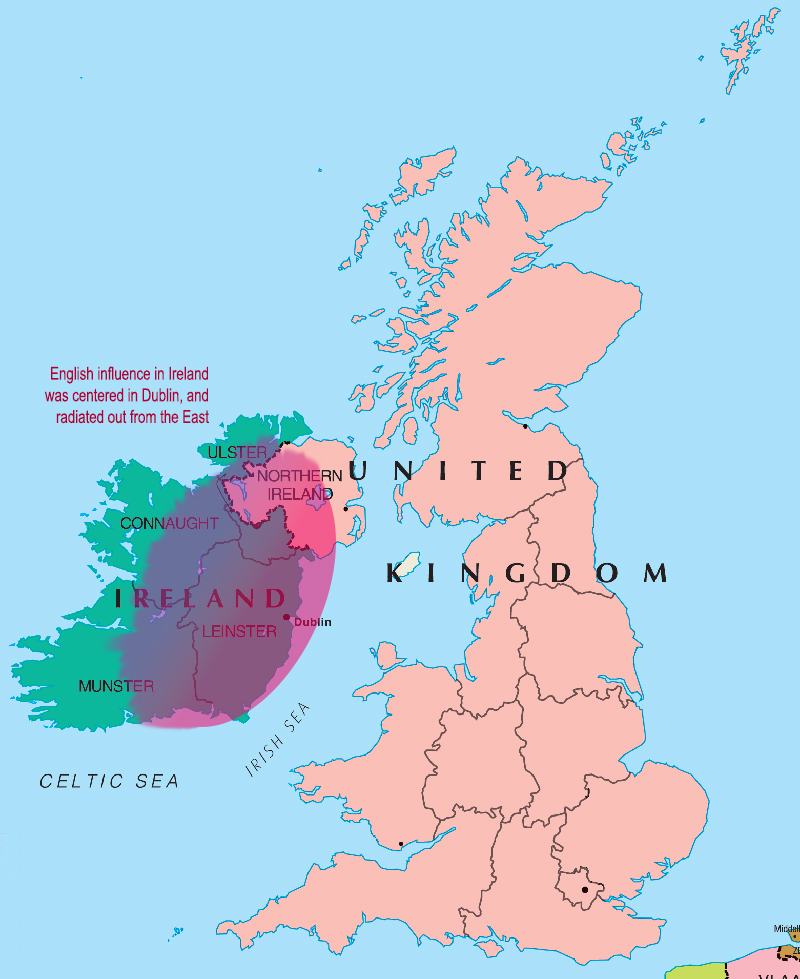
Even during the Tudor Plantations, the West had less arable land, so those areas were less desirable to the English or Scots-Irish planters. Geographically, the West is marked by rugged landscapes; its coastal counties are full of steep cliffs, rocky outcrops, and isolated peninsulas that extend into the Atlantic Ocean.
The West of Ireland has been idealized, romanticized, and mythologized for generations. Life is supposedly simpler there, where the empty landscapes of County Cork and the Midlands give way to the harsh Atlantic coast.
If you visit Dublin today, it looks and feels much like any other large European city. There are still "Irish" elements there, but it is in some ways an imitation of the grubby, urban, and materialistic society that the Irish imagine pervades their colonizer's country. But the West, beyond the reach of the English, is considered to be far more pure expression of what it means to be "Irish."
But here's the problem: what does that phrase "to be Irish" really mean? Are we romanticizing rural poverty and relative ignorance? Are we creating an ideal Irish peasant farmer, one who works an ungenerous land and barely scrapes by? Do we really want to champion the fishermen of the Aran Islands, who refuse to learn how to swim, knowing that eventually the sea will take them all?
Don't get me wrong; I love the West of Ireland. The valley full of Neolithic tombs at Carrowmore and the geographic anomaly of a granite lunar landscape like The Burren are two of my favorite places on the island. Yet when we press too hard on this idea of "The West," we can see that it's something so ill-defined that it means almost nothing, and can mean almost everything.
Irish Travellers
Irish Travellers are a traditionally nomadic group, an ethnic minority indigenous to Ireland. They have been around for centuries, with their own culture and language, and have traditionally made a living moving as they moved from place to place by engaging in horse trading, metalwork, storytelling, and music. There are roughly 31,000 Travellers in Ireland (less than 1%% of the national population), with another 15,000 in Great Britain and about 10,000 in the US. People used to think that Irish Travellers were descendants of those who lost their land and homes during the Great Famine, but this isn't true. As early as the 12th century, “Tinkers” are mentioned in the Irish annals and histories, referring to travelling craftspeople who were very important in the daily of life of the time. |
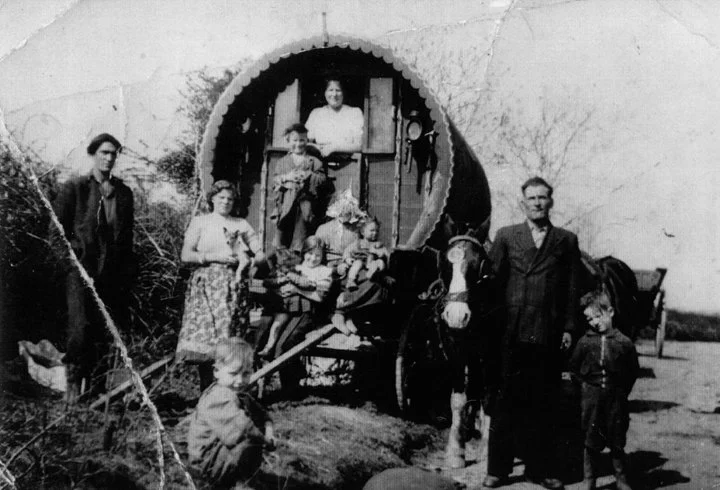
A Traveller family in the 1930s |
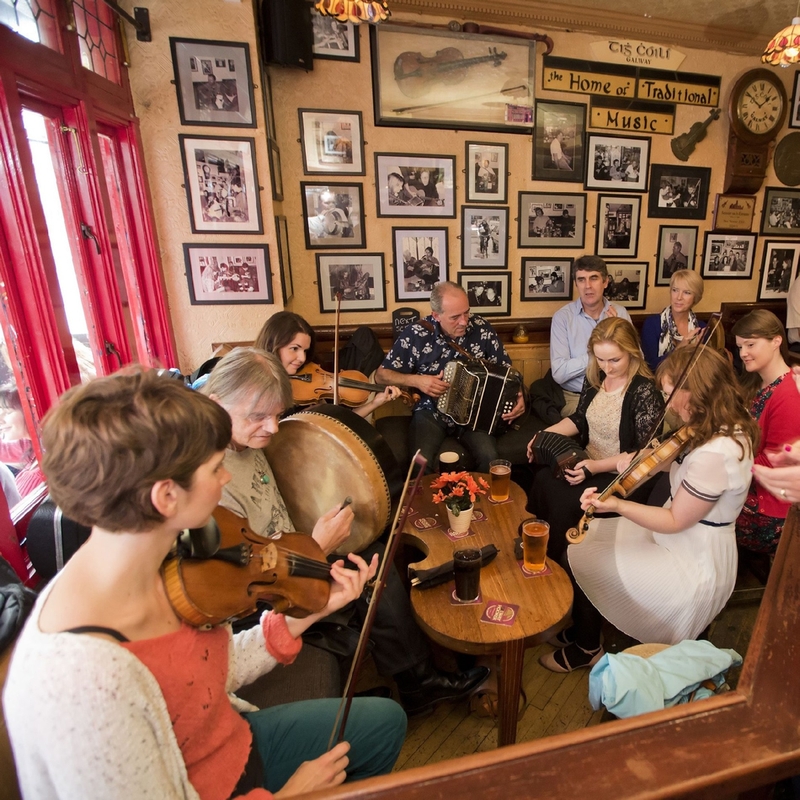
A Trad music session at An Púcán in Galway |
Their musical traditions had a central role in the development of "Trad" music, or traditional Irish music, particularly fiddle playing and uileann piping. For generations, Travellers brought songs and stories from town to town and developed unique styles of singing, storytelling, and playing musical instruments. |
Because of their itinerant lives, Irish Travellers are often stereotyped as cheats and criminals by the "settled folk." This stereotype is pervasive in person-to-person contact and in the media. A 2017 survey by the Irish Human Rights and Equality Commission found that Travellers were almost 10 times more likely to experience discrimination than white Irish people. The Gardaí (the Irish police force) have historically been complicit in this discrimination, with ethnic profiling, unjustified incarceration, and unwarranted searches and seizures. |
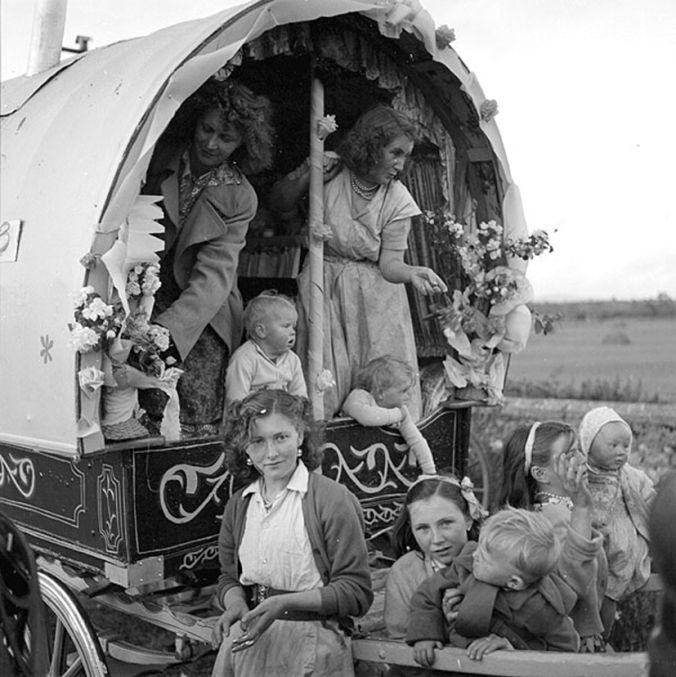
A Traveller family in the 1970s |
Travellers are among the most disadvantaged and marginalized groups in Irish society. According to the European Union, they suffer some of the worst discrimination and poverty of any ethnic group on the continent. They are discriminated against in personal, intrapersonal, and institutional settings. This discrimination has been linked to a mental health crisis in the community, with Travellers experiencing high rates of suicide, low literacy, poor health outcomes, and low life expectancy. 11% of Travellers in Ireland die by suicide, which is six times higher than in the general population, and life expectancy among men in the community is up to 15 years shorter than in Ireland as a whole. They have the highest rates of acute poverty and the lowest employment rates of any community in Europe. 80% of the community are unemployed, and only 3% live past the age of 65. |
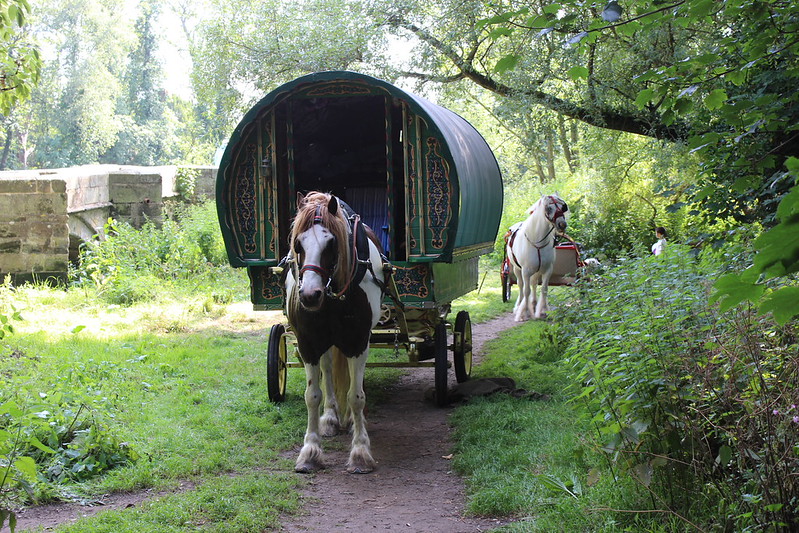
A Traveller wagon leaving a campsite 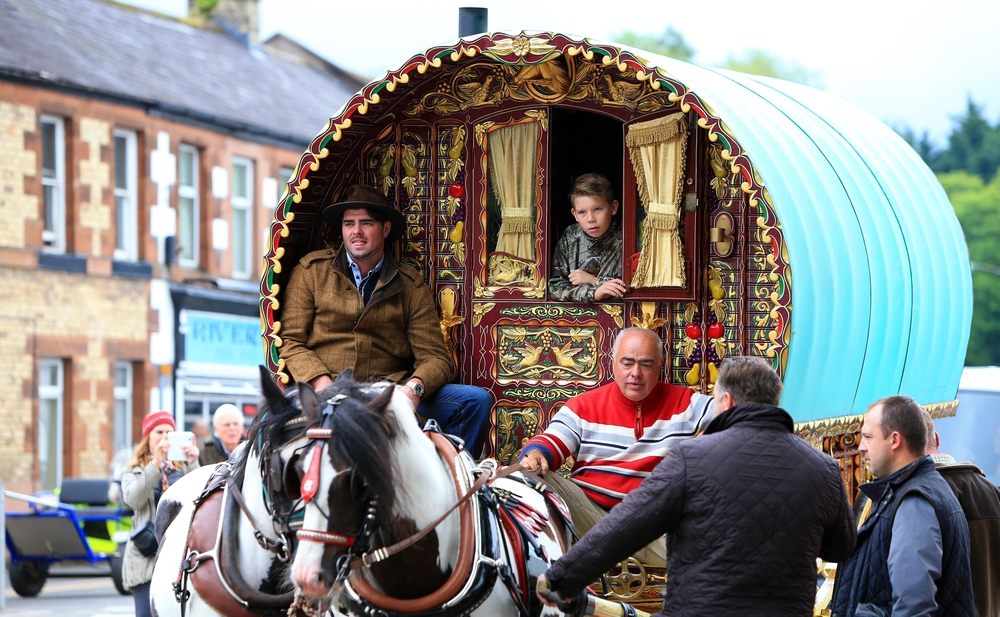
A modern Traveller family |
Travellers' Rights
The Irish state has, since the 1990s, recognized the disadvantages and hostility to which Irish Travellers are subject by treating them as a protected group. However, they were not considered a distinct ethnicity, and any rights granted to them were not considered to be inherent to the group, but bestowed as a gift of the state.
This characteristically Irish solution to the problem was met with disapproval from international bodies and academics. It could have been righted in 2017, when the Traveller ethnicity was finally recognized by the Irish state. However, this classification was just window-dressing, because it explicitly stated that the recognition of Traveller ethnicity would confer no additional rights on them.
Their distinct identity and cultural practices have often been misunderstood and misrepresented, leading to ongoing challenges in achieving social equality. This has heightened tensions between the Traveller community and settled Irish populations. While attempts to preserve their unique ethnic identity have been made, these efforts have at times clashed with prevailing societal norms.
In fact, recent changes in Irish national law have made life as a Traveller more difficult: their nomadic lifestyle has essentially been criminalized through trespassing and vagrancy laws aimed specifically at Traveller communities, and other laws have severely limited their ability to trade in markets and own horses. Horse ownership is a strong tradition within the community and symbol of Traveller culture, but it has been seriously curtailed.
In 2024, Irish Senator Eileen Flynn, a Traveller herself, testified before a committee of the Seanad Éireann (the Irish Senate) that “hatred [toward Travellers] has gone through the roof” in recent years and “white settled people don’t see this.”
The Place of Myth in Modern Ireland
The mythological story that gives the white stallion its name is a tale from the Fenian Cycle of Irish mythology. There are four major collections, or cycles, of Irish myths; this cycle focuses on the exploits of the mythical hero Fionn mac Cumhaill (Finn MacCool) and his group of hunters and warriors, the Fianna Éireann. They were supposed to have lived in the 3rd century CE. Like all good myths, these stories get told and retold, modified in different ways for different times and audiences. In Into the West, Oisín, the hero of this tale told by the boys' grandfather, is presented as a great Traveller. In the Fenian Cycle, Oisín is both a warrior and the greatest poet of Ireland. He's a demigod, the son of Fionn mac Cumhaill and Sadhbh (Syve), daughter of the King of the Tuatha Dé Danann (the supernatural race who ruled Ireland before the coming of the Milesians, who are the ancestors of the present-day Irish). In other stories, he's presented as the greatest poet, or the greatest warrior, or the greatest of the Fianna. These stories are malleable; they can accommodate many complications. |
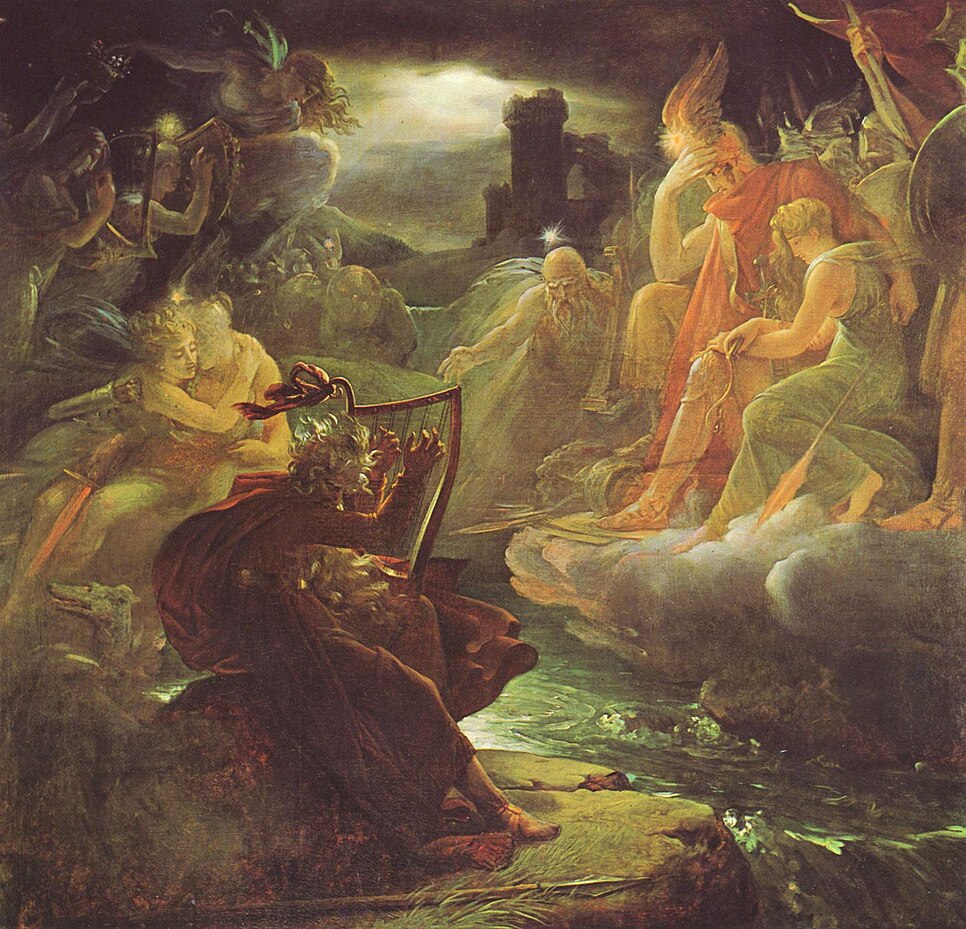
Ossian Evoking Ghosts on the Edge of the Lora, by François Pascal Simon Gérard, 1801 |
Tír na NÓgTír na nÓg, the Land of Youth, is a supernatural place, where there is no aging and no death. It is a world of beauty, health, abundance and joy. The Tuatha Dé Danann live there, and spend their eternal youth writing poetry, performing music, and feasting. Goibniu, the metalsmith of the Tuatha Dé Danann, also prepares their feasts, and the food and drink he offers them grants them their immortality. |
|
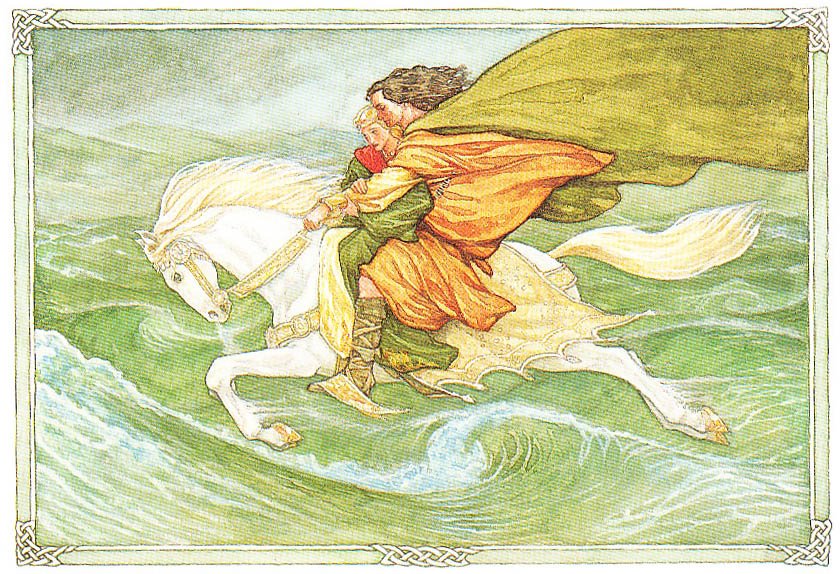
Oisin and Niamh of the Golden Hair, by PJ Lynch 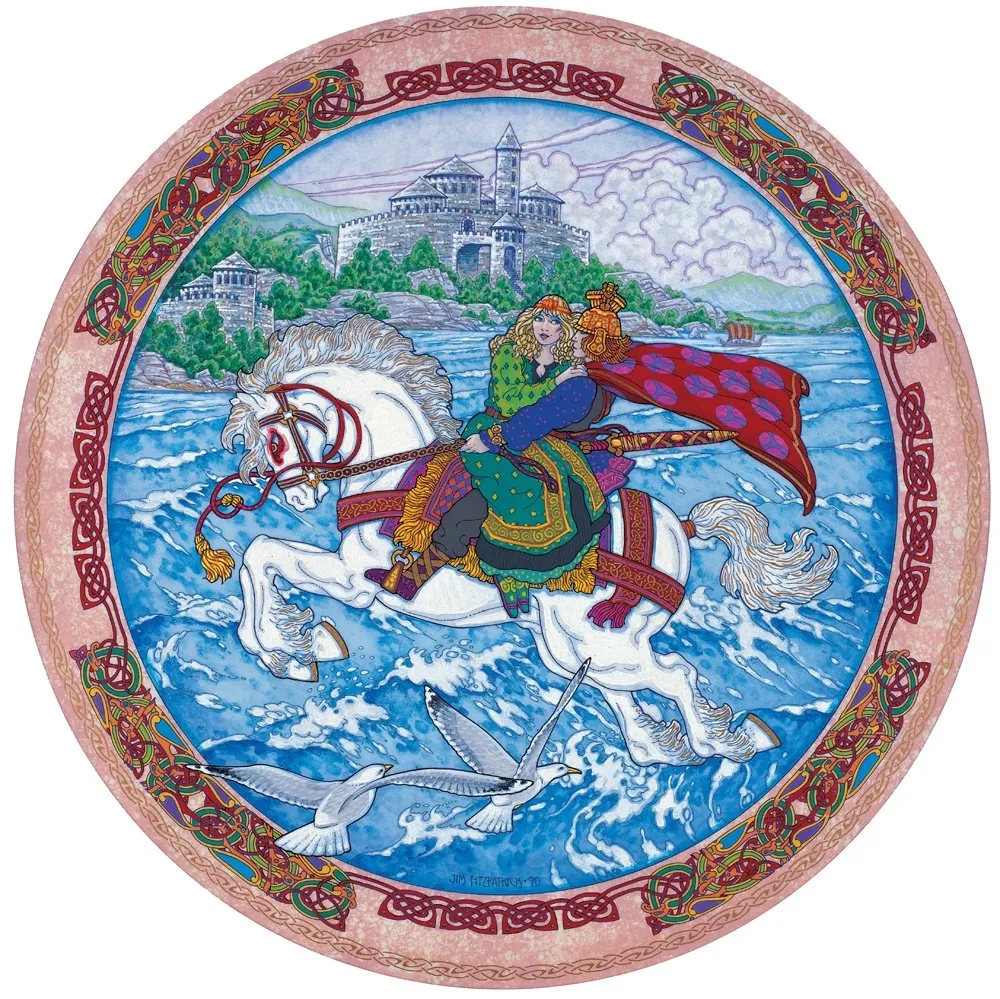
Oisin and Niamh, by Jim FitzPatrick |
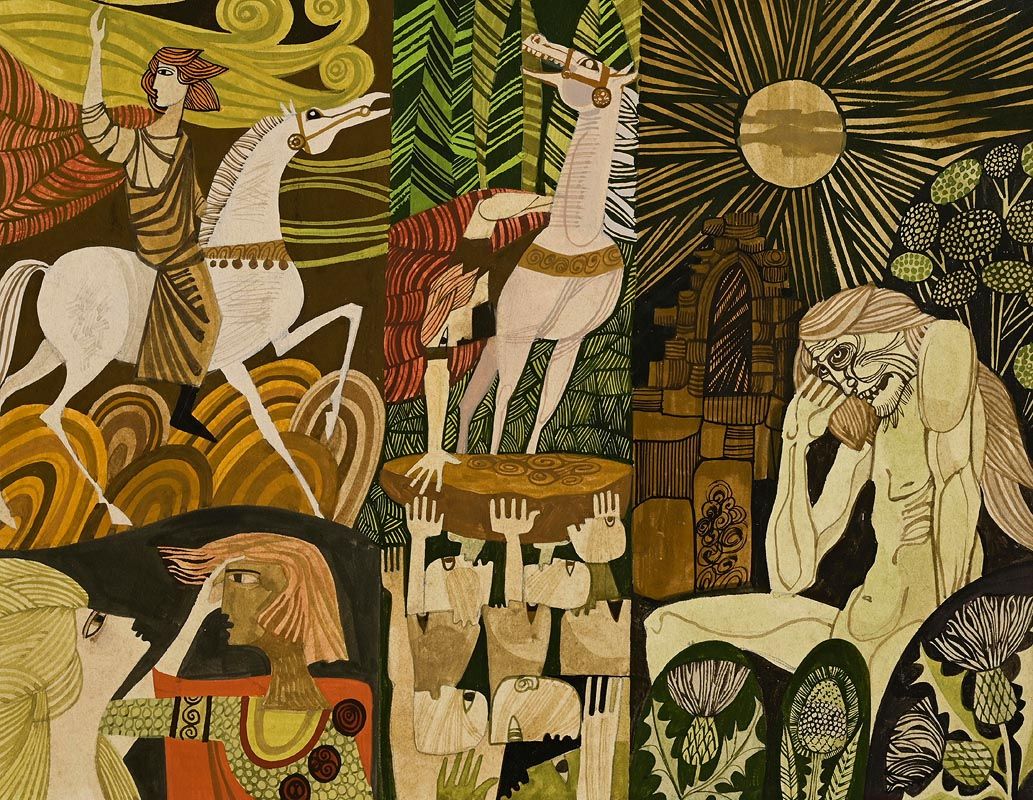
Oísin in Tír na NÓgOne day as the Fianna were out hunting, Niamh, a woman of the Otherworld, came riding up out of the waves on a white horse. She declared her love for Oísin, said that she wanted to take him to the Land of Youth (Tír na NÓg), and described the promises it held. Oísin agred and the two rode off together. In Tír na NÓg the two were married and had three children together. When he had spent what felt to him like three years there, Oísin became homesick and wanted to see his father and the Fianna again. But those three years were actually over 300 years on earth. Niamh reluctantly agreed to let Oisín visit his home, allowing him to ride her white horse. However, she warned him not to touch the ground on his visit, because then he would be unable to return. She told him the trip would give him nothing but sadness, because the Fianna were long gone from Ireland, and Christians now inhabited the land. Nevertheless, Oísin returned to Ireland, and searched for the Fianna in vain. During his search he came upon a group of farmers who were trying to remove a boulder from a field, but were being crushed under its weight. Oisin reached down and tossed the stone aside, but, as he did so, the girth of his saddle broke, and he fell to the ground. Instantly his body withered and twisted, as all the years gone by came upon him. He became feeble and blind, then shrivelled up and turned to dust. The instant his horse sensed it was riderless, it took off to return to Tír na NÓg. |
Oisín and St. Patrick
There is a later version of this myth that addresses the passing of Pre-Christian Ireland with the coming of Christianity to the island. The man most credited with bringing Christianity to Ireland is, of course, St. Patrick.
In this version, Oisín turns into that decrepit old man, but doesn't turn into dust. Having seen this strange young hero shrivel before their eyes into a feeble old man, the farmers he had helped brought Oisín to the monastery where St. Patrick lived.
Patrick welcomed the old man, and after questioning him, figured out who he was. He wondered how his guest had survived for so long, and he cared for Oisín with great kindness and honor. Seeing the old man lost in sadness that his world was gone, Patrick invited him to convert to Christianity. But Oisín clung to his own beliefs, and so the two entered into a great debate.
Oisín asked if he would see his hound in heaven, and Patrick responded that animals do not have souls, and therefore do not go to heaven. Oisín asked if Fionn mac Cumhail and the rest of the Fianna would be in heaven waiting for him. Patrick told him that those men gloried in battle and blood, had done much harm to others, and did not know his God. Therefore they were not in heaven but in hell.
Patrick told Oisín about the torments and demons of hell, and urged him to convert to Christianity to avoid such eternal pain. But Oisín did not agree. He told Patrick that no devil or demon could keep the great men he remembered in bondage forever.
Oisín argued that, if Patrick's God was so unfriendly that He offers hospitality only to those who obey His rules, and would turn out great and good men like Fionn mac Cumhail and the Fianna, then both his father and friends were certainly in hell. But Oisín was convinced that they had either overthrown the devil and were ruling there themselves, or had escaped long ago and were currently living somewhere else. And it was there, wherever they were, that he was bound, because he would not live in any house where his father was not welcome.
Then Oisín, a man out of time, last of the Fianna, having outlived all those he knew and loved, thanked Patrick for his kindness and hospitality, breathed his last, and went to find his friends.