The Wind that Shakes the Barley
Synopsis
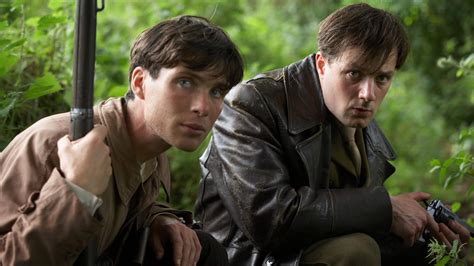
Ireland 1920: workers from field and country unite to form volunteer guerrilla armies to face the ruthless "Black and Tan" squads that are being shipped from Britain to block Ireland's bid for independence.
Damien O'Donovan is leaving Ireland to work in a highly-reputed London hospital, but he witnesses how the British Black and Tans abuse their authority and commit murder at will. He changes his mind about going to England, and instead joins his brother, Teddy, who is the leader of the loacl IRA brigade. Damien adopts the merciless logic of civil war, while Teddy mellows by experiencing endless suffering first-hand.
As the freedom fighters bold tactics bring the British to breaking point, both sides finally agree to a treaty to end the bloodshed. But the treaty causes a rift in Ireland and in this family. Despite the apparent victory, civil war erupts and families, who fought side by side, find themselves pitted against one another as enemies.
The film itself is bleak and uncompromising, but is full of gorgeous cinematography and tight pacing, and features a fine performance from Cillian Murphy.
Director
Ken Loach
Writer
Paul Laverty
Stars
Cillian Murphy, Pádraic Delaney, Liam Cunningham
Background
The Black and Tans
This British military group was formed in 1920, with 10,000 men, The majority were unemployed former British soldiers from England, Scotland, and Wales who had fought in WWI. They cultivated a reputation for brutality, committing murder, arson, and looting, and became notorious for reprisal attacks on civilians and civilian property, some of which were authorized by the British government.
Title
The film takes its title from Robert Dwyer Joyce's "The Wind That Shakes the Barley", a song set during the 1798 rebellion in Ireland and featured early in the film. The song made the phrase "the wind that shakes the barley" a motif in Irish republican song and poetry.
Awards and Reviews
Winner, the Palme d'Or at the 2006 Cannes Film Festival
Winner, Best Irish Film at the Dublin Film Critics Circle Awards
Winner, Best Film, Irish Film and Television Awards
plus 4 other awards and 25 other nominations
A 90% score on Rotten Tomotoes
Post-film Discussion
"The Wind That Shakes the Barley"
This is the 19th-century rebel song that gave the film its name. It shows the cycle of violence and remorse that is captured in Loach's film
I sat within a valley green sat there with my true love
And my fond heart strove to choose between the old love and the new love
The old for her, the new that made me think on Ireland dearly
While soft the wind blew down the glade and shook the golden barley
'Twas hard the mournful words to frame to break the ties that bound us
Ah, but harder still to bear the shame of foreign chains around us
And so I said, "The mountain glen I'll seek at morning early
And join the brave united men" while soft wind shook the barley
'Twas sad I kissed away her tears her arms around me clinging
When to my ears that fateful shot come out the wildwood ringing
The bullet pierced my true love's breast in life's young spring so early
And there upon my breast she died while soft wind shook the barley
I bore her to some mountain stream and many's the summer blossom
I placed with branches soft and green about her gore-stained bosom
I wept and kissed her clay-cold corpse then rushed o'er vale and valley
My vengeance on the foe to wreak while soft wind shook the barley
'Twas blood for blood without remorse I took at Oulart Hollow *
I placed my true love's clay-cold corpse where mine full soon may follow
Around her grave I wondered drear noon, night and morning early
With aching heart when e'er I hear the wind that shakes the barley
* The battle of Oulart Hill, the first rebel victory in the United Irishmen Rebellion of 1798. A rebel gathering of between 4,000 and 5,000 annihilated a detachment of 110 militia sent from Wexford town to stamp out the spreading rebellion in County Wexford.
 |
 |
 |
| Terms in the film | |
| The Black and Tans | A British paramilitary force (mostly WWI veterans) recruited to assist the Royal Irish Constabulary. They were known for their brutality, their attacks on civilians, and their burnings of Irish towns. They are the primary antagonists in the first half of the movie. |
| The IRA (Irish Republican Army) | The army of the Irish Republic that fought a guerrilla war against British forces from 1919–1921. This is the organization Damien and Teddy join; the film shows its internal evolution and eventual split. |
| Flying Column | A small, mobile unit of the IRA that lived "on the run" and launched surprise attacks.The O'Donovan brothers lead a flying column in the hills of County Cork. |
| The Anglo-Irish Treaty | The 1921 agreement that ended the Irish War of Independence, created the Irish Free State, and kept Northern Ireland as part of Great Britain. It granted Ireland "Dominion" status rather than full independence and required an oath of allegiance to the British Crown. This treaty causes the ideological rift between the brothers and is the catalyst for the film's second half. |
| The Free State | The government established by the Treaty, which remained a dominion of the British Empire.Teddy joins the Free State army, trading his civilian clothes for a formal military uniform. |
| The Republic | The ideal of a fully independent, 32-county Ireland, free from any oath to the British King. Damien refuses to settle for anything less than the Republic, leading him to fight against the Free State. |
| Sinn Féin | The political wing of the Irish independence movement. The film depicts their "underground" courts, which Damien uses to protect the poor from local moneylenders. |
Freedom and Tension
The film highlights a real historical tension, Nationalism vs. Socialism: should the revolution merely "change the color of the flag," or should it fundamentally restructure society to help the poor?
| The "Two Irelands" | |
| Pro-Treaty (Teddy) | Anti-Treaty (Damien) |
| The Free State perspective | The Republican/Socialist perspective |
| Pragmatism | Idealism |
| The "Stepping Stone" Theory Michael Collins (the real-life leader Teddy mirrors) argued that the Treaty didn't give Ireland full freedom, but the "freedom to achieve freedom." |
The Republic For Damien, anything less than a full, independent Republic—without an oath to the King—is a betrayal of those who died (like his friend Micheál). |
| Exhaustion After years of guerrilla warfare and British reprisals (the Black and Tans), many felt the country could not survive another month of war against the full might of the British Empire. |
Social Revolution Influenced by James Connolly, Damien believes that simply changing the flag from red to green is useless if the same oppressive economic systems (landlords and exploitative bosses) remain. |
| Legitimacy The Treaty was narrowingly approved by the Dáil (Irish Parliament), giving Teddy the "moral high ground" of defending a nascent democracy. |
Maintaining Oppression Damien's most chilling prediction was that there would be "Green and Tans," that the new Irish government would use the same brutal tactics as the British to suppress their own people in order to maintain "order." |
 |
 |
 |
The Minor Characters
The minor characters in the film serve as a microcosm for the Irish population during the struggle. Here is how the key figures relate to the central conflict:
| Character | Relationship to the brothers |
Role/Fate |
| Sinéad | Love interest of Damien; close family friend | The Civilian Cost Her home is destroyed by the British, and she eventually becomes a staunch Anti-Treaty supporter, feeling the ultimate betrayal when the brothers split. |
| Dan | Former union leader; IRA member | The Socialist Voice He was involved in the 1913 Dublin Lockout. He mentors Damien on the idea that independence is hollow without economic reform. He remains Anti-Treaty. |
| Chris Reilly | Lifelong friend of the O'Donovan brothers | The Tragic Informer Under threat of torture and the death of his family, he leaks information to the British. Damien is forced to execute him, marking the "death of innocence" for the group. |
| Sinéad's Grandmother | Matriarch | The Cultural Anchor She refuses to speak English to the British soldiers and maintains the "old ways," representing a quiet but stubborn resistance that predates the IRA. |
Points for Analysis/Discussion
The Language of Oppression
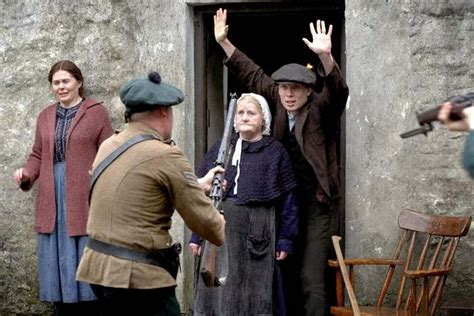
Notice how the British soldiers demand that the Irish men state their names in English. By refusing and giving his name in Irish (Micheál Ó Súilleabháin), the young Micheál is beaten to death. Following the Gaelic Revival, speaking in Irish rather than English became a way of fighting back against the colonialism of the English. This highlights how language was a primary battlefield for identity and sovereignty.
Reading and Writing
Closely aligned with the language mentioned above is the film's focus on reading and writing. Who's literate and who isn't? Questions like "Have you read the Proclamation?" or "Have you read the Treaty?" are coupled with commands to do so. Dan and Damien read the speeches of Daniel O'Connell. Orders are delivered in writing to the flying column. Sir John is forced to write to the British General, and is asked for "his letters" to his family before his execution. Chris Reilly can't write, and his mother can't read. Damien's letter is delivered by Teddy.
The Cycle of Violence
The film is bookended by scenes of execution. In the first half, the violence is both doled out by and directed at the "occupier" or those who help them. In the second half, the violence is fratricidal. Does the film suggest that once a society chooses the path of violence to achieve its goals, it is destined to turn that violence inward?
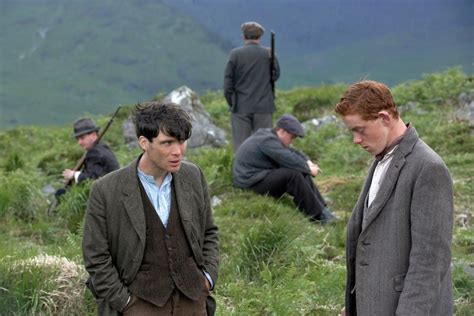
The Mirrored scene: Compare the scene where Damien executes Chris Reilly to the scene where Teddy executes Damien. How does the dialogue change? Who justifies the violence in each instance? Does the "necessity" of the act feel different when it's for a Republic versus when it's for a Free State?
The "Free State" Uniform
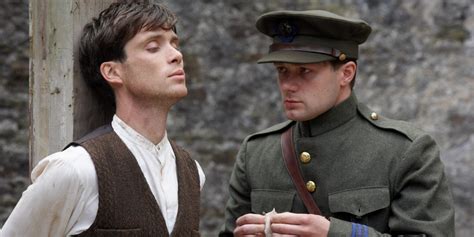
There is a visual shift when Teddy joins the Free State army. He trades his civilian trench coat for a formal green military uniform provided by the British. Damien sees this uniform as a sign of submission, while Teddy sees it as a sign of legitimacy.
Moral & Ethical Dilemmas
The role of the Church: The film briefly touches on the role of the Catholic Church in this Civil War. During the Civil War, the Church largely supported the Pro-Treaty/Free State side and threatened Anti-Treaty fighters with excommunication. This adds another layer of pressure to Damien’s isolation — he is fighting not just his brother and the government, but the social and moral authority of the time.
The Path to Violence: Damien initially believes the war is "unwinnable" and prefers medicine. What specific event serves as his "breaking point"? Was his choice to join the IRA inevitable?
The Cost of Loyalty: Damien is forced to execute a lifelong friend, Chris Reilly, for being an informer. How does this act change Damien? Is there a difference between "murder" and "execution for the cause" in the context of war?
Political & Social Themes
The Courtroom Scene: During the Republican court scene, a conflict arises over a wealthy loan shark who provides arms to the IRA. Teddy sides with the loan shark, while Damien sides with the poor woman. What does this scene reveal about the future of the revolution?
The "Green and Tans": Damien fears that if the Treaty is signed, they will simply replace the "Black and Tans" with "Green and Tans." What does he mean by this, and does the film suggest his fear was justified?
The Role of Women: How do characters like Sinéad and the grandmother contribute to the resistance? Does the film accurately reflect the Cumann na mBan (the Irish women's paramilitary organization)?
Cinematic Style & Impact
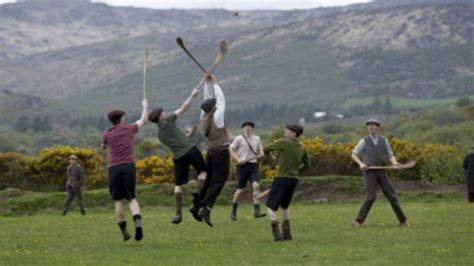
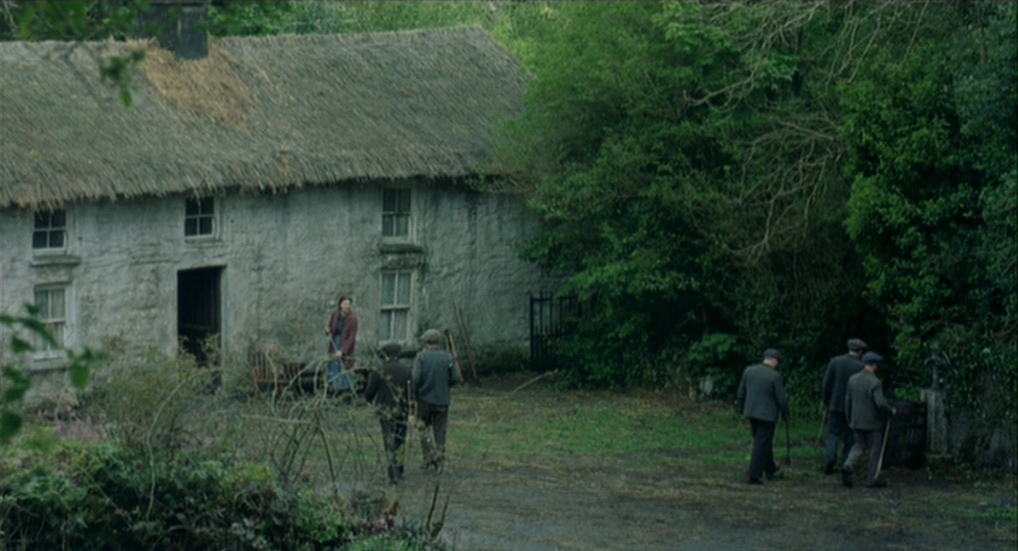
Setting: The film constantly brings viewers back to Sinéad's cottage. It's a stand-in for all of rural Ireland. From the raid by the Black and Tans—which ends with the killing of Micheál—to Teddy's delivery of Damien's letter, it is always the site of violence and its aftermath.
Visual Storytelling: Director Ken Loach often uses a "matter-of-fact" style with natural lighting. How does the contrast between the beautiful Irish landscape and the raw violence affect the experience of the film?
The Failed Revolution: You could say that the argument of the film is that the Irish Revolution was unfinished because it did not address the economics of colonialism. Ignoring the historical reality (the Free State did not become a Republic for another 25 years), was economic reform an unrealistic expectation for the Irish?
Cinematic Realism: Loach is known for using non-professional actors and location shooting. How did both of those contribute to the film’s historical "truth."?
The Tragedy of Damien: Is Damien O’Donovan a hero, a victim of circumstance, or a fanatic who lost his way?
The Ending: The film ends on a note of deep personal and national grief. Why did Loach choose to focus on a private family tragedy rather than the larger historical battles of the Civil War?
Some shots to consider
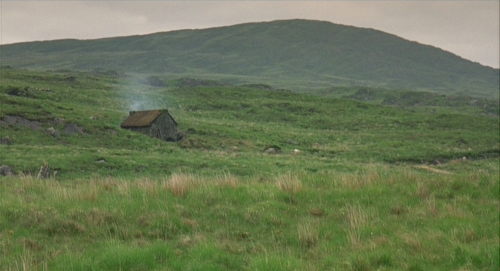
The lonely landscape
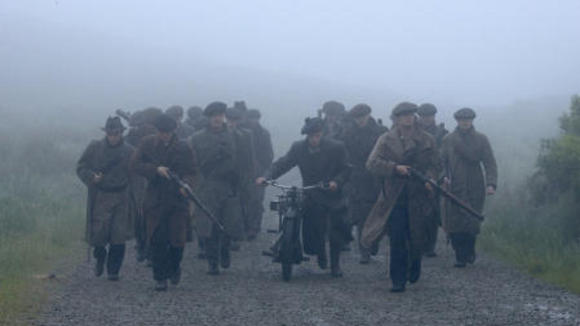
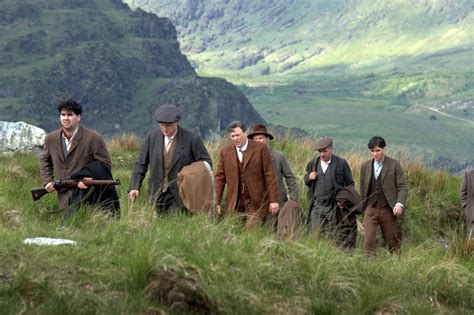
Loach emphasizes the distance between people and places with shots like this. The shots of the flying column marching, or riding in carts, go on for a long time. Damien talks about walking six hours with Chris Reilly's mother to take her to the chapel where he's buried. Such a land makes it difficult to create real connections between people.
The ironic march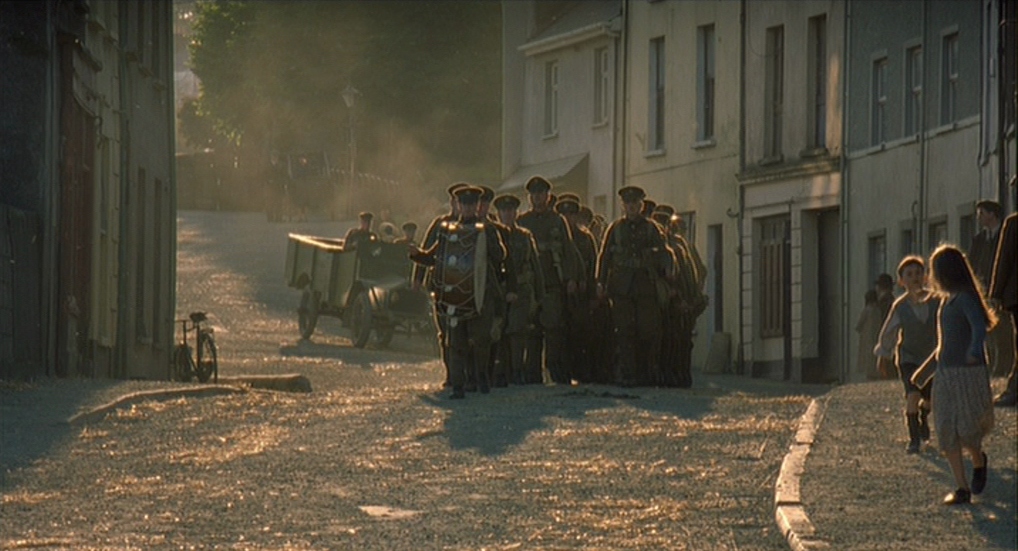
Oppositional placement
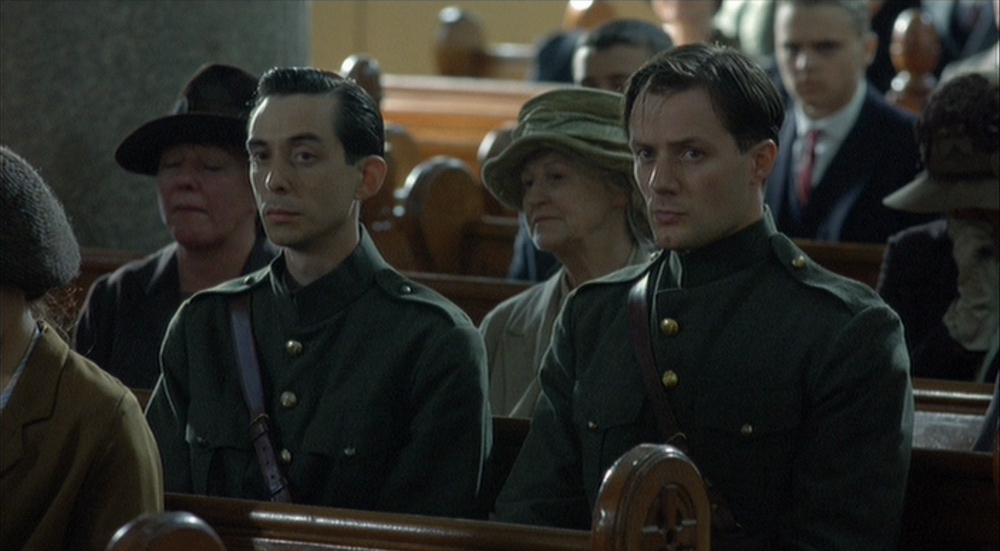 |
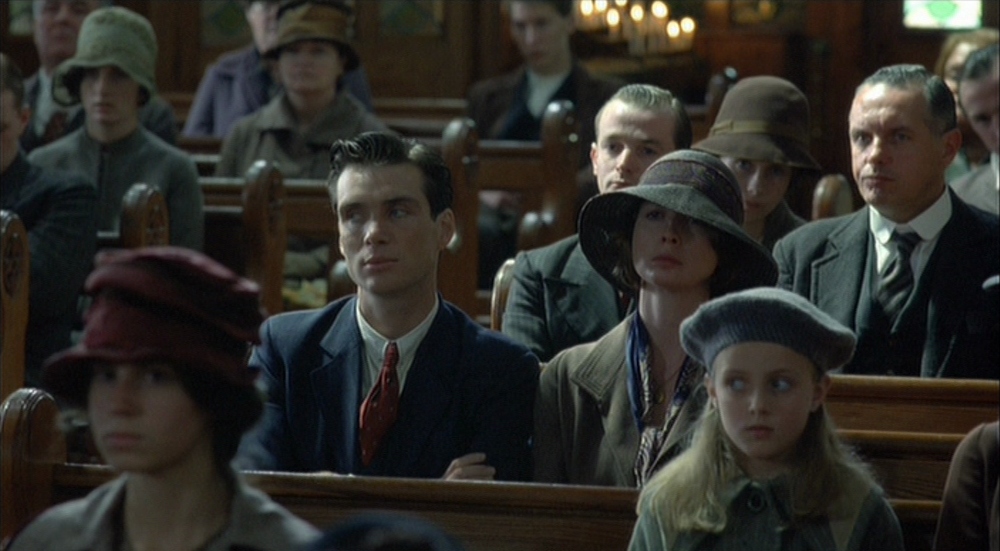 |
The divide between the brothers is illustrated in the church scene, with the two of them sitting on opposite sides of the aisle.
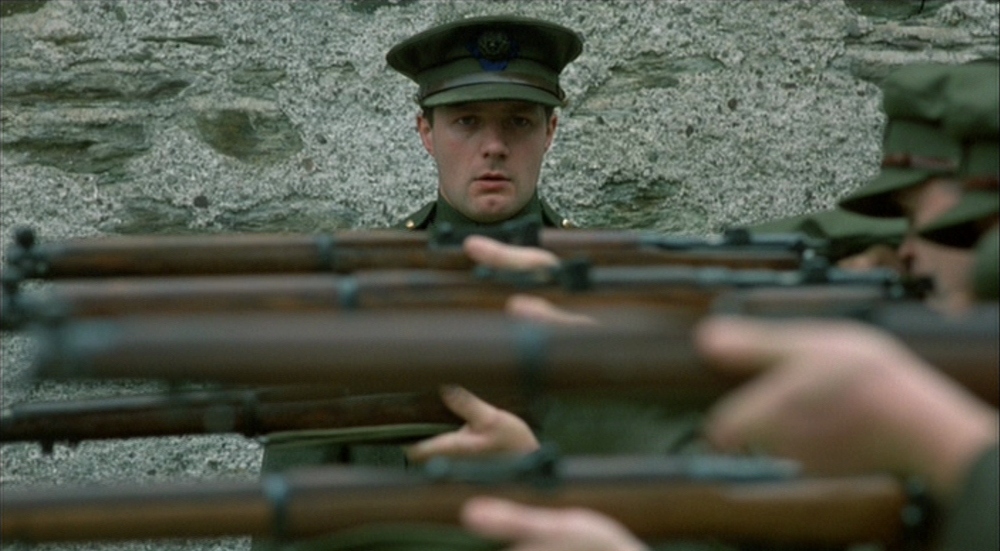
From IRA — to the Crown's Man?
As Teddy gives the command to fire, this shot, over the barrels of the rifles of the firing squad, captures his conflict, and suggests that he will always be surrounded by violence.
Some quotations to think about
Finbar: "Look to your left! Now look to your right! What do you see there? Mercenaries! That were paid to come over here to make us crawl, and to wipe us out. We've just sent a message to the British cabinet that will echo and reverberate around the world! If they bring their savagery over here, we will meet it with a savagery of our own!"
Damien: [loading revolver] "I studied anatomy for five years, Dan. And now i'm going to shoot this man in the head. I've known Chris Reilly since he was a child. I hope this Ireland we're fighting for is worth it."
Damien: ". . . And we walked for six hours and she didn't say one word. Then we got to the chapel . . . and I showed her the grave. And I'd put a . . . cross and some flowers on it. And she turned to me and she said, 'I never want to see your face again.' . . . I've crossed the line now, Sinead."
Dan: "If we ratify this treaty, all we're changing is the accents of the powerful and the colour of the flag."