ENGL 2100 F — LIT & HUMANITIES — FALL 2025
Everything you need to know for this class is in this syllabus. You might find this syllabus intimidating because of its length, but it is a one-stop-shop for you in this course. Along with the usual material about course policies and procedures, academic integrity, and accessibility accommodations, it also contains the course schedule, explanations for all your assignments, the prompts for the essays you'll be writing, and the rubrics we'll be using.
COURSE INFORMATION
ENGL 2100 F — Literature and Humanities: Graphic Novels
CRN: 81796
TR 2:00 pm - 3:15 pm
Info Tech 1004
Course Description
From the University Catalog: Examination of literature as an expression of the humanities through study of several complete works from at least two historical periods, two genres, and two cultures/countries. Includes an essay or projects involving documentation.
Course Dates
August 13: Full Term, Classes Begin, Attendance Verification must be completed on the first class meeting day
August 13 - 18: Full Term, Drop/Add, Ends at 11:59 P.M. on August 18
October 28: Full Term, Last day to withdraw without academic penalty
November 24-29: Thanksgiving Holidays for students.
December 3: Full Term, Last Day of Classes. This is a Monday class makeup day.
December 4: Study Day
December 5-11: Full Term, Final Exams
December 9, 3:00 - 5:00: Final Exam
Core IMPACTS
Core IMPACTS refers to the core curriculum, which provides students with essential knowledge in foundational academic domains. This course will help students master course content and support students’ broad academic and career goals.
This is a Core IMPACTS course that is part of the Arts, Humanities & Ethics domain.
This course should direct students toward a broad Orienting Question:
How do I interpret the human experience through creative, linguistic, and philosophical works?
Completion of this course should enable students to meet the following Learning Outcome:
Students will effectively analyze and interpret the meaning, cultural significance, and ethical implications of literary/philosophical texts in English or other languages, or of works in the visual/performing arts.
Course content, activities and exercises in this course should help students develop the following Career-Ready Competencies:
Ethical Reasoning: Assessing one’s own ethical values, recognizing ethical issues in a variety of settings, thinking about how different perspectives might apply to ethical dilemmas, and considering the ramifications of alternative actions.
Information Literacy: Recognizing when information is needed, and locating, evaluating, synthesizing, and effectively using the needed information, while appropriately crediting the original source of information.
Intercultural Competence: Developing knowledge, skills and behaviors that support effective and appropriate interaction in a variety of cultural contexts.
Required Material
You'll need these required books for this class:
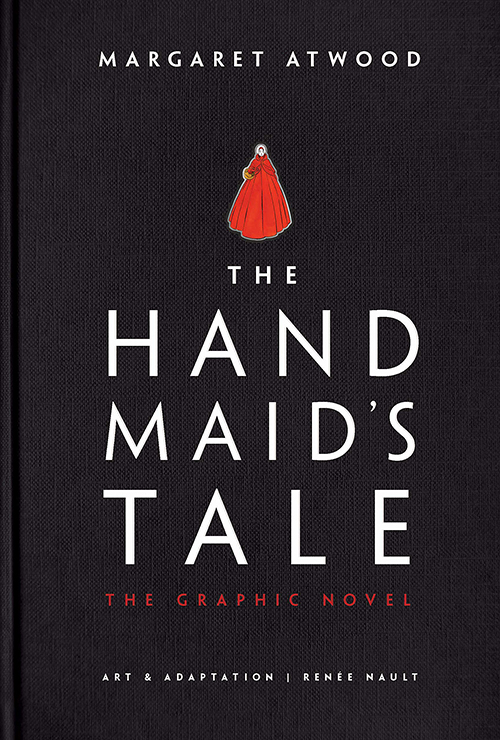
The Handmaid's Tale: The Graphic Novel |
Daytripper |
The Complete Maus: A Survivor's Tale |
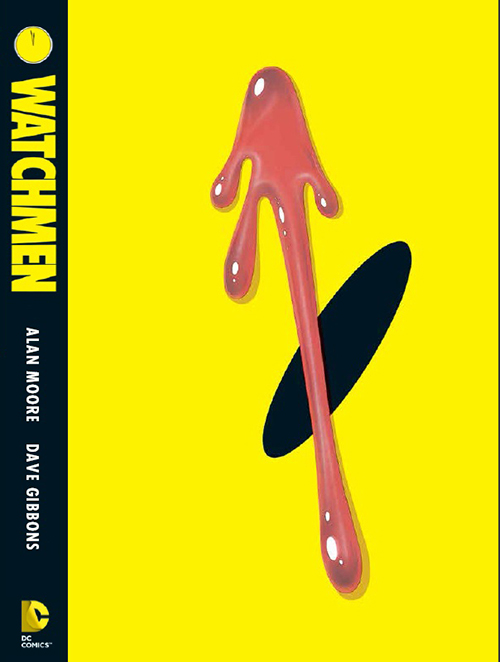
Watchmen |
 |
 |
 |
 |
Price Match
Barnes & Noble, who now run the University's bookstore, offer a price match guarantee. Here's a screenshot from their site (visible only to faculty). I can't vouch for the accuracy of this, but if you'd like to get a better price on your books for this class (or any other) you should take them up on this. The "Amazon price" links above were valid as of August 9; click on each for the current price there.
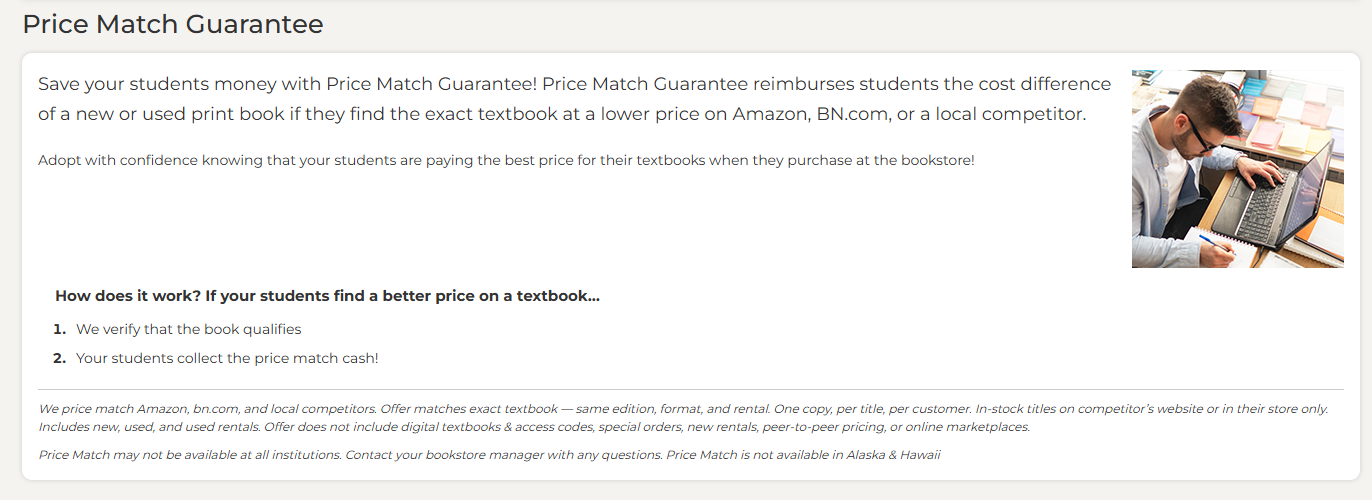
If you buy these books new from the bookstore without doing the price match, they'll cost you $114.99.
If you show them the Amazon prices, your cost should be $66.28.
I'll also be providing some resources for you — most notably The Student’s Comics and Graphic Novels Cheat Sheet — which you'll need for the first couple of weeks of class, and The English Major's MLA 9 Formatting Cheat Sheet, which you'll need in order to complete your essays.
Both of these are available on the course site in Folio.
Structure
General
This course will introduce you to the study of the hybrid genre of graphic novels. So we'll be covering matters like:
- visual literacy;
- visual rhetoric;
- the interplay of text and image;
- discipline- and genre-specific terminology; and
- frames and contexts for understanding images and texts.
Apparatus and Application
The course is organized so that we will spend the first couple of weeks getting our feet under us by familiarizing ourselves with the methodology used to study comics and graphic novels. You're already familiar with most of the methods we use to analyze texts; the process for graphic novels is a bit more complicated. We'll be borrowing ideas, processes, and language from film studies, art history, graphic design, psychology, and media studies to work with this genre. This is the apparatus.
After we have thus girded our loins, we'll address the texts at hand. You'll demonstrate your analytic skill and ability to communicate effectively through two exams and two short papers. This is the application of the apparatus.
Readings
The first two weeks of class will be a quick charge through The Student’s Cheat Sheet for Reading Comics and Graphic Novels. It will give us a framework for understanding the texts that follow. You'll have a chance to become familiar with visual rhetoric and practice the techniques necessary for thinking and writing about graphic novels.
Then we'll address, in order, The Handmaid's Tale, Watchmen, Daytripper, and Maus.
Essays
You'll write two short essays for this class. The first will be an out-of-class assignment requiring you to incorporate some research into the essay. You'll submit that essay to an asssignment dropbox in Folio, where it will go through TurnItIn to check for academic integrity. The second will be written as part of your final exam; you'll write it in class in a blue book.
The prompts for both essays are included below.
Exams
You'll have two exams, one halfway through the course and one at the end of the course. These will contain some practical questions (can you use the vocabulary of visual analysis?), some questions about the works we've covered (can you remember what you've read?), and some background questions (can you place a work in its historical and social contexts?). The second exam will also include the essay I mentioned just above.
EXPECTATIONS
Learning Commitment
The "Carnegie Unit" is how universities define credit hours and categorize the amount of work students do for each credit hour. Each credit requires fifteen "contact hours" which are essentially the hours you spend in class during the semester. And each contact hour requires two hours of outside work, or time devoted to the class that doesn't happen during the class meetings. This is a three-credit course, with 45 contact hours. Those 45 contact hours necessitate at least 90 hours of out-of-class work on your part. That's at least 135 hours committed for each three-credit class that you take. Over a 15-week semester, that breaks down to nine hours per week that you should spend on this class. I've designed the reading and writing requirements with that level of commitment in mind.
If you're not a self-starter, or you have problems with deadlines, or you just don't think you can commit to this level of work, you should probably look for another section of this class.
Academic Integrity
I expect that you will conduct yourself within the guidelines of the Honor System. All academic work should be completed with the high level of honesty and integrity that this University demands.
I don't know of a person at this institution who tolerates academic dishonesty. Beyond the moral implications, as professors, we find it insulting. All instances of plagiarism will be reported to the Office of Student Conduct. Any instance will result in an F in the course and possible further sanctions. Plagiarism is presenting someone else's work as your own without giving them credit. Someone else is defined as anyone other than you: another student, a friend, a relative, a source on the Internet, articles or books. And work is defined as ideas as well as language. So taking someone else's ideas and putting them in your own words—or using someone else's words to express your ideas—is plagiarism. And, in the case of friends and family, it doesn't matter if they give you permission.
A note about group work: I encourage you to use an app like GroupMe amongst yourselves to discuss the texts we're covering, the assignments, and any other aspect of the class. If for no other reason, you need a space to complain about me, without me listening. This engagement, where you can share and improve each other's work, is, in many ways, the core of our endeavor, as we hone our own ideas about the material we're covering through discussions with others. You should also discuss your writing with your classmates, as hearing a number of ideas will help you create and polish your own. However, this does not mean that you should write your papers as a group. While discussion is obviously a group activity, writing is a solitary one, and should be treated as such. Any attempt to subvert this would be an instance of academic dishonesty.
LET ME JUST INTERRUPT MYSELF HERE TO STRESS A SIGNIFICANT POINT. You may have just passed right by that mention in the previous paragraph where I said that discussing your writing with other people is a good thing. But apart from devoting a sufficient amount of time to your writing and revising, having someone else read your work is the single most effective thing you can do to improve your writing. I'll have more about that later in this syllabus.
The University has an extensive definition of Academic Dishonesty (from the Student Conduct Code). It's what we use when we address matters of academic integrity:
CHEATING
Cheating is (a) the use or attempted use of unauthorized materials, information, or study aids in any academic exercise; or (b) actions taken to gain unfair or undue advantage over others. Examples of cheating include (but are not limited to):
- Receiving, providing, and/or using unauthorized assistance or materials on any work required to be submitted for any course to include (but not limited to) online services or social media.
- Alteration or insertion of any grade so as to obtain unearned academic credit.
- Fabricating information, research, and/or results such as taking, or attempting to take, an examination for another Student, alteration of legitimate research data, alteration or distortion of laboratory experiments, or deliberate distortion of another's work or results.
- Collaborating with others on assignments without the faculty’s consent.
- Impeding the ability of Students to have fair access to materials assigned or suggested by the Faculty Member (e.g., removal or destruction of library or other source materials).
- Demonstrating any other forms of dishonest behavior.
PLAGIARISM
Plagiarism is the offering of the words, ideas, computer data programs, or graphics of others as one’s own in any academic exercise. Examples of plagiarism include (but are not limited to):
- The offering of another's work, whether verbatim or paraphrased, as original material without identifying the source(s) in an academic paper, discussion post, exam, assignment or any other academic work.
- Directly quoting the words of others without using quotation marks or indented format to identify them.
- Self-plagiarism: re-submitting work previously submitted without appropriate or accurate citation or credit and/or without explicit approval from the instructor.
- Use of materials prepared by another person or agency to assist in the completion of coursework. This may include but is not limited to the selling of term papers or other academic materials, as well as the using of online platforms or websites to post/receive answers to coursework/exams.
- Demonstrating any other forms of dishonest behavior.
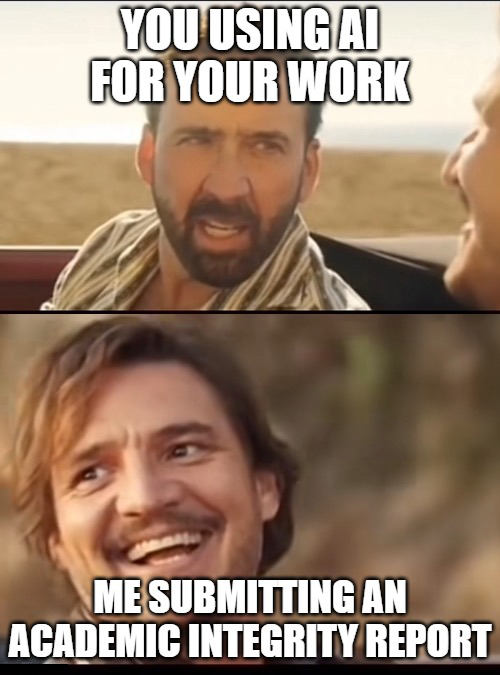
So let's say I think you might have copied and pasted some AI-generated material into your first paper. I am obligated to complete an Incident Report about it, because this isn't just about your integrity, but mine as well. If it's your first report, you'll be able to request a hearing through the Office of Student Conduct. Both you and I will speak at your hearing, and I'll send a copy of this syllabus along with the documents in question to the Hearing Officer. That means that you won't be able to claim that you didn't know that what you were doing was wrong, since I'm telling you it is right here.
COURSE SCHEDULE
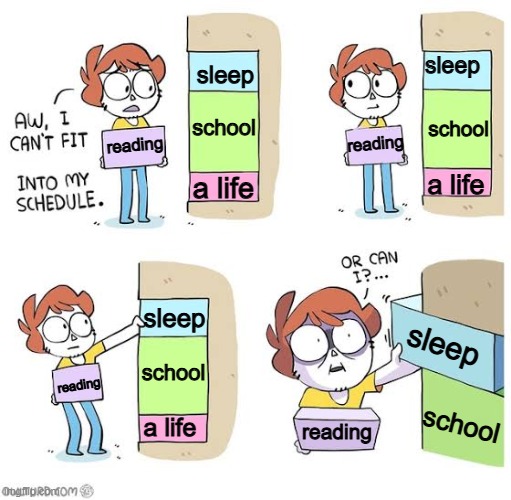
While I have listed sections, chapters, or page numbers below, I think that doling out a text in bite-sized chunks is counterproductive, especially in higher education. If you consider reading such a chore that you need page counts or deadlines to prod you to finish a book, or if you need to ask me how far you should read in a book, you might need to reconsider your readiness to take on work at the post-secondary level.
Reading should be a pleasure; it is most certainly a privilege. With the texts below you should grab the opportunity to read as far as you can as soon as you can.
| 8/14 | Introduction to the Course |
| 8/19 | The Student’s Comics and Graphic Novels Cheat Sheet, pp. 1-15 |
| 8/21 | The Student’s Comics and Graphic Novels Cheat Sheet, pp. 16-37 |
| 8/26 | The Student’s Comics and Graphic Novels Cheat Sheet, pp. 38-61 |
| 8/28 | The Student’s Comics and Graphic Novels Cheat Sheet, pp. 62-82 |
| 9/2 | The Handmaid's Tale, chapters I - III |
| 9/4 | The Handmaid's Tale, chapters IV - VI |
| 9/9 | The Handmaid's Tale, chapters VII - IX |
| 9/11 | The Handmaid's Tale, chapters X - XIII |
| 9/16 | The Handmaid's Tale, chapters XIV - Historical Notes |
| 9/18 | Watchmen, chapters 1-2 |
| 9/23 | Watchmen, chapters 3-4 |
| 9/25 | Watchmen, chapters 5-6 |
| 9/30 | Watchmen, chapters 7-8 |
| 10/2 | Watchmen, chapters 9-10 |
| 10/7 | Watchmen, chapters 11-12 |
| 10/9 | Exam review |
| 10/14 | EXAM 1 |
| 10/16 | Daytripper introduction. PAGE ANALYSIS ESSAY DUE, midnight |
| 10/21 | Daytripper, chapters 1 - 2 |
| 10/23 | Daytripper, chapters 3 - 4 |
| 10/28 | Daytripper, chapters 5 - 6 |
| 10/30 | Daytripper, chapters 7 - 8 |
| 11/4 | Daytripper, chapters 9 (dream) - 10 |
| 11/6 | The Complete Maus, Part I, Foreward, chapters 1 - 2 |
| 11/11 | The Complete Maus, Part I, chapters 3 - 4 |
| 11/13 | The Complete Maus, Part I, chapters 5 - 6 |
| 11/18 | The Complete Maus, Part II, chapters 1 - 2 |
| 11/20 | The Complete Maus, Part II, chapters 3 - 4 |
| 12/02 | The Complete Maus, Part II, chapter 5 |
| 12/9 | EXAM 2 - 3:00 to 5:00 |
INSTRUCTORS

My 28thFirst Day of School as a professor
Dr. Pellegrino
I'm Dr. Joe Pellegrino, an Associate Professor in the Department of English. My initial research areas were Irish and postcolonial literature, but we reinvent ouselves as we go, so now my fields of interest include things like graphic novels and the scholarship of teaching and learning.
I did my PhD in English at UNC-Chapel Hill, and before that I studied at The New England Conservatory, Mannes College of Music, St. Louis University, and Duquesne University. I taught my first college class in 1982 at Duquesne; since then I've taught at UNC, Eastern Kentucky University, the University of South Carolina-Upstate, Greenville Technical College, Converse College, and here at Georgia Southern.
Professionally, I edit a journal, The International Journal for the Scholarship of Teaching and Learning. I'm interested in a number of fields, but most of my publications are either on Irish studies, postcolonial lit, or teaching. For the last few years I've been splitting my time between the English Department and the University's Office of Institutional Assessment and Accreditation, where I've worked on our reaccreditation materials. I'm currently working on materials concerning our consolidation with East Georgia State College.
I also work on the British Commonwealth and Postcolonial Studies Conference, the the oldest and longest-running annual meeting of its kind in the United States. Check out that web site; the design is one of my best.
I've got two daughters who are growing in wisdom, beauty, and grace. I make heirloom furniture, keep my finger on the pulse of new technology, wish I could spend more time doing music, and try to keep my head above water. I've crossed most items off my bucket list, but still have one: to see the Northern Lights.
Ms. Morrison
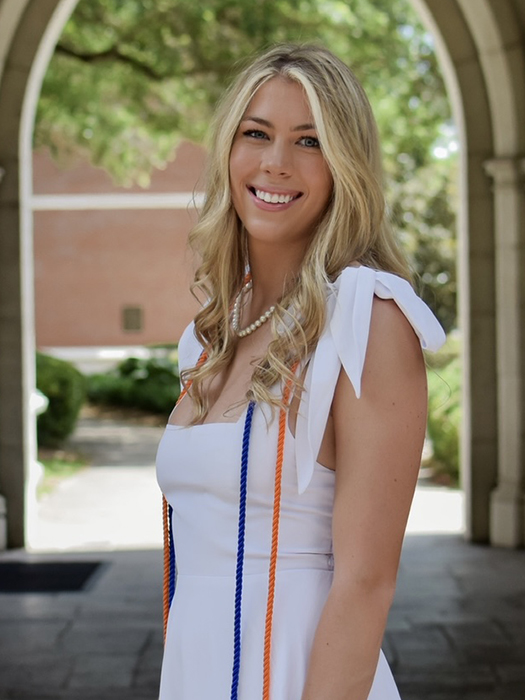
I’m Grace Morrison, a Masters student in English at Georgia Southern and the Teaching Assistant for this course. This year, I am also working at the Writing Center, which is in the Henderson Library on the 2nd floor, next to the Learning Commons (so come see me over there if you need essay help).
I received my BA in English with a minor in Mass Communication from the University of Florida in 2022. After graduation, I worked at a literary agency and as a grant writer before starting the English MA program here. My areas of interest include British Literature and Feminist theory, and now graphic novels.
I have a one-year-old white lab named Pippin, and when I’m not on campus or at home, I’m usually practicing yoga or trying out a new restaurant.
Contact Information
 Aurora Borealis from below |
Dr. Pellegrino Office: 3308B Newton Building Office hours: T: 8:00-9:15; 11:00-12:15; 3:30-5:00 R: 8:00-9:15; 12:15-1:45; 3:30-5:00 and by appointment Phone: 912.478.5953 Email: jpellegrino@georgiasouthern.edu |
Ms. Morrison Office: 1111 Newton Building Office hours: by appointment only Phone: 912.478.0141 Email: gm07507@georgiasouthern.edu |
 Pippin from the driver's seat |
A WORD ABOUT EMAIL
OK, maybe two words : CONTENT and FORM
CONTENT
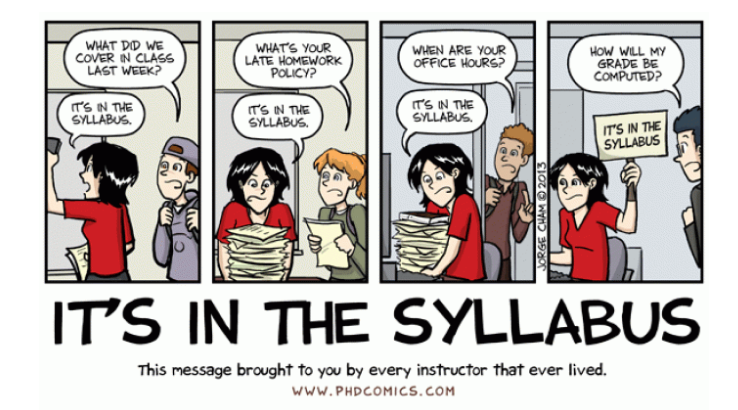
Please don't hesitate to post to me if you have a question about any of the readings, especially if you're struggling to figure them out. But please think twice about posting questions where the answer is in this syllabus. If you do, I have two options for a reply: I can copy and paste material from the syllabus or schedule just for you, but that's redundant, since you already have access to the material. Or I can reply with something like "check the syllabus" or "check the schedule," which you should already know to do. Since neither of those are satisfactory, if you ask a question that is already answered in the syllabus or in the schedule, I won't be replying at all.
FORM
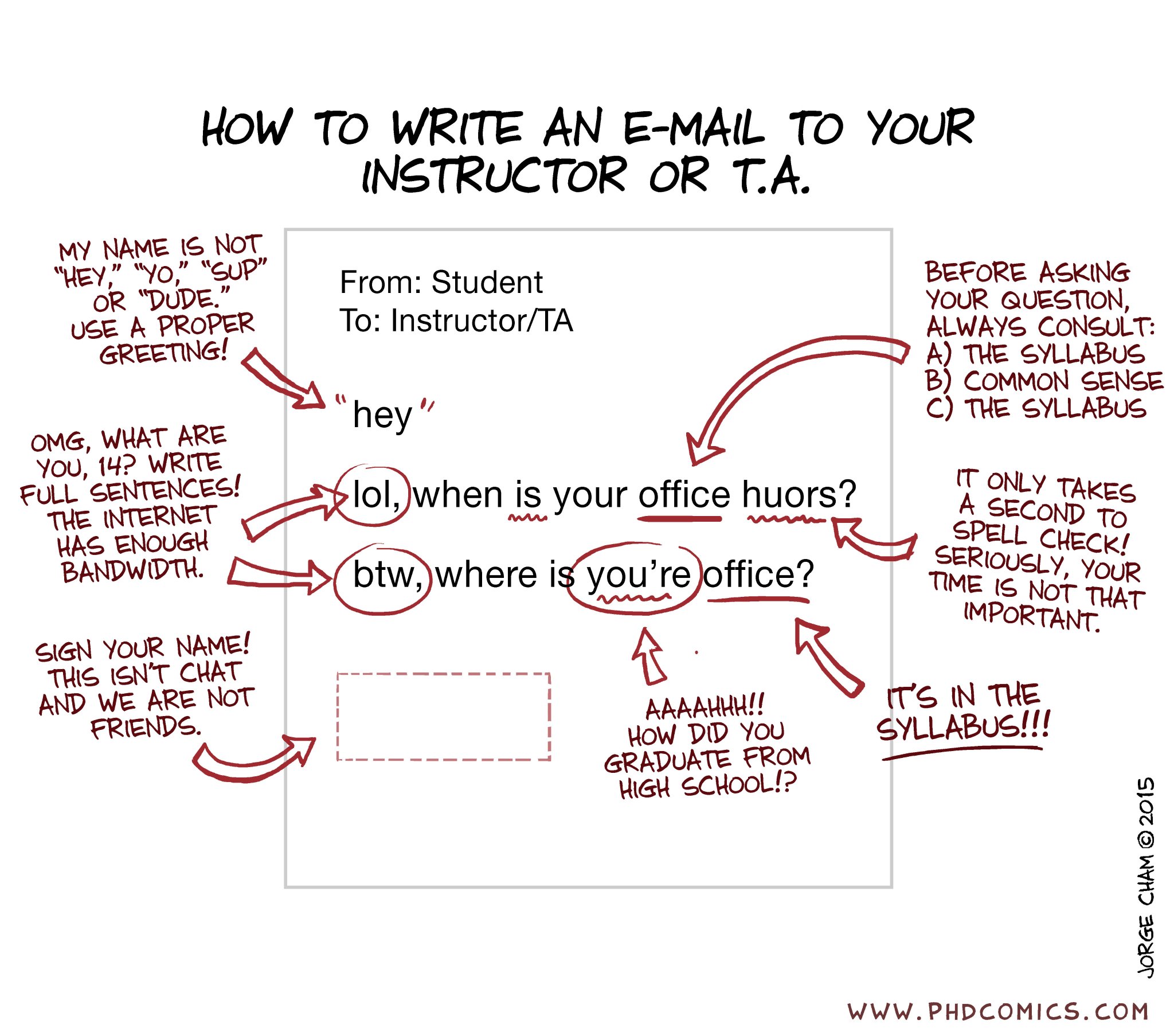
See that image there on the right? It's not just some funny advice about how to write an email to one of your instructors or teaching assistants; it's a set of guidelines that we expect you to follow. When you write anything, you change the form to suit the content. So you don't write an email to a professor like you're writing a DM to your friend. Look at the graphic, then follow the rules on it.
And as with the questions that have already been answered in this syllabus, I could embarrass you by reminding you of those rules when you don't follow them, or I could just not respond to you until you actually get it right. And just in case you can't parse what those rules are, I'll put them into a list:
- My name is not "Hey," "Yo," "'Sup," or "Dude" — use a proper greeting.
- Don't use acronyms or texting shorthand — write in full sentences. Use a grammar checker.
- Spell-check it before you send it. When you have tools available to you and you don't use them, you're not only demonstrating that you don't know how to communicate at anything beyond a middle-school level, you're also demonstrating your inability to use simple tools in order to make yourself look better.
- Check the syllabus before you make yourself look foolish (see the previous point).
- Sign your name.
So let me sum this all up:
if you don't hear back from me after you send me an email, it's either because you can't write an email correctly for the audience you're trying to address, or you're asking a question that I've already answered in this document.
CLASS POLICIES
Attendance
The University Undergraduate Catalog states unequivocally: “Students are expected to attend all classes.” Attendance in this class is not optional. Attending class means that you are present and attentive for the whole class period and that you are prepared for the day’s lesson. Unless you are missing class for a University-sanctioned reason, missing class, regardless of the excuse, will be counted as an absence.
But life gets complicated. So you'll have a free pass to miss almost 15% of our classes, regardless of the reason. You can miss because it's a nice day and you don't want to be inside, or your friend is coming in from out of town, or you were just up too late last night. The reason doesn't matter. Now, let me be clear, I certainly don't encourage you to miss any classes that you're physically well enough to attend. But I'll give you two weeks of absences (that's four classes) before your absences begin to negatively affect your grade for the class. If you are absent more than four times, regardless of the excuse, your final grade will be lowered by one point for every subsequent absence.
If you have to miss more than your allotted absences, there is obviously something going on in your life that does not allow you to pursue this degree wholeheartedly, so you should consider withdrawing from the course, if not the University. Keep this in mind when using your absences—that’s ALL you will be allowed. You do not want me in the position of deciding whose excuse is valid and whose isn’t, so I don’t need any documentation for your absences. If you’re within the limit it is not necessary, and after the limit it will not matter.
By now you recognize that arriving on time for class is, at its core, a sign of respect for your classmates and your professor. Tardiness, therefore, is a statement saying that your time is more important than anyone else’s. I will strike a blow for the group by counting every instance of tardiness as 1/3 of an absence. So, if you’re doing the math, you can be tardy several times without any consequences, save the collective disdain for your actions. And yes, your tardiness works in conjunction with your absences, so a combination of the two will push you toward the negative consequences outlined above.
At the beginning of each class I'll have a series of sign-in sheets at the front of the auditorium, laid out in alpha order. When you come to class, sign in on the appropriate sheet before you go to your seat.
Writing Proficiency
If you need additional work on the surface features of your writing, I'll let you know. Basically, if I can't understand what you're trying to say in your first paper, then you'll have to work at writing more clearly. I'll ask you to schedule sessions at the Writing Center in order to be more successful on your next paper.
The reason professors make students write papers is not because we love to mark them up, or because we somehow enjoy this. I'm willing to bet that every professor you ask would say that marking and grading papers is the worst part of their job; I know it is for me. The only thing that makes it bearable is hoping that I'll be able to engage with your ideas, or see the texts we're covering through your eyes. But if I have to stop after every sentence to figure out what you're trying to say, I'm most certainly not thinking about your ideas.
So do yourself a favor: give yourself enough time to do a good job on these papers. Remember that writing clearly takes far more time than you think it does, because you have to consider your argument from a reader's perspective, not your perspective.
I realize that the grand academic dance of submitting your work, having it evaluated, then responding to that evaluation (either through improving your work in your next paper, or by coming to see me in my office) is essentially a negotiation between us. You want to demonstrate your abilities with X amount of work, an amount that you think deserves a certain grade. You submit your work without knowing how others will see it, and only become aware of their perceptions when your work is returned to you with my comments. But this puts you at a disadvantage, because, as in any negotition, the party that makes the first move does so blindly, and so gives up any hope of advantage.
So in the spirit of openness, let me make the first move, and try to level the playing field here by sharing some grading secrets. I'll start with a personal comment:
I know my reputation precedes me, and I know what it is:
He reads our work too closely!
He's just cruel when he asks questions!
He marks every little mistake!
He asks condescending questions!
He expects too much from us!
The way he acts in class and the way he grades don't match!
While I don't revel in that description, it's pretty accurate. I don't believe it's too much to ask that your subjects agree with your verbs, your tenses are consistent, and you write like you know what you're doing. Expecting anything less from you, or assuming that you can't write for an academic audience, is an insult to your intelligence and abilities.
- This is academic writing, where clarity and concision are essential. If your work isn't clear, if every sentence doesn't hang together, you're losing the negotiation. What you have written may make sense to you, but it needs to make sense to your readers as well.
- At the post-secondary level, your writing isn't evaluated in terms of the amount of work you put into it. Just like any other skill, the amount of effort necessary to master academic writing varies from person to person. I am sure that it would take me far more effort than most of you to get back to playing football. But even if I did ten times the work you did, when we both showed up on the field, you'd probably still be better at it than me, and we'd both be evaluated on the abilities and skills we could demonstrate, not on the time it took us to gain them.
- If you pay attention to what each prompt is asking you to write about, and keep that in mind as you think about your paper, you're making a good start.
- If you look at the rubric, especially the distinctions between the levels of performance in content and form, you should get a good idea of how successful your paper will be.
- If you're wondering if your "X amount of work" is enough, it isn't.
- If you're thinking that you've changed enough of that material that you've copied and pasted to make it look like your own work, think again.
- If you think some LLM can do your work, think again.
- If you're curious about why I can make such bold statements, ask me why Google reached out to me when they were first getting started to be one of only 25 alpha and beta testers.
- If writing and evaluating papers is a negotiation, then presenting someone else's work as your own is a gamble, and you're betting your academic career that you can get away with it. I've just told you what I bring to the table, so if you really think you can get away with it, my only advice is to do it as early as possible, so you can spare both of us the work for the rest of semester, because you'll already be gone from this class.
Timeliness
I DO NOT ACCEPT LATE ASSIGNMENTS. NO EXCEPTIONS, NO EXCUSES. A late assignment is any work that is not turned in during the class period in which it is due. This means that you must anticipate any problems that will occur. In other words, a computer / printer / drive / car / arm being broken at the last minute is not an excuse. To avoid last-minute catastrophes (which always occur), DO NOT WAIT UNTIL THE LAST MINUTE TO DO YOUR WORK.
ADA-Related Accommodations
In compliance with the Americans with Disabilities Act (ADA), this course will honor requests for reasonable accommodations made by individuals with disabilities or demonstrating appropriate need for learning environment adjustments. Students must self-disclose their disability to the Student Accessibility Resource Center (SARC) before academic accommodations can be implemented.
For additional information, please call the SARC office at (912) 478-1566 on the Statesboro campus, or at (912) 344-2572 on the Armstrong and Liberty campuses.
Contingencies
If for any reason we might have a break in the continuity of instruction, I've got a couple of plans in place:
- If the institution shuts down:
We will move completely to Zoom sessions for our classes, and exams will be administered through Folio. Exams will be available in Folio for the entire day on which they're scheduled. You can take the exam at any time during that 24-hour period. Once you open the exam, you'll have the usual amount of time to complete it (75 minutes for Exam 1, 120 minutes for Exam 2). All other course activities will continue as planned. Class discussions may be a bit more forced, but we'll muddle through. - If you are under quarantine:
I can't grant you any exemption to the attendance policy unless I receive a report from the GS CARES Team about your status. You can't just email me to say that you think you might have a virus and are self-isolating in order to minimize the chance of infecting others. That means that if you think you might have been exposed, or if you have tested positive, you must complete a COVID-19 Health Reporting Form, which can be found in the COVID-19 Information & Resources section of your MyGeorgiaSouthern page.
If you do have a CARES report and must self-isolate, it'll be like this class did not exist for you during your period of isolation. So those absences will not count against your total absences for the class (see the Attendance policy above), and you will neither gain nor lose points for the class discussions you missed. If a paper is due during your quarantine, you'll have an extension until you return to class. If you miss either exam, we'll work that out on a case-by-case basis.
ESSAY PROMPTS
Page Analysis Essay
For this essay, you'll select a single page from from either The Handmaid's Tale or Watchmen., and illustrate how that page develops or contributes to a central theme — or the relationship between themes — of that work. The thesis of your paper should be specific about the theme(s) you see at work on the page. Then the body of your paper should illuminate how the page develops the theme(s), and how the page connects to the work as a whole.
Your complete essay should be somewhere between 500 and 750 words, not counting your Works Cited page. You should format these in accordance with the MLA 9 guidelines. If you want a shortcut for MLA 9 formatting, there's The English Major's MLA 9 Cheat Sheet available to you in Folio.
Your choice of a page to write on is crucial. Choose a page that offers plenty of material for you to interpret. Consider how the page contributes to the theme or themes you see at work locally on the page, and globally in the work as a whole. Focus on at least three elements from the section on "The Structural Frame" in The Student’s Comics and Graphic Novels Cheat Sheet:
- Composition
- Framing
◦ Shot
◦ POV
◦ Viewing angle - Salience
- Vectors/Lines
- Foreground/background
- Gaze
- Body language
- Color and lighting
- Contrast
- Symbolism/icons
Your conclusion should address the overall design of the page: how does the artist use the above elements to advance the themes of the story?
RESEARCH REQUIREMENT
You will have to incorporate the work of other scholars into this essay. That means, usually, material that has been peer-reviewed. You may consult online summaries or analyses from sites like Shmoop, SparkNotes, or Wikipedia, and you should most definitely work with The Student’s Comics and Graphic Novels Cheat Sheet, but they will not count as scholarly sources for the purposes of this essay. I'm not going to mandate a crazy number of sources for you; I would think at least two might suffice, but hearing from more voices is always a good thing. I've compiled some resources you can use, so check the journals in Resources for the Study of Comics and Graphic Novels (linked here and in Folio) for a good place to start your research.
FORMATTING WARNINGS
I'm serious about the formatting for this essay. If your formatting is incorrect when you submit your first version, I'll return it to you and you'll have to resubmit it. But the ceiling for your grade will be 5 points lower than it was for your first effort. The ceiling for everyone's first attempt is 100; it's 95 for a first resubmission. If you can't get it right the second time, your ceiling will be 15 points lower (an 85). Miss it the third time and your ceiling will be 30 points lower (a 70).
Claiming that your formatting is incorrect because you "just copied what was online" is one of the feeblest excuses you can offer, especially since you have the guidelines to get it right the first time available to you in Folio. The same holds true for any entry on your Works Cited page. You'll have to cite the work you're using properly in your text, and then include it properly as an item on your Works Cited page.
Finally, do not trust online citation generators! I've yet to find one that is consistently accurate. Instead, check The English Major's MLA 9 Cheat Sheet. Everything you need to know about formatting is in there.
Your TurnItIn Originality Score
After you submit your paper and TurnItIn has completed its analysis, you are able to see your TurnItIn Originality Score. In general, lower numbers are better here, unless you're quoting a lot of material from the text. Your score will also have a color attached to it. If the color you see is anything other than green, check your paper again to see that you have cited all your sources correctly. If you have, then you're good. If you haven't, then you can revise your paper and resubmit it. I will evaluate only the most recent version of your paper in the dropbox, but you can submit as many versions of it as you feel necessary.
Meaning, Significance, and Ethical Implications Essay
For the second half of your final exam, you'll be writing an essay addressing the meaning, cultural significance, and ethical implications of one of the texts we've covered in the class. You'll begin by choosing a particular moment or site within a text of your choosing. Once you've settled on that, you'll address the following questions in separate paragraphs:
- What does this particular moment/site mean? How does it illustrate some thematic concern that the author wants to address?
- Why is this moment/site important? What significance does this site have for readers of the text? What idea(s) is the author trying to impress upon the readers?
- What are the ethical implications of this moment/site? Does the author reward or punish the character(s) for their actions? Are there wider implications or applications of this plot point for all readers?
As you can see from the prompt, this is not something you can just make up on the spot. This is why I'm telling you here what 50% of your final exam will be, 15 weeks before you have to write it. You should have your essay planned out well before you walk into the final exam.
GRADING
My Process
When I mark your essays, here's my process: I read each of them at least three times. On the first read, I apply the Minimum Standards Rubric below, which comes from the Technical College system in South Carolina. This rubric is applied to papers from students at two-year schools, and it defines the minimum acceptable standards there. If your essay makes it through the Minimum Standards Rubric, I then read through your paper again, going through it looking for your argument and if you addressed the prompt in your essay. In my final reading, I ask the grading questions here and evaluate it with the Essay Rubric below. This reading is where I mark your paper.
Minimum Standards Rubric
| THE FOLLOWING ERRORS ARE SERIOUS, AND THEREFORE WARRANT SPECIAL CONSIDERATION AS YOUR PAPERS ARE BEING GRADED: | |
| FUNDAMENTALS | These errors in grammar and usage are unacceptable in college-level academic writing:
• sentence fragment
Any paper having a combination of four or more of these serious errors will automatically receive a failing grade (F).
• comma splice and/or fused sentence • agreement (subject/verb and/or pronoun/antecedent) • incorrect verb form (tense or person) |
| SPELLING | Any paper having six or more different misspelled words will automatically receive a failing grade (F). (Misspellings include mistakes with the use of the apostrophe.) |
| COMBINATION | A combination of the above-mentioned serious errors and misspellings, even though not sufficient to fail a paper, will lower the grade substantially. |
| OTHER ERRORS | A paper can fail for other reasons as well, such as weak content, poor organization, confused sentence structure, not addressing the assignment requirements, or plagiarism. |
Essay Rubric
| TRAIT | 4 | 3 | 2 | 1 |
| Analysis | This project organizes and synthesizes evidence to reveal insightful patterns, differences, or similarities related to its focus. It states a conclusion that is a logical extrapolation from the evidence presented. | This project organizes evidence to reveal important patterns, differences, or similarities related to its focus. It states a conclusion focused solely on the inquiry findings. The conclusion arises specifically from and responds specifically to the evidence presented. | This project presents evidence, but the organization is not effective in revealing important patterns, differences, or similarities related to its focus. It states a general conclusion that, because it is so general, also applies beyond the scope of the evidence presented. | This project lists evidence, but it is not organized and/or is unrelated to its focus. It states an ambiguous, illogical, or unsupportable conclusion. |
| Interpretation/ Meaning |
This project presents an interpretation that is logical, centers on the meaning of the text, and reflects the student's informed evaluation and ability to place textual evidence and perspectives discussed in priority order. The consequences and implications are identified clearly. | This project presents an interpretation that is logically tied to a range of information within the text, addresses the meaning of the text, and considers differing perspectives. The consequences and implications are identified. | This project presents an interpretation that is logically tied to textual information because information is chosen to fit the desired conclusion. Some consequences and implications are identified. | This project presents an interpretation that is inconsistently tied to some of the textual information discussed. The consequences and implications are oversimplified. |
| Significance | This project discusses the significance of the text within multiple contexts (social, cultural, historical, economic, environmental, etc.). | This project discusses the significance of the text within a single context (social, cultural, historical, economic, environmental, etc.). | This project briefly mentions the significance of the text within a single context (social, cultural, historical, economic, environmental, etc.). | This project does not discuss the significance of the text within a context. |
| Ethics | This project thoughtfully considers the ethical implications of the text for multiple audiences (distinguished socially, culturally, or historically). | This project considers the ethical implications of the text for an audience (distinguished socially, culturally, or historically). | This project briefly mentions the ethical implications of the text for an audience (distinguished socially, culturally, or historically). | This project does not consider the ethical implications of the text for an audience. |
Questions I ask while grading
For each sentence in your paper, I ask the following questions:
- What are you saying? At a basic level, I’m trying to decode the meaning of each sentence. If I cannot understand what you’re trying to say, everything that follows is problematic. If your sentence is confused, convoluted, or contradictory, you make it difficult, or even impossible, for me to answer this basic question.
- Is what you’re saying accurate? Does this sentence demonstrate that you understand the text or the critic you’re addressing? For instance, if you’re summarizing someone else’s argument, I need to assess if you’re being true to the original author's intent. In your response, I’m assessing your evidence and examples.
- Is what you’re saying well-expressed grammatically and mechanically? This assumes that your grammar and mechanics aren’t so bad that I’ve been stymied back up at Question #1.
- Does the writing have appropriate flow, in that each idea links up with the one previously and the one to follow in a way that meets audience needs, attitudes, and knowledge?
If I can answer all four of these questions positively for every sentence, you’re doing well. But when the answer is no, complications ensue. If I can’t understand what you’re saying, I have no way to engage with your ideas, and so I have additional questions:
- Do you not understand the original text you’re addressing?
- Do you understand the original text, but your writing leaves a gap between that understanding and what is written on the page?
Marks on your papers
When I return your papers to you, they'll have marks on them, but almost no comments. Only in very rare cases, where errors aren’t immediately obvious, will I write a short comment. For the most part, your errors or issues are underlined and marked with a letter representing one of four categories:
| MARK | EXPLANATION |
|---|---|
| A = ARGUMENT | These are errors or issues with the points you’re trying to make. They could be inconsistencies, the use of quotations that don’t do what you need them to do, fundamental contradictions in your macro structure, or a number of other things concerning how you’re moving your argument forward. |
| C = CLARITY | Usually sentence-level matters where you either need to be more clear and specific, explain yourself better, or resolve a contradiction. |
| F = FORMAT | You should use MLA 9 formatting for your paper. You'll follow it to set up how your paper looks on the page (your header, your margins, your page numbering) and how you handle things like titles of works, using quotations in your text, and creating a Works Cited page. You have The English Major’s MLA 9 Formatting Cheat Sheet available to you in Folio. “I used an online citation generator” is one of the most damning criticisms of your own abilities you can offer. If I suggested you weren’t capable of looking up and following a simple set of discipline-specific rules, you would be offended. So why would you admit that about yourself, especially since I'm telling you here that they are all, to varying degrees, inaccurate? |
| M = MECHANICS | Errors in sentence construction, usage, punctuation, spelling, etc. In general, there’s a reason why English has at least 64 different prepositions: they all mean something different. Oh, and burn your thesauruses. Using an elevated word that you think you might know the meaning of works doubly against you: it could be the wrong word for the situation, and it’s not the clear and concise word, which is what you want. Brackets [. . .] usually indicate errors with sentence construction. |
EVALUATION
| ASSIGNMENT | WEIGHT |
| Exam 1 | 25% |
| Page Analysis Essay | 25% |
| Exam 2 (part 1) | 25% |
| Meaning/Significance/Ethical Implications Essay (Exam 2, part 2) | 15% |
| Class Discussion/Participation | 10% |
| TOTAL | 100% |