
COURSE INFORMATION
ENGL 5526(G) 01F 20th & 21st Century British Lit
CRNs: UG: 13007 G: 13009
Spring 2024
MW 4:00 - 5:15
Online Synchronous
One-Click Access: https://georgiasouthern.zoom.us/j/86325412639?pwd=MFB4S3ByKzE5SDkza3V1OTBzbU9mQT09
Meeting ID: 863 2541 2639
Passcode: kR324R@jtS
The University Catalog describes this course as "A study of major British and Commonwealth poets, novelists, and dramatists against the background of the major social and cultural changes of the 20th and 21st centuries."
What we'll be doing this semester is taking a detailed look at the major movements of Modernist, Post-Modern, and Contemporary British literature. Our definition of "British" will be pretty broad, because we'll also consider material from areas that were under British colonial rule.
We'll situate ourselves with a couple of authors who were what we would now call "influencers," then we'll look at a few works from the Irish Literary Renaissance, because Ireland is England's closest and longest-held colony (and the Brits like to take credit for all the Nobel Prizes that Irish writers have won). After some work from WWI, we'll be set up to address Modernism as the most important literary movement of the past 200 years. I'll argue that Modernism sprang to life fully formed with Eliot's "The Love Song of J. Alfred Prufrock," and reached its high point with his "The Waste Land."
Following in Eliot's footsteps are the second-generation Modernists, whose experience of WWII was bad, but nowhere near as earth-shattering as WWI was for the first Modernists. Then we'll look at the burgeoning field of postcolonial literature, and the overlap between the idea of "British" and the notion of "Anglophone." We'll conclude with an intense and thought-provoking novel that complicates the ideas of "Civilized" and "Barbarian," "Self" and "Other," "Us" and "Them."
- January 8: Classes begin
- January 8-11: Drop-Add period
- January 15: MLK Day; no class
- February 12: BCPS Conference; no class
- March 4: Last day to drop with a "W"
- March 11-15: Spring Break, no class
- April 29: Last day of classes
- May 1: 3:00 pm - Final Exam
Learning Outcomes are the knowledge or skills you should gain (and be able to demonstrate) by the end of a particular course.
Career Readiness Competencies are core competencies developed by the National Association of Colleges and Employers (NACE). They address eight areas where employers agree that your abilities and skills signify your readiness to begin and/or extend your career. Below are the skills you'll have the opportunity to practice in this course.
Upon successful completion of this course, you should be able to:
- Analyze and interpret 20th- and 21st-century British/Anglophone texts in their historical/cultural/genre contexts, considering the relationship between language form and meaning, using discipline-specific analytic tools.
- Synthesize multiple voices in your work through the ethical incorporation of external sources, following genre-specific conventions.
- Create your own clear, precise, well-developed, and highly-organized texts, addressing particular purposes and audiences.
- Revise your written work through a reflective and iterative process that fulfills the expectations of academic literary studies.
| Self-Development | Communication |
|
|
| Critical Thinking | Equity and Inclusion |
|
|
| Leadership | Professionalism |
|
|
| Teamwork | Technology |
|
|
These career readiness skills will serve you well no matter what your next steps after graduation might be. Find out more about them on this page of the NACE site.
You'll need to purchase these required books for this class:
The Norton Anthology of English Literature, 10th edition, volume F. WW Norton, 2018. ISBN: 9780393603071. |
|
Coetzee, J.M.Waiting for the Barbarians. Penguin, 1982. ISBN: 9780140061109. |
|
I'll also be providing quite a few resources for you, including one play, and small collections from various authors that will be available on the course site in Folio:
Thomas Hardy, poetry
Gerard Manley Hopkins, poetry
John Millington Synge, The Playboy of the Western World
Virginia Woolf, "The Mark on the Wall"
Seamus Heaney, poetry
Eavan Boland, poetry
Neil Gaiman, "How to Talk to Girls at Parties"
Zadie Smith, "Meet the President"
A “trigger” is anything that might cause a person to experience a strong emotional and/or psychological response. Some triggers are shared by large numbers of people (for example, rape), while others are more idiosyncratic (for example, orange juice).
All texts read in this course, all class discussions, and all ancillary materials may contain instances of the following potential triggers, as well as other unanticipated and so unlisted potential triggers: ignorance; willful ignorance; cultural insensitivity; oppression; persecution; swearing, abuse (physical, mental, emotional, verbal, sexual), self-injurious behavior (self-harm, eating disorders, etc.), talk of drug use (legal, illegal, or psychiatric), suicide, descriptions or pictures of medical procedures, descriptions or pictures of violence or warfare (including instruments of violence), corpses, skulls, or skeletons; needles; racism; classism; sexism; heterosexism; cissexism, ableism; hatred of differing cultures or ethnicities; hatred of differing sexualities or genders; body image shaming; neuroatypical shaming; dismissal of lived oppressions, marginalization, illness, or differences; kidnapping (forceful deprivation of or disregard for personal autonomy; discussions of sex (even consensual); death or dying; beings in the natural world against which individuals may be phobic; pregnancy and childbirth; blood; serious injury; scarification; glorification of hate groups; elements which might inspire intrusive thoughts in those with psychological conditions such as PTSD, OCD, or clinical depression.
Unless expressly stated otherwise, the views, findings, interpretations, and conclusions expressed in the texts read in this course, the classroom discussions, and the ancillary material do not necessarily represent the views of the University or the course instructor.
All texts read in this course, all class discussions, and all ancillary materials may also contain instances of overwhelming beauty, profound truths, and serious reflection on what it means to be human.
By remaining registered in this class, you agree to be exposed to all of the above. As Jenny Jarvie has written,
Structuring public life around the most fragile personal sensitivities will only restrict all of our horizons. Engaging with ideas involves risk, and slapping warnings on them only undermines the principle of intellectual exploration. We cannot anticipate every potential trigger—the world, like the Internet, is too large and unwieldy. But even if we could, why would we want to? Bending the world to accommodate our personal frailties does not help us overcome them.
— Jarvie, Jenny. “Trigger Happy.” The New Republic, 3 March 2014.
In short, texts and/or discussions in this class may make you uncomfortable. . . for many of them, that may be the whole point.
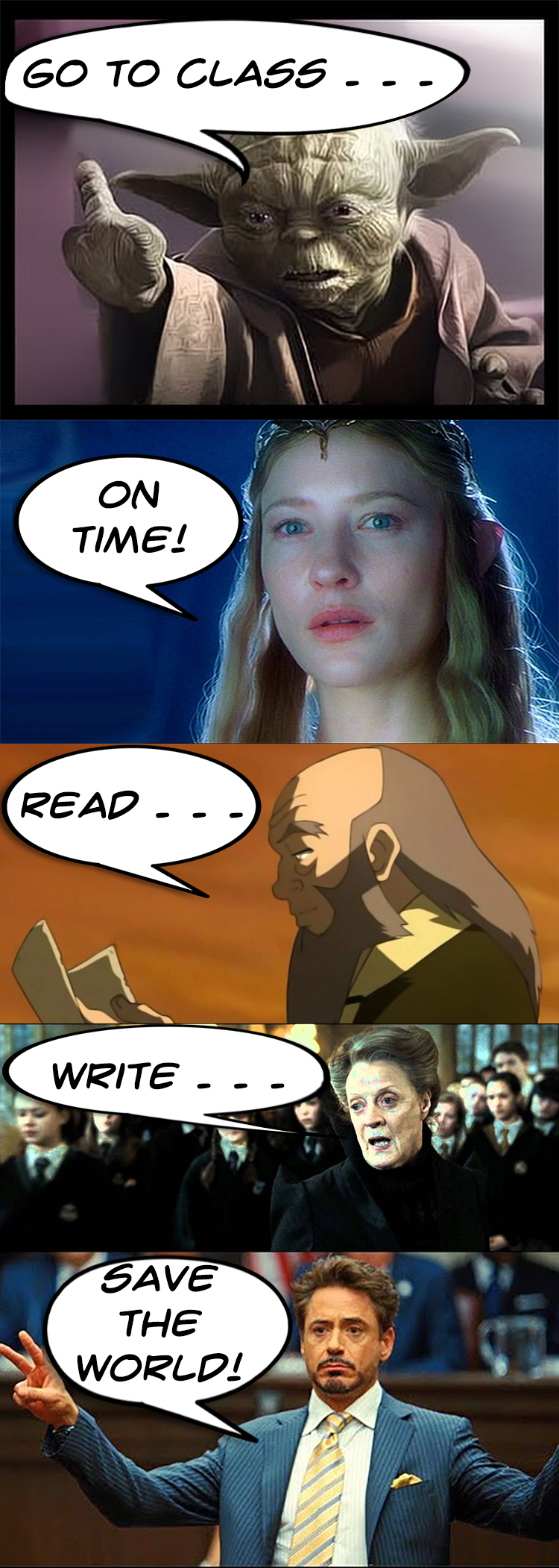
COURSE STRUCTURE
This course is a fast-paced introduction to some of the most important works written in English in the 20th and 21st centuries. So we'll be looking at:
- the effects of historical events, cultural values, and social movements on literary production;
- the pendulum swings of literary periods;
- the essential primary texts you need to know in order to understand the past 120 years; and
- the secondary sources and research that allow for a deeper understanding of these works.
Most of the interpretations of these works I'll be offering will be pretty middle-of-the-road. They'll be informed by a close reading of the text and the application of a number of critical lenses. Since one of the learning outcomes of this course is to understand these texts in their historical, social, and cultural milieus, my thoughts on them will be informed by context-oriented approaches, but our main approach will be text-oriented. We may avail ourselves of some author-oriented analyses, but we will rarely deal with reader-oriented approaches.
You'll demonstrate your analytic skill and ability to parse these texts through two exams, a digital humanities research assignment, and a multimodal writing/reflection assignment. In the writing/reflection assignment, especially, I'll ask you to apply parts of the apparatus above to the texts we're covering.
As you will see in the schedule below, there are a variety of genres represented in this class, but there's quite a bit of poetry, more than some of you may be comfortable with. I've set up the class this way for two reasons; the first is philosophical and the second is practical. Primarily, I think the best way to capture the zeitgeist of a particular historical moment, or to understand the impact of a literary movement, is through poetry. Works in this genre contain far more distilled language than those in any other genre, so it's easier to get at the essence of the subject at hand. Also, studying poetry allows us to cover far more ground. We could spend the semester reading only novels, but the nature of the academic calendar means that we would deal with far fewer texts, and you'd be familiar with far fewer authors.
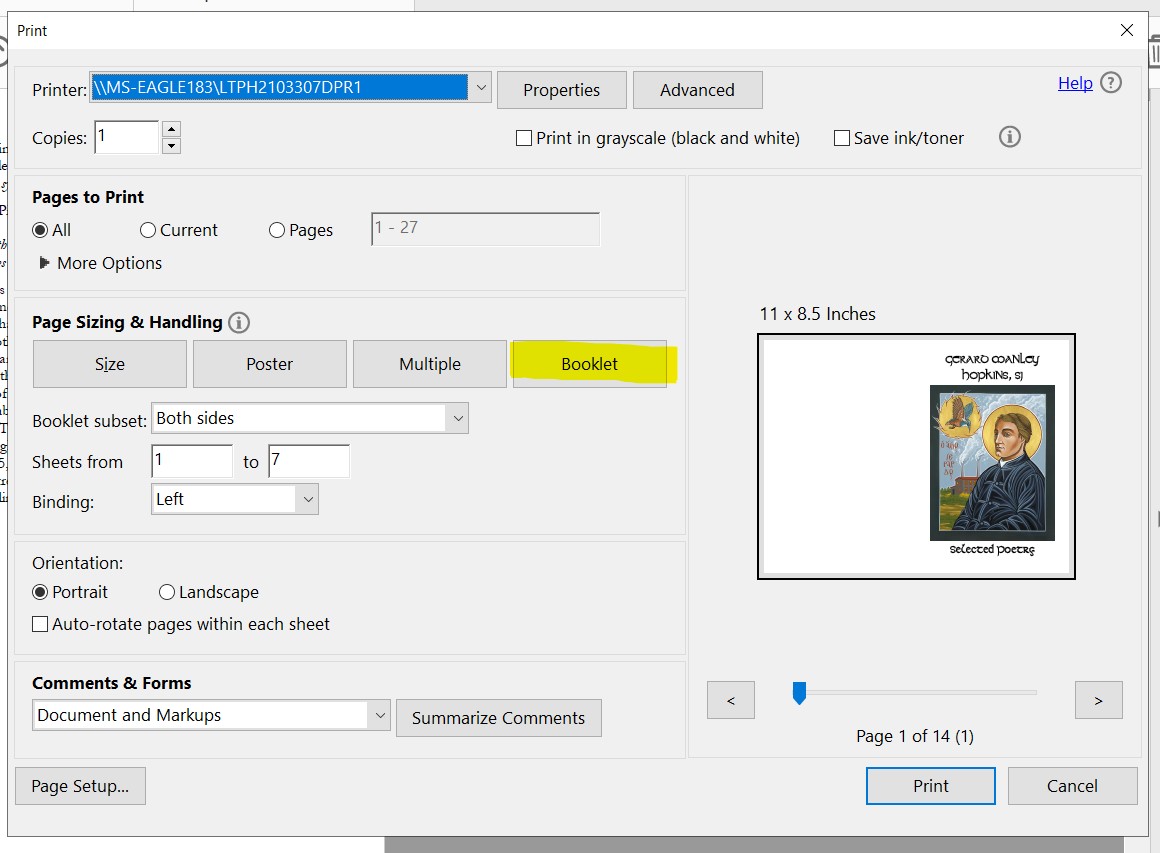
At a practical level, most of the material I'll pass to you is formatted to print as a small book. If you have access to a printer that will print double-sided and do a book fold, you'll see these as I intended them. If you don't have access to such a printer, then I'll also have versions available that will print single-sided on letter-sized paper. The Word versions of these files in Folio are already set to print as a book. The pdf versions in Folio can be printed single-sided on 8.5" x 11" paper (the Acrobat default), or they can be printed as a book.
The image to the right is a screencap of the print dialog in Acrobat. Select "Booklet" - highlighted in yellow here - and make sure all the other functions match those in the screenshot.)
Whatever you do, don't open the Word docx versions of these files in Folio! Due to D2L's inability to actually render common fonts, almost everything in them will be formatted incorrectly. If you absolutely must open these files within Folio (instead of downloading and printing them), please use the pdf versions.
We'll be trying something a little different for this class, in that I won't ask you to write a traditional researched essay on some text that we cover in this class. Instead, you'll be responsible for a Digital Humanities Assignment (where you'll do plenty of research, then distill what you find into glosses and notes that will help support other students) and a Multimodal Found Essay Assignment, where first you'll curate a number of primary texts, images, videos, secondary material, and/or material in other media that surround one of the major themes of the class, then reflect on your process and explain why and how you made the choices that you did.
Both assignments are explained in detail below.
We'll have two exams, one halfway through the course and one at the end of the course. These will contain some practical questions (can you scan a line of poetry?), some short answer questions (can you see the elements of a literary movement in a work?), and some essay questions (can you apply some of the fundamental concepts we're using to a particular piece?).
COURSE EXPECTATIONS
The "Carnegie Unit" is how universities define credit hours and categorize the amount of work students do for each credit hour. Each credit requires 15 "contact hours," which are essentially the hours you spend in class during the semester. And each contact hour requires two hours of outside work, or time devoted to the class that doesn't happen in the classroom itself. This is a three-credit course, with 45 contact hours. Those 45 contact hours necessitate at least 90 hours of out-of-class work on your part. That's at least 135 hours committed for each three-credit class that you take.
If you're not a self-starter, or you have problems with deadlines, or you just don't think you can commit to this level of work, you should probably look for another section of this class.
I expect that you will conduct yourself within the guidelines of the Honor System. All academic work should be completed with the high level of honesty and integrity that this University demands.
I don't know of a person at this institution who tolerates academic dishonesty. Beyond the moral implications, as professors, we find it insulting. All instances of plagiarism will be reported to the Office of Student Conduct. Any instance will result in an F in the course and possible further sanctions. Plagiarism is presenting someone else's work as your own without giving them credit. Someone else is defined as anyone other than you: another student, a friend, a relative, a source on the Internet, articles or books. And work is defined as ideas as well as language. So taking someone else's ideas and putting them in your own words—or using someone else's words to express your ideas—is plagiarism. And, in the case of friends and family, it doesn't matter if they give you permission.
A note about group work: I encourage you to use an app like GroupMe amongst yourselves to discuss the texts we're covering, the assignments, and any other aspect of the class. If for no other reason, you need a space to complain about me, without me listening. This engagement, where you can share and improve each other's work, is, in many ways, the core of our endeavor, as we hone our own ideas about the material we're covering through discussions with others. You should also discuss your writing with your classmates, as hearing a number of ideas will help you create and polish your own. However, this does not mean that you should write your papers as a group. While discussion is obviously a group activity, writing is a solitary one, and should be treated as such. Any attempt to subvert this would be an instance of academic dishonesty.
LET ME JUST INTERRUPT MYSELF HERE TO STRESS A SIGNIFICANT POINT. You may have just passed right by that mention in the previous paragraph where I said that discussing your writing with other people is a good thing. But apart from devoting a sufficient amount of time to your writing and revising, having someone else read your work is the single most effective thing you can do to improve your writing. I'll have more about that later in this syllabus.
The University has an extensive definition of Academic Dishonesty (from the Student Conduct Code). It's what we use when we address matters of academic integrity:
CHEATING
Cheating is (a) the use or attempted use of unauthorized materials, information, or study aids in any academic exercise; or (b) actions taken to gain unfair or undue advantage over others. Examples of cheating include (but are not limited to):
- Receiving, providing, and/or using unauthorized assistance or materials on any work required to be submitted for any course to include (but not limited to) online services or social media.
- Alteration or insertion of any grade so as to obtain unearned academic credit.
- Fabricating information, research, and/or results such as taking, or attempting to take, an examination for another Student, alteration of legitimate research data, alteration or distortion of laboratory experiments, or deliberate distortion of another's work or results.
- Collaborating with others on assignments without the faculty’s consent.
- Impeding the ability of Students to have fair access to materials assigned or suggested by the Faculty Member (e.g., removal or destruction of library or other source materials).
- Demonstrating any other forms of dishonest behavior.
PLAGIARISM
Plagiarism is the offering of the words, ideas, computer data programs, or graphics of others as one’s own in any academic exercise. Examples of plagiarism include (but are not limited to):
- The offering of another's work, whether verbatim or paraphrased, as original material without identifying the source(s) in an academic paper, discussion post, exam, assignment or any other academic work.
- Directly quoting the words of others without using quotation marks or indented format to identify them.
- Self-plagiarism: re-submitting work previously submitted without appropriate or accurate citation or credit and/or without explicit approval from the instructor.
- Use of materials prepared by another person or agency to assist in the completion of coursework. This may include but is not limited to the selling of term papers or other academic materials, as well as the using of online platforms or websites to post/receive answers to coursework/exams.
- Demonstrating any other forms of dishonest behavior.
So let's say I think you might have copied and pasted some AI-generated material into your first paper. I am obligated to complete an Incident Report about it, because this isn't just about your integrity, but mine as well. If it's your first report, you'll be able to request a hearing through the Office of Student Conduct. Both you and I will speak at your hearing, and I'll send a copy of this syllabus along with the documents in question to the Hearing Officer. That means that you won't be able to claim that you didn't know that what you were doing was wrong, since I'm telling you it is right here.
COURSE SCHEDULE
DATE |
CLASS ACTIVITY |
DUE |
|---|---|---|
01/08 |
Introduction / Syllabus / The movement toward Modernism |
|
01/10 |
Hardy: “Hap”, “The Ruined Maid”, “Channel Firing”, “Drummer Hodge” |
|
01/17 |
Hopkins: “As kingfishers catch fire, dragonflies dráw flame”, “God’s Grandeur”, “Pied Beauty”, “The Windhover” |
|
01/22 |
Yeats: “The Lake Isle of Innisfree”, “When You Are Old”, “Adam’s Curse”, “Easter, 1916” |
|
01/24 |
Synge: The Playboy of the Western World |
|
01/29 |
Synge: The Playboy of the Western World |
|
01/31 |
Owen: “Preface”, “Anthem for Doomed Youth”, “Dulce Et Decorum Est”, “Strange Meeting”, “Disabled” |
|
02/05 |
Yeats: “The Second Coming”, “Leda and the Swan”, “Sailing to Byzantium”, “Among School Children” |
|
02/07 |
Joyce: “Araby” |
|
02/12 |
CLASS CANCELLED | |
02/14 |
Joyce: “The Dead” |
|
02/19 |
Exam 1 |
|
02/21 |
Introduction to Modernism; Woolf, "The Mark on the Wall" |
|
02/26 |
Eliot: “The Love Song of J. Alfred Prufrock” |
|
02/28 |
Eliot: “The Waste Land” |
|
03/04 |
Eliot: “The Waste Land” |
|
03/06 |
Smith: “Sunt Leones”, “Our Bog Is Dood”, “Not Waving but Drowning”, “Thoughts About the Person from Porlock” |
|
03/18 |
Auden: “Musée des Beaux Arts”, “In Memory of W. B. Yeats”, “The Shield of Achilles” |
DH Assignment |
03/20 |
Thomas: “The Force That Through the Green Fuse Drives the Flower”, “Fern Hill”, “Do Not Go Gentle into That Good Night” |
|
03/25 |
Larkin: “Church Going”, “MCMXIV”, “High Windows”, “This Be the Verse”, “Aubade” |
|
03/27 |
Walcott: “As John To Patmos”, “Ruins of a Great House”, “The Almond Trees”, “The Sea Is History” |
|
04/01 |
Heaney: "Digging", "Requiem for the Croppies", "The Tollund Man", "Punishment" |
|
04/03 |
Heaney: "Casualty", "Clearances", "Keeping Going" |
|
04/08 |
Boland: “Anorexic”, “The Pomegranate”, “In Which the Ancient History I Learn Is Not My Own”, “Quarantine” |
|
04/10 |
Gaiman, "How to Talk to Girls at Parties" |
|
04/15 |
Smith, "Meet the President!" |
|
04/17 |
Coetzee, Waiting for the Barbarians |
|
04/22 |
Coetzee, Waiting for the Barbarians |
|
04/24 |
Coetzee, Waiting for the Barbarians |
MM ASSIGNMENT |
04/29 |
Coetzee, Waiting for the Barbarians |
|
05/01 |
3:00 pm : EXAM 2 |
INSTRUCTOR
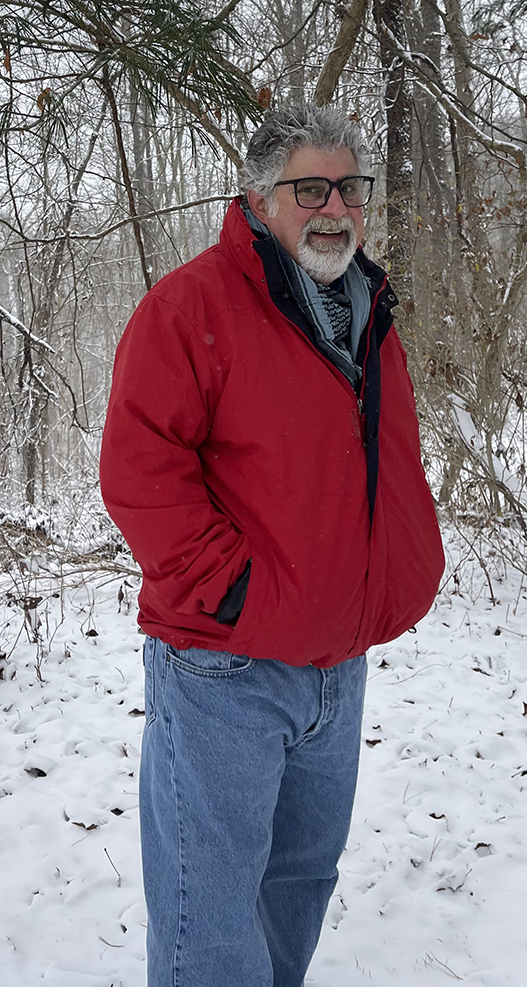
I'm Dr. Joe Pellegrino, an Associate Professor in the Department of English. I teach lots of different classes. My specialties are Irish literature and postcolonial literature, so I end up doing classes that don't fit into the standard Brit Lit/American Lit model, things like Irish lit, African lit, graphic novels, etc.
I went to school for a long time, and went to lots of different schools: Duquesne University, St. Louis University, Mannes College of Music, The New England Conservatory, and UNC-Chapel Hill, which is where I got my doctorate in English. I've also taught at a lot of schools: Duquesne, UNC, Eastern Kentucky University, Walden University, University of South Carolina-Upstate, Greenville Tech, Converse College, and here at Georgia Southern. I've had some experience in online education; while at EKU I was the University Director for the (short-lived) Kentucky Commonwealth Virtual University, and have taught online classes for over 20 years now.
Professionally, I edit a journal, The International Journal for the Scholarship of Teaching and Learning. I'm interested in a number of fields, but most of my publications are either on Irish studies, postcolonial lit, or teaching.
I also work on the British Commonwealth and Postcolonial Studies Conference, the oldest and longest-running annual meeting of its kind in the United States. Check out that web site; the design is one of my best.
I have only one item on my bucket list: to see the Northern Lights. One day I'll get there, but in the meantime I check in on the site linked here, from the Churchill Northern Studies Center in Churchill, Manitoba. I've got two daughters who are growing in wisdom, beauty, and grace. I make heirloom furniture (pretty much a middle-aged guy cliché), try to keep up with new technology, wish I could spend more time doing music, and constantly try to keep my head above water.

Office:
Room 3308B, Newton Building
Phone: 912.478.5953
Office Hours: MW, 12:00 - 4:00
Email: jpellegrino@georgiasouthern.edu
English Department in Statesboro:
Room 1118, Newton Building
622 COBA Drive
Statesboro, GA 30460
912.478.0141
OK, maybe two words: CONTENT and FORM
CONTENT
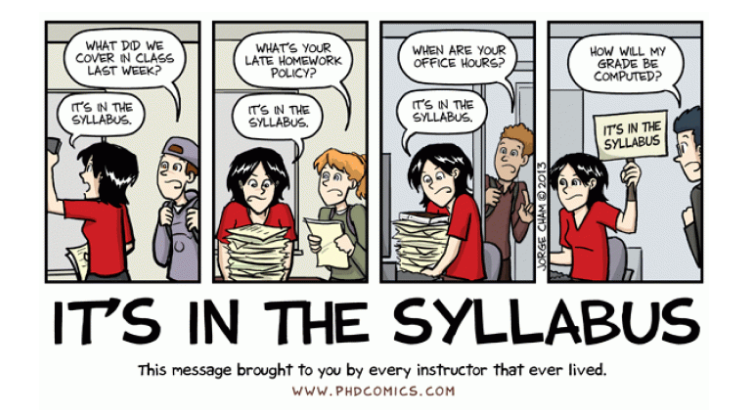
Please don't hesitate to post to me if you have a question about any of the readings, especially if you're struggling to figure them out. But please think twice about posting questions where the answer is in this syllabus. If you do, I have two options for a reply: I can copy and paste material from the syllabus or schedule just for you—because you didn't actually check it yourself—or I can reply with something like "check the syllabus" or "check the schedule." Both of these options are redundant, because you already have access to the answer to your question, and you should already know to check the syllabus. And both of these options reflect poorly on your abilities, either to understand what is required of you or to comprehend what you have read. Since I don't want to think less of your abilities, neither of these options are satisfactory. So if you ask a question that is already answered in the syllabus or in the schedule, I won't be replying at all.
FORM
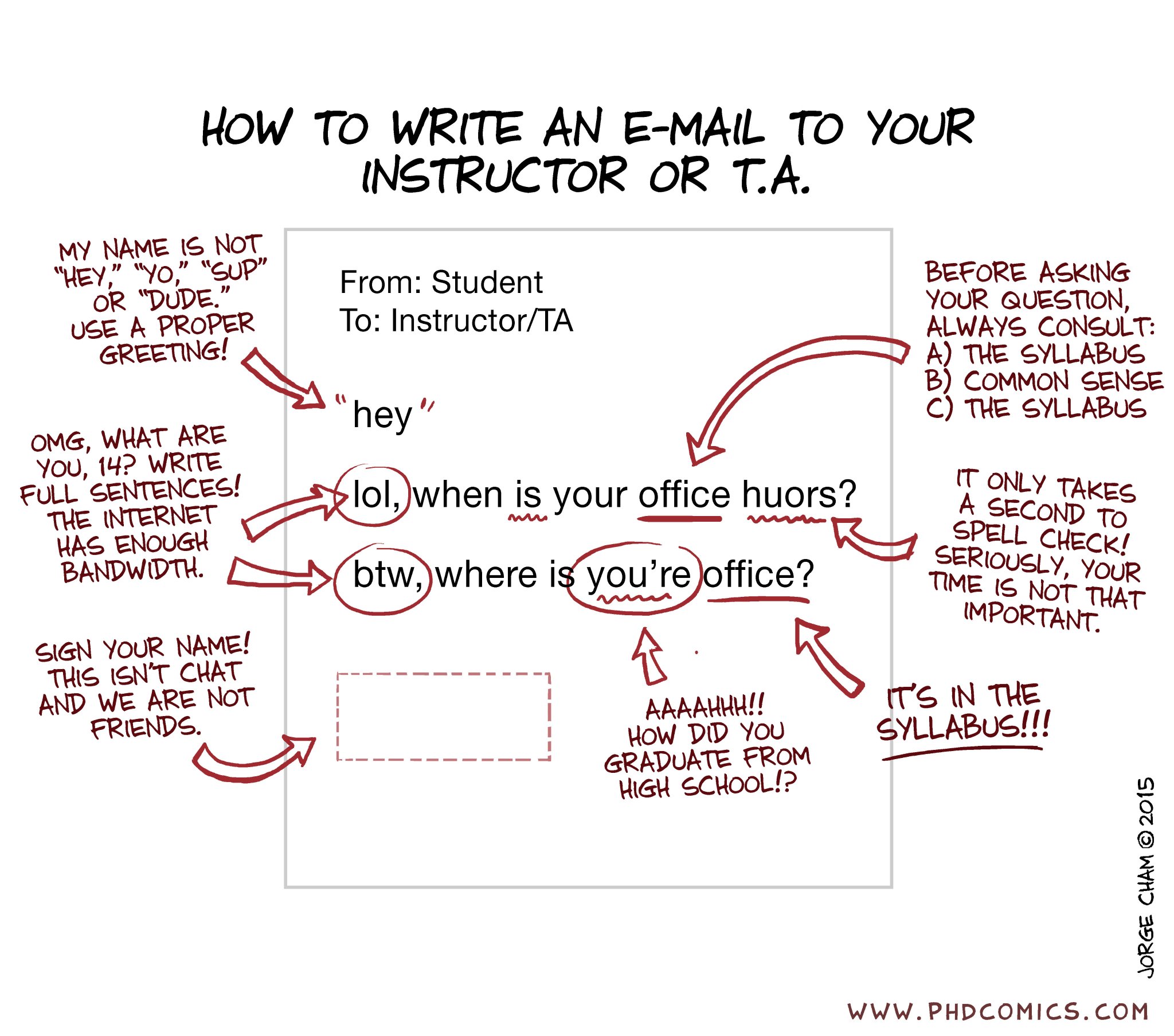
See that image there on the right? It's not just some funny advice about how to write an email to one of your instructors or teaching assistants; it's a set of guidelines that we expect you to follow. When you write anything, you change the form to suit the content. So you don't write an email to a professor like you're writing a DM to your friend. Look at the graphic, then follow the rules on it.
And as with the questions that have already been answered in this syllabus, I could embarrass you by reminding you of those rules when you don't follow them, or I could just not respond to you until you actually get it right. And just in case you can't parse what those rules are, I'll put them into a list:
- My name is not "Hey," "Yo," "'Sup," or "Dude" — use a proper greeting.
- Don't use acronyms or texting shorthand — write in full sentences. Use a grammar checker.
- Spell-check it before you send it. When you have tools available to you and you don't use them, you're not only demonstrating that you don't know how to communicate at anything beyond a middle-school level, you're also demonstrating your inability to use simple tools in order to make yourself look better.
- Check the syllabus before you make yourself look foolish (see the previous point).
- Sign your name.
So let me sum this all up:
if you don't hear back from me after you sent me an email, it's either because you can't write an email correctly for the audience you're trying to address, or you're asking a question that I've already answered in this document.
CLASS POLICIES
The University Undergraduate Catalog states unequivocally: “Students are expected to attend all classes.” Attendance in this class is not optional. Attending class means that you are present and attentive for the whole class period and that you are prepared for the day’s lesson. Unless you are missing class for a University-sanctioned reason, missing class, regardless of the excuse, will be counted as an absence.
But life gets complicated. So you'll have a free pass to miss almost 15% of our classes, regardless of the reason. You can miss because it's a nice day and you don't want to be inside, or your friend is coming in from out of town, or you were just up too late last night. The reason doesn't matter. Now, let me be clear, I certainly don't encourage you to miss any classes that you're physically well enough to attend. But I'll give you two weeks of absences (that's four classes) before your absences begin to negatively affect your grade for the class. If you are absent more than four times, regardless of the excuse, your final grade will be lowered by one point for every subsequent absence.
If you have to miss more than your allotted absences, there is obviously something going on in your life that does not allow you to pursue this degree wholeheartedly, so you should consider withdrawing from the course, if not the University. Keep this in mind when using your absences—that’s ALL you will be allowed. You do not want me in the position of deciding whose excuse is valid and whose isn’t, so I don’t need any documentation for your absences. If you’re within the limit it is not necessary, and after the limit it will not matter.
By now you recognize that arriving on time for class is, at its core, a sign of respect for your classmates and your professor. Tardiness, therefore, is a statement saying that your time is more important than anyone else’s. I will strike a blow for the group by counting every instance of tardiness as 1/3 of an absence. So, if you’re doing the math, you can be tardy several times without any consequences, save the collective disdain for your actions. And yes, your tardiness works in conjunction with your absences, so a combination of the two will push you toward the negative consequences outlined above.
Since this is a synchronous online class, being present means being in the zoom with your camera on and your microphone muted (unless you wish to speak, which I wholeheartedly encourage).
If you need additional work on the surface features of your writing, I'll let you know. Basically, if I can't understand what you're trying to say in your first paper, then you'll have to work at writing more clearly. I'll ask you to schedule sessions at the Writing Center in order to be more successful on your next paper.
The reason professors make students write papers is not because we love to mark them up, or because we somehow enjoy this. I'm willing to bet that every professor you ask would say that marking and grading papers is the worst part of their job. I know it is for me. The only thing that makes it bearable is hoping that I'll be able to engage with your ideas, or see the texts we're covering through your eyes. But if I have to stop after every sentence to figure out what you're trying to say, I'm most certainly not thinking about your ideas.
So do yourself a favor: give yourself enough time to do a good job on these papers. Remember that writing clearly takes far more time than you think it does, because you have to consider your argument from a reader's perspective, not your perspective.
I realize that the grand academic dance of submitting your work, having it evaluated, then responding to that evaluation (either through improving your work in your next paper, or by coming to see me in my office) is essentially a negotiation between us. You want to demonstrate your abilities with X amount of work, an amount that you think deserves a certain grade. You submit your work without knowing how others will see it, and only become aware of their perceptions when your work is returned to you with my comments. But this puts you at a disadvantage, because, as in any negotition, the party that makes the first move does so blindly, and so gives up any hope of advantage.
So in the spirit of openness, let me make the first move, and try to level the playing field by giving you a few tips:
- I'll begin with a personal comment:
I know my reputation precedes me, and I know what it is, that I'm one of the closest and cruelest readers of student work in the department. I mark every little error. I ask condescending questions. I expect too much from you. My classroom demeanor and my grading don't match.
While I don't revel in that description, it's pretty accurate. I don't believe it's too much to ask that your subjects agree with your verbs, your tenses are consistent, and you write like you know what you're doing. Expecting anything less from you is an insult to your intelligence, not mine. - This is academic writing, where clarity and concision are essential. If your work isn't clear, if every sentence doesn't hang together, you're losing the negotiation. What you have written may make sense to you, but it needs to make sense to your readers as well.
- At the post-secondary level, your writing isn't evaluated in terms of the amount of work you put into it. Just like any other skill, the amount of effort necessary to master academic writing varies from person to person. I am sure that it would take me far more effort than most of you to get back to playing football. But even if I did ten times the work you did, when we both showed up on the field we'd be evaluated on our skills, not on the time it took us to gain them.
- If you pay attention to what the prompt is asking you to write about, and keep that in mind as you think about your paper, you're making a good start.
- If you look at the rubric, especially the distinctions between the levels of performance in content and form, you should get a good idea of how successful your paper will be.
- If you're wondering if your "X amount of work" is enough, it isn't.
- And one last personal comment:
Before we had things like TurnItIn and other automatic checkers on academic integrity, I was the guy other faculty members went to to track down cases of suspected plagiarism. When Google was just getting off the ground, I was a beta tester for them (one of 25 in the country). I've also been teaching English for over 40 years now. So if you're thinking that you've changed enough of that material that you've copied and pasted to make it look like your own work, think again. If writing and evaluating papers is a negotiation, then presenting someone else's work as your own is a gamble, and you're betting your academic career that you can get away with it. I've just told you what I bring to the table, so if you really think you can get away with it, my only advice is to do it as early as possible, so you can spare yourself the work for the rest of semester, because you'll have already failed this class.
I DO NOT ACCEPT LATE ASSIGNMENTS. NO EXCEPTIONS, NO EXCUSES. A late assignment is any work that is not turned in during the class period in which it is due. This means that you must anticipate any problems that will occur. In other words, a computer / printer / drive / car / arm being broken at the last minute is not an excuse. To avoid last-minute catastrophes (which always occur), DO NOT WAIT UNTIL THE LAST MINUTE TO DO YOUR WORK.
You'll submit your assignments electronically to the appropriate section of the Learning Management System (Folio).
In compliance with the Americans with Disabilities Act (ADA), I will honor requests for reasonable accommodations made by individuals with disabilities or demonstrating appropriate need for learning environment adjustments. If you wish to avail yourself of any accommodations, you must disclose your disability to the Student Accessibility Resource Center (SARC) before I can implement any academic accommodations. That office will furnish you with a list of accommodations and a cover letter that you'll give to me. It's informally known as "a green sheet." Without that green sheet from the SARC, I can't offer you any accommodations.
For additional information, please call the SARC office at (912) 478-1566 on the Statesboro campus, or at (912) 344-2572 on the Armstrong and Liberty campuses.
If for any reason we might have a break in the continuity of instruction, I've got a couple of plans in place:
- Since we're an online synchronous class, we're not really affected by things like the institution shutting down, so I'll skip right to more personal things.
- If you are under quarantine:
I can't grant you any exemption to the attendance policy unless I receive a report from the GS CARES Team about your status. You can't just email me to say that you think you might have a virus and are self-isolating in order to minimize the chance of infecting others. That means that if you think you might have been exposed, or if you have tested positive, you must complete a COVID-19 Health Reporting Form, which can be found in the COVID-19 Information & Resources section of your MyGeorgiaSouthern page.
If you do have a CARES report and must self-isolate, it'll be like this class did not exist for you during your period of isolation. So those absences will not count against your total absences for the class (see the Attendance policy above), and you will neither gain nor lose points for the class discussions you missed. If a paper is due during your quarantine, you'll have an extension until you return to class. If you miss either exam, we'll work that out on a case-by-case basis.
ASSIGNMENTS
Your first research assignment for this class is a Digital Humanities project. Each of you will be asked to annotate a number of pages from Derek Walcott's famous book-length poem, Omeros. The pages you'll receive will be highlighted with my suggestions for words, phrases, or ideas that need annotations, but there may, and probably will, be several more that you find on your own.
Annotations can vary from mere definitions of unfamiliar words to unpacking the information necessary for understanding those words. Annotation includes adding purposeful notes, key words and phrases, definitions, and connections tied to specific sections of text. Your work will support other readers’ ability to clarify and synthesize ideas, pose relevant questions, and capture analytical thinking about these texts. Details of the process and a rubric for the quantity and quality of annotations required will be available during the first two weeks of class.
A Multimodal Essay (sometimes called a found essay or commonplace book) involves compiling and creatively arranging existing texts (including quotes or passages from various sources) to create a cohesive and meaningful narrative. It requires careful selection and arrangement of the found material to convey a specific theme or message. This assignment will require you to compose a found essay of at least 12 exhibits and then write a reflective essay (750-1000 words) describing the choices you made, why you chose them, and reflecting on the content you have curated.
Composing a Multimodal Essay:
Choose a Theme or Topic
Decide on a central theme, topic, or message you want your essay to convey. This will guide your search for relevant quotations and passages. You may want to choose a broad starting theme like place, death, fear, natural imagery, agency, or community to start with. However, I expect your theme to develop and become more focused over time.
Gather Material
Collect a diverse range of source materials that relate to your chosen theme. These materials can include quotations from books, articles, interviews, poems, song lyrics, speeches, and more. Make sure you have all the necessary bibliographic information for each source, so that you can eventually give due credit to the original authors/creators in your Works Cited page. Some of your exhibits should come from readings assigned to the class (or recommended by me) but may also include sources that relate to the material covered in class. If you’re not sure if its related, come by my office hours or email me.
Read and Select
Thoroughly read through your collected materials and identify passages, quotations, or excerpts that resonate with your theme.
Organize and Arrange
Begin arranging the selected passages in a way that creates a coherent narrative flow. You can experiment with different orders and combinations to see how they fit together best. As with any essay, you want your found essay to flow logically. This may involve arranging your exhibits topically, chronologically, or developmentally.
Create Transitions
As you arrange the passages, consider adding your own brief commentary or transitional sentences to link the found materials together. These transitions can provide context and help guide a reader through your essay.
Maintain Consistency
While the passages may come from various sources, strive for consistency in terms of tone, style, and voice. The goal is to create a unified reading experience.
Edit and Revise
Review your essay for clarity, coherence, and readability. Make sure that the arrangement of passages makes sense and effectively conveys your chosen theme.
Cite Sources
Properly attribute each exhibit to its original source. Include a Works Cited page to acknowledge the authors and works from which you've drawn the material. Follow MLA 9 guidelines for all citations.
Title and Introduction:
Choose a title that introduces the theme you're exploring. Your introduction should explain why that theme is important in 20th/21st-Century Brit Lit.
Formatting
Depending on your content, the contexts you're exploring, or your sense of appropriateness, format your essay in a way that is visually appealing and easy to read. You can use indentation, different fonts, visuals, etc. to create a strong aesthetic component.
Reflect on Your Message
Conclude your multimodal section with a reflective essay (750-1000 words) on the overarching message or insights you've drawn from the compiled passages. This essay will tie together your materials and offer your perspective on the theme. This section should be formatted as a standard academic paper according to the MLA 9 guidelines.
GRADING
Your Digital Humanities assignment for this class will be evaluated according to this rubric:
| DIGITAL HUMANITIES ASSIGNMENT RUBRIC | ||||
| Criterion | Max points | Performance for full credit | Points per item | Bonus possible? |
| Number of annotations | 20 | 20 + annotations | 1 point each | Y, up to 10 |
| Reference to/use of literary sources | 20 | 10 + annotations with references | 2 points each | N |
| Variety of sources | 15 | 5 + different literary sources | 3 points each | Y, up to 10 |
| Depth of annotations Annotation of a paragraph or more. |
25 | 10 + annotations | 2.5 points each | Y, up to 10 |
| Use of multimedia (image, video, audio) Each use must be cited; does not count as a literary source. |
10 | 10 + annotations incorporating media | 1 point each | Y, up to 5 |
| Grammar / Usage / Formatting | 10 | No errors | – 1 per error | N |
Your Multimodal Essay assignment for this class will be evaluated according to this rubric:
| Organization | How the writer structures their text, with their purpose and their audience in mind.
|
| Significance | How the writer makes clear to their audience that each element provided supports the text’s central purpose.
|
| Multimodality | How the writer chooses multimodal elements for their essay, and how they combine those modes in a single text.
* Various sources define modes differently; these might include linguistic, aural, visual, spatial, and gestural elements; written, oral, visual, electronic, and nonverbal elements; or any of a number of other combinations.
|
| Reflection | How the writer considers the material presented throughout this course.
|
For each sentence you write, I ask the following questions:
- What are you saying?
At a basic level, I’m trying to decode the meaning of each sentence. If I cannot understand what you’re trying to say, everything that follows is problematic. If your sentence is confused, convoluted, or contradictory, you make it difficult, or even impossible, for me to answer this basic question. - Is what you’re saying accurate?
Does this sentence demonstrate that you understand the text or the critic you’re addressing? For instance, if you’re summarizing someone else’s argument, I need to assess if you’re being true to the original author's intent. In your response, I’m assessing your evidence and examples. - Is what you’re saying well-expressed grammatically and mechanically?
This assumes that your grammar and mechanics aren’t so bad that I’ve been stymied back up at Question #1. - Does your writing have appropriate flow?
Does each idea link up with the one before it and the one following it in a way that meets audience needs, attitudes, and knowledge?
If I can answer all four of these questions positively for every sentence, you’re doing well. But when the answer is no, complications ensue. If I can’t understand what you’re saying, I have no way to engage with your ideas, and so I have additional questions.:
- Do you not understand the original text you’re addressing?
- Do you understand the original text, but your writing leaves a gap between that understanding and what is written on the page?
EVALUATION
| DH Assignment | 20% |
| MM Assignment | 25% |
| Exam 1 | 20% |
| Exam 2 | 25% |
| Participation | 10% |
| TOTAL | 100% |