Background
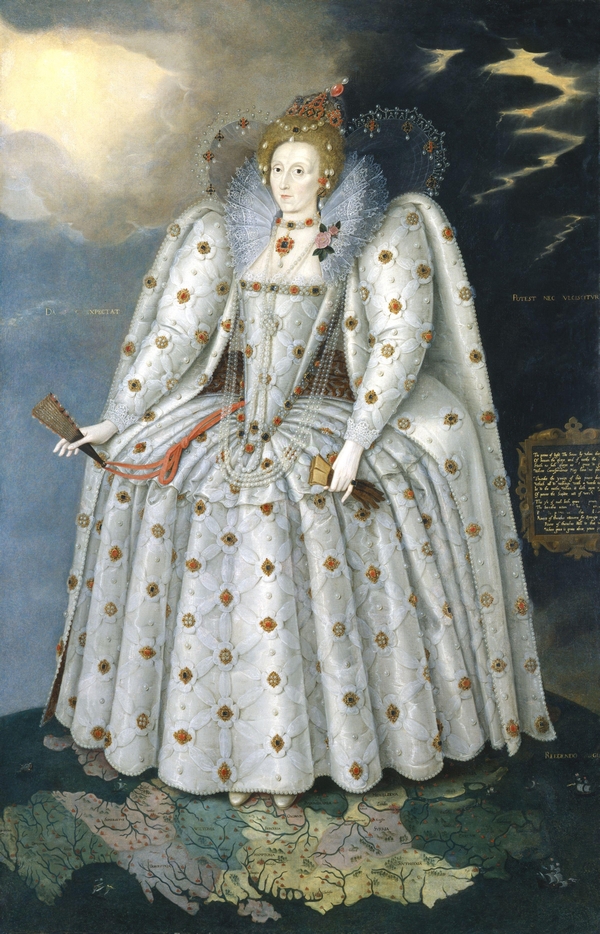
Any starting point for Irish history will be arbitrary, so let's start with one that we might all recognize: the reign of the last monarch of the House of Tudor, The Virgin Queen, Gloriana, Supreme Head of the Church of England, Astraea, Diana, Cynthia, Belphoebe, Elissa, Eliza Queen of Shepherds all, Good Queen Bess, Elizabeth Regina, or, as we know her, Elizabeth I. The 44 years and 4 months of her reign (17 November 1558 to 24 March 1603) are generally pitched as a golden age. Encyclopedia Britannica considers her reign to be "probably the most splendid age in the history of English literature, during which such writers as Sir Philip Sidney, Edmund Spenser, Roger Ascham, Richard Hooker, Christopher Marlowe, and William Shakespeare flourished.
But not everybody was so enthusiastic about her reign. In "The Royal Image in Elizabethan Ireland," Christopher Highley demonstrates how Elizabeth was viewed by many of her Irish subjects. Some terms they had for her included:
Images of Elizabeth were burned, defaced, spit upon, torn up, or otherwise defaced. "Obscene and blasphemous portraits of Elizabeth were displayed in continental Catholic countries; throughout her reign, attempts were made to harm the queen "by stabbing, burning, or otherwise destroying her image." (65)
Even Old English Catholics in Ireland reacted to Elizabeth's fulfillment of the Tudor Conquest. William Lyon, the bishop of Cork and Ross, during his annual inspection of school books, discovered:
The Tudor Plantations
The Tudor Plantations in 16th- and 17th-century Ireland were a series of acts by the English crown that confiscated land owned by the Irish and colonized it by sending settlers from England and Scotland. The Crown saw the plantations as a means of controlling, anglicizing and "civilizing" Gaelic Ireland. The Crown simply divided the land into blocks of 12,000, 8,000, 6,000, or 4,000 acres, then bestowed that land upon "Undertakers" (wealthy English colonists who “undertook” the task of importing tenants). Their job was simple: find non-Irish tenants who would work the land. Plantation land, however, could not be leased to the Irish. The Undertakers sought out families in England and Wales who would then be shipped to Ireland.
The main plantations took place from the 1550s to the 1620s, with some failed attempts at the beginning of this time (because not enough colonists would sign on). But biggest and most successful was one of the last, the Plantation of Ulster. This Plantation involved confiscated territory being granted to new landowners on the condition that they would establish settlers as their tenants and that they would introduce English law and the Protestant religion. The estates established here were smaller, from 350 to 2,000 acres. In general, the plantations led to the founding of many towns, massive demographic, cultural and economic changes, changes in land ownership and the landscape, and also to centuries of ethnic and sectarian conflict. The Ulster Plantation, with an influx of roughly 10,000 Scots, made the most radical changes to Ireland in all the realms above.
The English have been in Ireland a long time. . . .
Here's the English-owned land in Ireland before the reign of Elizabeth I:
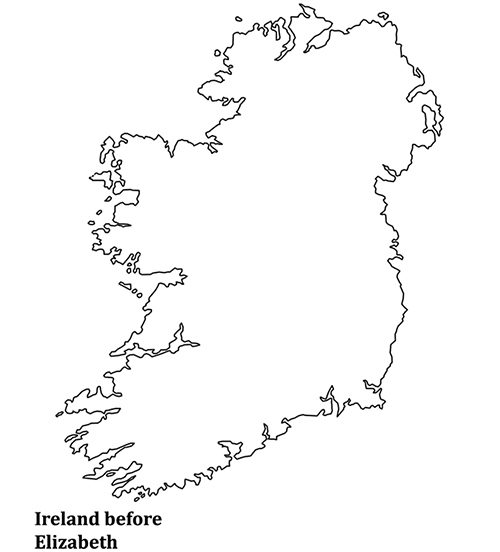
| Land Ownership | Area | % |
| Catholics | 32,595 miles2 | 100% |
| Protestants | 0 miles2 | 0 |
Here's English-owned land after Elizabeth and the Tudors
gave plantations to English nobles and those loyal to their house:
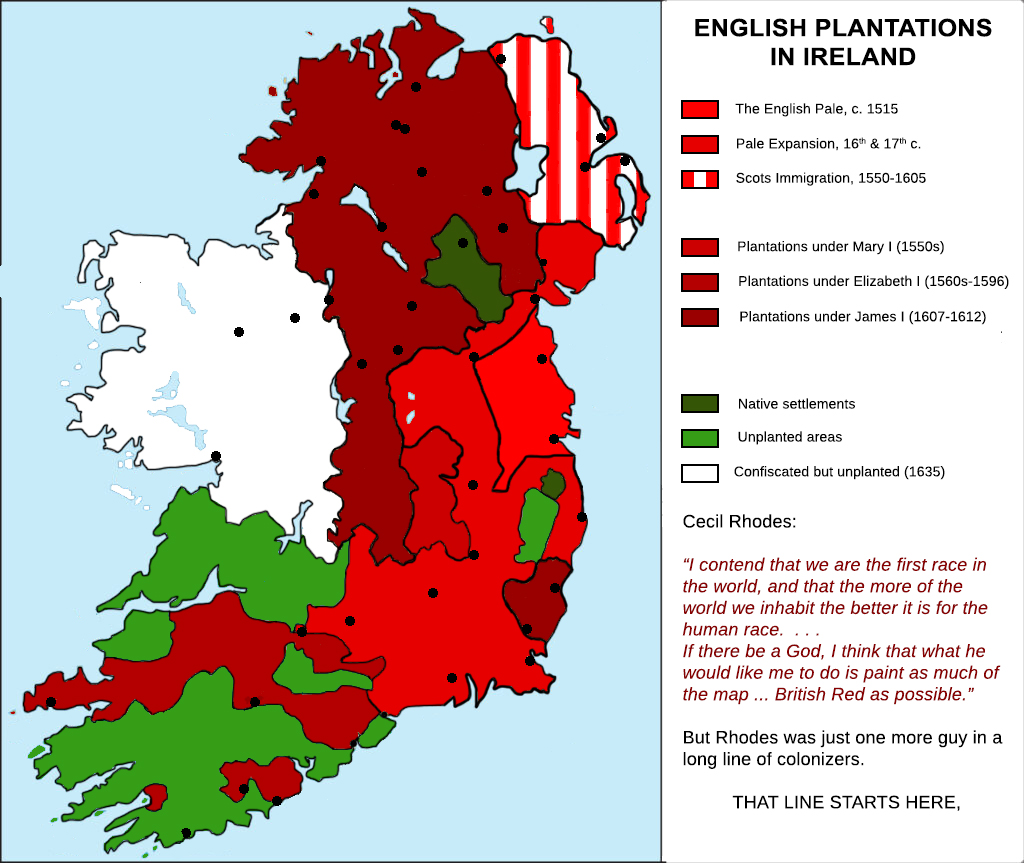
| Land Ownership | Area | % |
| Catholics | 2,608 miles2 | 8% |
| Protestants | 29,988 miles2 | 92% |
| TOTAL PRICE OF ALL LAND TRANSFERRED: £0 | ||
The Protestant Ascendancy
This mass confiscation of land was rounded off with Cromwell's confiscation of 2/3 of the land remaining in Catholic hands after 1640. Tens of thousands of Scots had already been given land in the north during the Ulster Plantation. Then 12,000 soldiers who served in Cromwell's army were given acreage in the midlands. These boots-on-the-ground farmers, however, weren't the ones making the real money. The members of the English aristocracy who were granted confiscated lands—those absentee landlords who lived in Britain and collected rents from their estates in Ireland—are the one who saw the real windfall. These English and Anglo-Irish families who owned most of the land, and had almost limitless power over their tenants, were at the top of the social and economic pyramid, and were known as the Ascendancy class. Some of their estates were huge: the Earl of Lucan, for example, owned over 60,000 acres. They used agents to administer their property, and many of them had no interest in it except to spend the money the rents brought in.
The Penal Laws
The rise of this new ruling class, the Protestant Ascendancy, was facilitated and formalized in the legal system after 1691 by the passing of various Penal Laws, which discriminated against the majority Irish Catholic population of the island. These laws were instituted during the last years of the 17th century and the early years of the 18th century. They were imposed on Ireland's Roman Catholic population, and enforced for over a century. At this time, Catholics on the island outnumbered Protestants by at last 5 to 1, but the Penal Laws undermined Catholic economic and political power by land confiscation. Enacted by the Irish Parliament, they were designed to maintain Protestant control and dominance by denying Irish Catholics religious freedom, education, political representation, and property rights. They reinforced the Protestant Ascendancy by concentrating property and public office in the hands of those who, as communicants of the established Church of Ireland, subscribed to the Oath of Supremacy. This Oath acknowledged the British monarch as the "supreme governor" of matters both spiritual and temporal, and abjured "all foreign jurisdictions [and] powers" — by implication both the Pope in Rome and the Stuart "Pretender" in the court of the King of France.
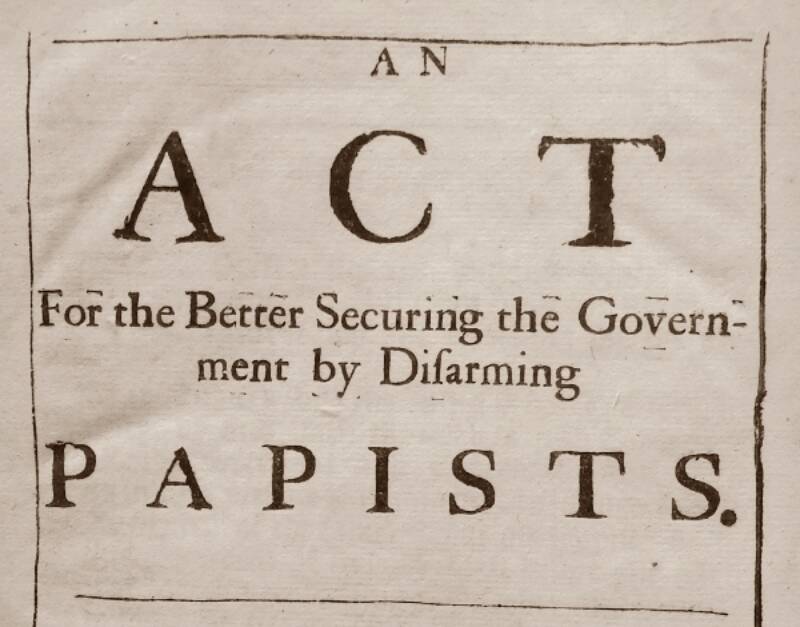
Many of these Penal Laws were on the books before 1695, but their enforcement was inconsistent. But the 1695 passage of the Settlement of Ireland Act, which declared all acts and laws made by previous Parliaments to be void, cleared the decks for a new political and economic order in Ireland. This act was accompanied by two others, An Act for the Better Securing the Government, by Disarming Papists and An Act to Restrain Foreign Education, that laid the groundwork dor the rigid, systematic, and continuous enforcement of this body of laws for over a century.
From An Act for the Better Securing the Government, by Disarming Papists:
For preserving the public peace, and quieting the kingdom from all dangers of insurrection and rebellion for the future; be it enacted by the King's most excellent Majesty, by and with the advice and consent of the lords spiritual and temporal and commons in this present Parliament assembled, and by authority of the same, that all Papists within this kingdom of Ireland shall, before the first day of March next ensuing, discover and deliver up to some justice or justices of the peace, or to the mayor, bailiff, or head officer of the county, city, town corporate, or place respectively where such papist shall dwell and reside, all their arms, armour, and ammunition of what kind soever the same be, which are in his or their hands or possession . . .
From An Act to Restrain Foreign Education:
Whereas it has been found by experience that tolerating at Papists keeping school or instructing youth in literature is one great reason of many of the natives continuing ignorant of the principles of the true religion . . . no person of the Popish religion shall publicly teach school or instruct youth . . . upon pain of 20 pounds and prison for three months for every such offence . . .
A sample of the Penal Laws
- Catholics could not hold public office (Member of Parliament, Judge, Solicitor, Jurist, Barrister, Sheriff, Member of a Town Council, or Civil Servant)
- Catholics could not vote or be elected to office.
- Catholics could not buy any land.
- Catholics could not own a horse worth more than £5. Catholics could not own a horse worth more than £5.
- Catholics could not travel more than five miles from their homes.
- Catholics could not lease land for longer than 31 years, and the annual rent was equal to 2/3 of the land's value.
- Catholics could not hold arms nor be members of the armed forces.
- Catholics could not establish schools or send their children abroad for education.
- Catholics could not marry a Protestant.
- Catholics could not be an orphan’s guardian.
- Catholics could not live in many provincial towns.
- Any Protestant seeing a Catholic tenant farmer working land that, in their opinion, yielded crops worth more than 1/3 the annual rent, could enter the farm, and, by swearing to the fact of that yield, could take possession of the farm.
- Any Protestant could take the horse of a Catholic, no matter how valuable the animal was, by paying £5.
- Catholics were fined £60 if they did not attend an Anglican Church of Ireland worship service at least once each month.
- Catholics (and Dissenters) were required to pay tithes to the Anglican Church of Ireland.
- Existing Catholic clergy were registered and required to take an oath of loyalty to the Anglican Church of Ireland. But those clergy considered especially dangerous, the members of the Catholic hierarchy, members of monastic communities, and all Jesuits, were exiled.
- Any Catholic priest who emigrated to Ireland was to be hanged.
The 1798 Rebellion
This was one of the largest rebellions against English rule. It was also the most threatening to the English, because, for the first time, Catholics and Protestants united against the Crown. The Society of United Irishmen, inspired by the American and French revolutions, was founded in 1791, with the first two chapters in Belfast and then in Dublin. Members were primarily middle class, but the Belfast society was mostly Presbyterian, and the Dublin society was a mix of Catholics and Protestants. Their initial objectives were minimal: suffrage for Catholics and those who did not own property. They had a determinedly non-sectarian outlook, their motto being, as their leading member Theobald Wolfe Tone put it,
to unite Catholic, Protestant, and Dissenter, under the common name of Irishman
Some of their early demands were granted by the Irish parliament. Catholics were given the right to vote in 1793, but only if they owned land worth more than 40 shillings. They were allowed to pursue higher education, obtain degrees, and serve in the military and civil service. But they still could not hold any public office or sit in Parliament.
The United Irishmen were banned and went underground in 1794. Wolfe Tone went into exile, first in America and then in France, where he lobbied for military aid for revolution in Ireland. The Society then claimed that their goal was a fully independent Irish Republic. They began organizing a clandestine military structure, working with other secret societies, both Catholic (the Defenders) and Protestant (the Peep of Day Boys and the Orange Order), to recruit more foot soldiers for the hoped-for revolution. As a result, while the majority of the United Irishmen’s top leadership remained Protestant, their foot soldiers, except in northeast Ulster, became increasingly Catholic.
In 1796 Wolfe Tone returned from France with a large fleet set on invasion, with almost 14,000 troops. But the fleet ran into a series of terrible storms, and many ships were wrecked off Bantry Bay in County Cork. This forced them to return to France. The government in Dublin, shocked by how close they had come to being invaded, responded with a vicious wave of repression, passing an Insurrection Act that suspended habeas corpus and other peacetime laws.
British troops, local militia, and a force that was fiercely loyalist and mostly Protestant (the Yeomanry), government forces attempted to terrorize any would-be revolutionaries in Ireland who might aid the French in the event of another invasion. The Crown forces’ methods including burning the houses of Catholics and Catholic churches, summary executions, and "pitch-capping," where tar was placed on a victim’s scalp then set on fire.
Their rebellion was supposed to begin on May 23, 1798, but the Dublin authorities became aware of their plans and arrested most of the senior United Irishmen leadership on May 22. With their leaders mostly in prison or in exile, the rising flared up in in a localized and uncoordinated manner. Large bodies of United Irishmen rose in arms in the counties around Dublin; Kildare, Wicklow, Carlow and Meath, but Dublin city itself, which was heavily garrisoned and placed under martial law, did not stir.
The only successful implementation of their plans came in County Wexford. did the United Irishmen meet with success. There the insurgents defeated some militia and Yeomanry units and took the towns of Enniscorthy and Wexford. The leadership of the Wexford rebels was both Protestant—their military leader, Harvey Bagenal—and Catholic—several Catholic priests like Father John Murphy. The majority of the fighting force was Catholic, united by their outrage at the sectarian atrocities committed in the previous months by the Yeomanry.
But these rebels failed to take the towns of New Ross and Arklow, despite determined and costly assaults, and remained bottled up in the southeastern corner of the island. The Wexford rebellion was smashed about a month after it broke out, when over 13,000 British troops converged on the main rebel camp at Vinegar Hill on June 21, 1798. They rained artillery on the rebels, but were not able to capture all the rebels. Some who escaped tried to spread the rebellion into County Kilkenny, and others attempted to join up with United Irishmen in counties Kildare and Meath, before finally seeking refuge in the Wicklow mountains. Guerrilla fighting continued, but the main rebel stronghold had fallen.
In the north, the mainly Presbyterian United Irishmen launched their own uprisings in counties Antrim and Down, in support of Wexford in early June. However, after some initial success, they were defeated by government troops and militia.
The main fighting in the 1798 rebellion lasted just three months, but the deaths ran into the tens of thousands. Estimates range from 10,000 to 70,000 dead rebels. Of course, thousands more were injured, and thousands of farms and homes were burned. Thousands more former rebels were exiled to Scotland or transported to penal colonies in Australia.
While the radicals of the 1790s had hoped that religious divisions in Ireland could be put aside, the fierce sectarian violence that took place on both sides during the rebellion actually hardened sectarian animosities. Many northern Presbyterians began to see the British connection as less potentially dangerous for them than an independent Ireland, where they would be a minority.
The United Irishmen’s hope of founding a secular, independent, democratic Irish Republic therefore ended in total defeat. But their foundation of the ideology of Irish republicanism would have a long and enduring legacy upon Irish politics.
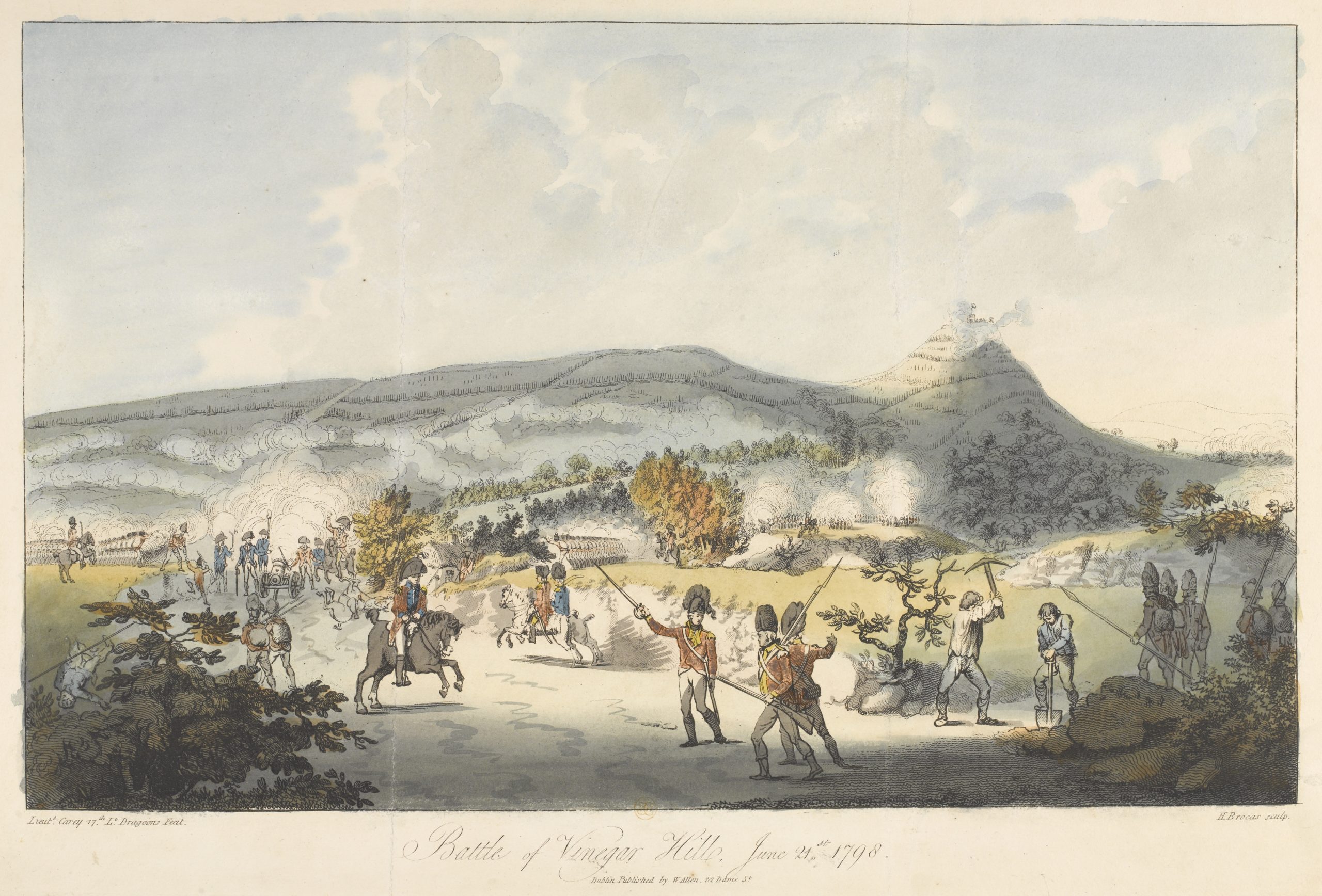
The Act of Union
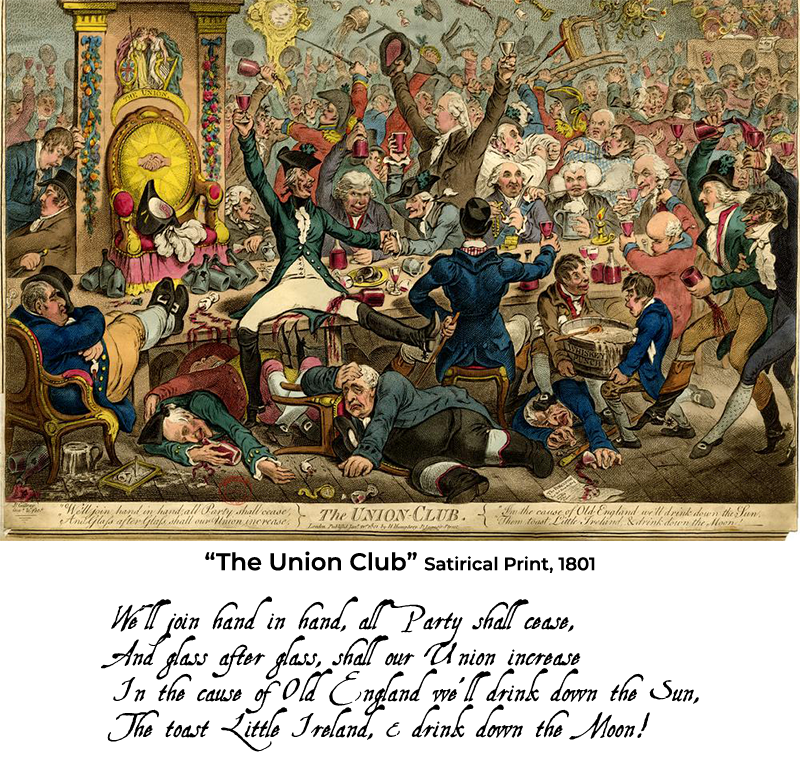
The ultimate result of the 1798 Rebellion was The Act of Union, which was passed in 1800. This Act abolished the independent Irish Parliament in Dublin, and brought Irish Administration under the British Parliament. As a result, Britain and Ireland had a common King, Parliament, army and flag. Union had always been distrusted and disliked. It was only brought about after enormous expense and much bribery. Ironically, the Act of Union led to the resignation of one of its finest supporters: William Pitt, the Prime Minister of England. Pitt decided to solve the troubles in Ireland by proposing Parliamentary union with England, coupled with Catholic emancipation. The Irish Protestant Parliament was recalcitrant, but pressure from Dublin Castle, combined with a wholesale distribution of honors, places, and pensions, soon brought about a change of heart.
Pitt intended the Act of Union to be accompanied by relief to Catholics from paying tithes to support the Anglican Church in Ireland, state payment of salaries to the Irish Catholic priesthood and, above all, Catholic emancipation, allowing Catholics to sit in Parliament. But King George III refused to accept this, insisting that Catholic emancipation would violate the terms of his Coronation Oath, by which he had sworn to maintain the privileges of the Anglican Church. Finally, rather than break a pledge, Pitt resigned in 1801. The way in which union had been brought about left Ireland betrayed and resentful.
Farmers, Cottiers, and Strong Farmers
Ireland at this time had a very unbalanced social structure. Farmers rented the land they worked, and those who could afford to rent large farms would break up some of the land into smaller plots. These were leased to "cottiers" or small farmers, under a system called "conacre." Nobody had security or tenure, and rents were high. Very little cash was used in the economy. The cottier paid his rent by working for his landlord, and he could rear a pig to sell for the small amount of cash he might need to buy clothes or other necessary goods.
There was also a large population of itinerant agricultural laborers, who traveled around the island looking for work. Essentially day laborers, they could barely make a living, because not many Irish farmers could afford to hire them. In 1835, an inquiry found that over 2,000,000 people in Ireland were without regular employment of any kind. Under the Irish Poor Law of 1838, workhouses were built throughout the country and financed by local taxpayers.
An Gorta Mór - The Great Hunger
Background
Ireland's rickety system held together only because the rural peasants had a cheap and plentiful source of food. The potato, introduced to Ireland about 1590, could grow in the poorest conditions, with very little labor. This was important, because laborers had to give most of their time to the farmers they worked for, and had very little time for their own crops.
But in 1845, half of Ireland's potato crop failed, as did about 3/4 of the crop over the next seven years. This was caused by e mold, phytophthora infestans. The spores of this mold were carried by wind, rain and insects to Ireland from Britain and the European continent. A fungus then affected the potato plants, producing black spots and a white mold on the leaves, soon rotting the potato into a pulp.
Before it ended in 1852, the Great Hunger resulted in the death of roughly one million Irish from starvation and related causes, with at least another million forced to leave their homeland as refugees.
By the summer of 1847, over three million people were being fed by government soup kitchens and those organized by Quakers. So many people died in so short a time that mass graves were provided.

Economics
The dominant economic theory in mid-19th century Britain was laissez-faire, which held that it was not a government's job to provide aid for its citizens, or to interfere with the free market of goods or trade. Despite this philosophy, the initial response to the Famine under the British Prime Minister Sir Robert Peel, was prompt, efficient and interventionist. He sent over a Scientific Commission to examine the facts. The commissioners reported that ½ of the crop was now destroyed, or unfit for use, but they incorrectly diagnosed the cause of the blight.
The Corn Laws
Food prices in Ireland were beginning to rise, and potato prices had doubled by December of 1845. Meanwhile, the Irish grain crop was being exported to Britain. Public meetings were held, and prominent citizens called for the exports to be stopped and for grain to be imported as well. However, this would have meant repealing the Corn Laws, and there was great opposition in Britain to this.
The Corn Laws, an exception to the doctrine of laissez-faire, laid down that large taxes had to be paid on any foreign crops brought into Britain. This kept grain prices artificially high, and the British traders would lose profits if the laws were repealed. Since the Act of Union made Ireland legally a part of the United Kingdom, its corn crop could be moved to England without incurring the tax. However, corn crops brought into Ireland to relieve the famine could be taxed.
Prime Minister Peel pushed through a repeal of the Corn Laws in 1846. This split the Tory Party, and Peel was forced to resign. In a powerful speech to Parliament he said, "Good God, are you to sit in cabinet and consider and calculate how much diarrhea, and bloody flux, and dysentery a people can bear before it becomes necessary for you to provide them with food?"

Peel to Russell
Peel was succeeded at Prime Minister by Lord John Russell, a rigid exponent of laissez-faire. In October of 1846, as it became clear that over 90% of the potato crop of Ireland was blighted, Lord Russell set out his approach to the famine: "It must be thoroughly understood that we cannot feed the people. . . . We can at best keep down prices where there is no regular market and prevent established dealers from raising prices much beyond the fair price with ordinary profits."
Russell's policies emphasized employment rather than food for famine victims, in the belief that private enterprise, not government, should be responsible for food provision. He also stressed that the cost of Irish relief work should be paid for by Irishmen. Peel's Relief Commission was abolished, and relief work was put in the hands of 12,000 civil servants in the Board of Works, who could only manage to find work for only 750,000 members of the 9 million who were starving. In return for their hard (and often pointless) labor, starving peasants were paid starvation wages.
Tens of thousands of people died during the winter of 1846, but Russell and his colleagues never thought of interfering with the structure of the Irish economy in the ways that would have been necessary to prevent the worst effects of the famine.

Relief Efforts
But non-governmental organizations and other national governments were not as heartless as Russell's government. The Society of Friends, or Quakers, first became involved with the Irish Famine in November 1846, when some Dublin-based members formed a Central Relief Committee. They intended that their assistance would supplement other relief, but the relief provided by the Quakers proved crucial in keeping people alive when other relief systems failed. A number of Quakers were critical of government relief policies, holding them to be inadequate and misjudged.
The Quakers donated food, mostly American flour, rice, biscuits, and Indian meal, along with clothes and bedding. They set up soup kitchens, purchased seed, and provided funds for local employment. During 1846-1847, the Quakers gave approximately £200,000 for relief in Ireland.
In 1847, the Quaker soup kitchens were supplemented by those run by local authorities, charities, private individuals, and, eventually, the British government. But many of them were established by Protestant charities, and would only offer food to Catholics (the overwhelming majority of those who were starving) if they converted. There was also a London chef, Alexis Soyer, who set up soup kitchens in Dublin, achieved great economies of scale, and charged Dublin's elite five shillings to watch. Nevertheless, soup kitchens probably supplied food for 3,000,000 people. In keeping with Russell's philosophy that a government should not provide a social safety net, his government set up public-work schemes, which paid minimally, but enough to buy food. In 1847, 715,000 men were employed in this way. There were also workhouses, which provided food and shelter in exchange for 60 hours of labor each week. In 1849, 1,000,000 people were subject to them.

Donations for the Irish Famine came from distant and unexpected sources. Calcutta, India sent £16,500 in 1847, Bombay another 3,000. Florence, Italy, Antigua, France, Jamaica, and Barbados sent contributions. The Choctaw tribe in North America, recently forcibly removed from their homeland through the Trail of Tears and ravaged by disease on their reservation in Oklahoma, sent $710. Many major cities in America set up Relief Committees for Ireland, and Jewish synagogues in America and Britain contributed generously.
Many Irish still believe that Queen Victoria donated merely 5 pounds to famine relief, but in 1847 she donated £2000, with a further £500 given to a ladies' Clothing Fund.
Desperately poor Irish emigrants, struggling to survive in the slums of New York, contrived to send home more than $326,000 [about £9 million today] in just two months.
The British Relief Association was founded in 1847, and raised money in England, America, and Australia. They benefited from a "Queen's Letter" from Victoria, appealing for money to relieve the distress in Ireland. The total raised was £171,533. A second "Queen's Letter" in October of 1847 reflected a hardening of British public opinion; it raised hardly any additional funds. In total, the British Relief Association raised approximately £470,000.
In August of 1847, when the Association had a balance of £200,000, their agent in Ireland, Polish Count Strzelecki, proposed that the money be spent to help schoolchildren in the west of Ireland. The British Treasury Secretary, Charles Edward Trevelyan, warned against it, fearing "it might produce the impression that the lavish charitable system of last season was intended to be renewed." Strzelecki proved adamant and Trevelyan conceded that a small portion of the funds could be used for that purpose.

A note about Trevelyan
To this day, Trevelyan continues to divide opinion. The Cork Multitext Project notes:
Trevelyan's most enduring mark on history may be the quasi-genocidal anti-Irish racial sentiment he expressed during his term in the critical position of administrating relief for the millions of Irish peasants suffering under the Irish famine as Assistant Secretary to HM Treasury (1840-1859) under the Whig administration of Lord Russell.
On the other side, the BBC's Historic Figures webpage states:
His most lasting contribution, however, began in the 1850s with the publication of his and Sir Stafford Northcote's report on "The Organisation of the Permanent Civil Service." The report led to the transformation of the civil service. Educational standards and competitive admission examinations ensured that a more qualified body of civil servants would become administrators.
There is evidence that Trevelyan deliberately dragged his feet in disbursing direct government food and monetary aid to the Irish during the height of the Famine, due to his strident belief in laissez-faire economics and the free hand of the market. In a letter to an Irish peer, Lord Monteagle of Brandon, a former Chancellor of the Exchequer, he described the famine as an "effective mechanism for reducing surplus population" as well as "the judgement of God." He also wrote that, "The real evil with which we have to contend is not the physical evil of the Famine, but the moral evil of the selfish, perverse and turbulent character of the people."
Trevelyan never expressed remorse for his comments, even after the the final number of deaths attributed to the famine in Ireland—approximately 1 million—became known. His defenders claim that factors other than Trevelyan's personal acts and beliefs were more central to the problem.
Cecil Woodham-Smith, considered the preeminent authority on the Irish Famine, wrote of him in The Great Hunger: Ireland 1845-1849:
his mind was powerful, his character admirably scrupulous and upright, his devotion to duty praiseworthy, but he had a remarkable insensitiveness. Since he took action only after conscientiously satisfying himself what he proposed to do was ethical and justified he went forward impervious to other considerations, sustained but also blinded by his conviction of doing right.
Exports During The Famine
In 1845, a famine year in Ireland, 3,251,907 quarters (8 bushels = 1 quarter) of corn were exported from Ireland to Britain. That same year, 257,257 sheep were exported to Britain. In 1846, another famine year, 480,827 swine and 186,483 oxen were exported to Britain.
Woodham-Smith notes that,
...no issue has provoked so much anger or so embittered relations between the two countries (England and Ireland) as the indisputable fact that huge quantities of food were exported from Ireland to England throughout the period when the people of Ireland were dying of starvation.
Although the potato crop failed, the country was still producing and exporting more than enough grain crops to feed the population. But that was a "money crop" and not a "food crop," and could not be interfered with. In fact, Ireland was actually producing sufficient food, wool, and flax, to feed and clothe not 9,000,000, but 18,000,000 people, yet a ship sailing into an Irish port during the famine years with a cargo of grain was sure to meet six ships sailing out with a similar cargo.
This is one of the most remarkable and scandalous facts about the famine period: the average monthly exports of food FROM Ireland during the famine were worth £100,000 (that's over 12,500,000 2026 USD)). For almost the whole of the famine, Ireland remained a net exporter of food. 9,992 calves were exported from Ireland to England during "Black '47," an increase of 33% from the previous year. In the 12 months following the second failure of the potato crop, 4,000 horses and ponies were exported. The export of livestock to Britain (with the exception of pigs) increased during the famine. The export of bacon and ham increased. In total, over 3,000,000 live animals were exported from Ireland between 1846-50, more than the number of people who emigrated during the famine years.
Almost 4,000 vessels carried food from Ireland to the ports of Bristol, Glasgow, Liverpool and London during 1847, when 400,000 Irish men, women and children died of starvation and related diseases. The food was shipped under guard from the most famine-stricken parts of Ireland: Ballina, Ballyshannon, Bantry, Dingle, Killala, Kilrush, Limerick, Sligo, Tralee, and Westport.
During the first 9 months of "Black '47" the export of grain-derived alcohol from Ireland to England included the following: 874,170 gallons of porter, 278,658 gallons of Guinness, and 183,392 gallons of whiskey. The total amount of grain-derived alcohol exported during that time was 1,336,220 gallons.
A wide variety of commodities left Ireland during 1847, including peas, beans, onions, rabbits, salmon, oysters, herring, lard, honey, tongues, animal skins, rags, shoes, soap, glue and seed.
The most shocking export figures concern butter. Butter was shipped in firkins, each one holding nine gallons. In the first nine months of 1847, 56,557 firkins were exported from Ireland to Bristol, and 34,852 firkins were shipped to Liverpool. That works out to be 822,681 gallons of butter exported to England from Ireland during nine months of the worst year of famine. If the other three months of exports were at all comparable, then we can safely assume that 1,000,000 gallons of butter left Ireland while 400,000 Irish people starved to death.
Obviously, there was sufficient food in Ireland to prevent mass starvation, and that food was brought through the worst famine-stricken areas on its way to England. British regiments guarded the ports and warehouses in Ireland to guarantee absentee landlords and commodity speculators their "free market" profits.
When Ireland experienced an earlier famine in 1782-83, ports were closed in order to keep home-grown food for domestic consumption. Food prices were immediately reduced within Ireland. The merchants lobbied against such efforts, but their protests were overridden. Everyone recognized that the interests of the merchants and the distressed people were irreconcilable. In the Great Famine, that recognition was disregarded.

Evictions
During the worst months of the famine, in the winter of 1846-47, tens of thousands of tenants fell in arrears of rent and were evicted from their homes. A nationwide system of ousting the peasantry began to set in, with absentee landlords, and some resident landlords as well, more determined than ever to rid Ireland of its "surplus" Irish. In 1850 alone, over 104,000 people were evicted.
With potato cultivation over because of the blight, tenants could pay no rents. Sheep and cattle could pay rent, so landlords decided to give the land over to them.
Mortality
In 1841 the population of Ireland was given as 8,175,124. It is almost certain that, owing to geographical difficulties and the unwillingness of the people to be registered, the census of 1841 gave a total smaller than the population in fact was. Officers engaged in relief work put the population as much as 25% higher (over 10,000,000 people); landlords distributing relief were horrified when providing, as they imagined, food for 60 persons, to find more than 400. By 1851, after the famine, the population had dropped to 6,552,385. The census commissioners calculated that, at the normal rate of increase, the total should have been 9,018,799, so the loss of at least 2,500,000 persons had taken place.
"Famine Relief" Under Trevelyan
Charles Edward Trevelyan, the British Treasury Secretary in charge, was the civil servant most involved in Irish famine relief. He firmly believed in a laissez-faire system. Trevelyan opposed expenditure and raising taxes, advocating self-sufficiency. He was convinced that any attempt to raise the standard of living of the poorest section of the population above subsistence level would only result in increased population, which would make matters worse.
Trevelyan on Irish overpopulation in 1846:
"being altogether beyond the power of man, the cure has been applied by the direct stroke of an all-wise Providence in a manner as unexpected and as unthought of as it is likely to be effectual."
In 1848, after over 1,000,000 Irish people had died due to famine, he wrote:
"The matter is awfully serious, but we are in the hands of Providence, without a possibility of averting the catastrophe if it is to happen. We can only wait the result."
Later that year he declared:
"The great evil with which we have to contend is not the physical evil of the famine, but the moral evil of the selfish, perverse and turbulent character of the people."
In 1848 Trevelyan was knighted for his services in Ireland.
A Policy of Extermination
With very few exceptions, British politicians were decidedly against offering Ireland any relief.
In 1849 Edward Twisleton, the Irish Poor Law Commissioner, resigned to protest lack of aid from Britain. The response from the Earl of Clarendon, acting as Lord Lieutenant of Ireland, is shocking for what it reveals about British intentions:
"He [Twisleton] thinks that the destitution here [in Ireland] is so horrible, and the indifference of the House of Commons is so manifest, that he is an unfit agent for a policy that must be one of extermination."
Other British politicians echoed this view. The Chancellor of the Exchequer (head of the Treasury) responded to an Irish landlord in 1848:
"I am not at all appalled by your tenantry going. That seems to be a necessary part of the process . . . We must not complain of what we really want to obtain."
British newspapers and magazines promoted this idea that the Irish were not worthy of any aid to the population at large. The lead story in the August 30, 1847 edition of The Times of London said,
"In no other country have men talked treason until they are hoarse, and then gone about begging for sympathy from their oppressors. In no other country have the people been so liberally and unthriftily helped by the nation they denounced and defied."
In another edition they look forward to the day when the Irish are wiped out:
"They are going. They are going with a vengeance. Soon a Celt will be as rare in Ireland as a Red Indian on the streets of Manhattan . . . Law has ridden through, it has been taught with bayonets, and interpreted with ruin. Townships leveled to the ground, straggling columns of exiles, workhouses multiplied, and still crowded, express the determination of the Legislature to rescue Ireland from its slovenly old barbarism, and to plant there the institutions of this more civilized land."
James Wilson, the editor of The Economist, responded to Irish pleas for assistance during the famine with this:
"It is no man's business to provide for another. . . . If left to the natural law of distribution, those who deserve more would obtain it."
Cholera
In December of 1848, cholera began to spread through many of the overcrowded workhouses, pauper hospitals, and crammed jails in Ireland. On April 26, 1849, Lord Clarendon wrote to Prime Minister Russell: ". . . it is enough to drive one mad, day after day, to read the appeals that are made and meet them all with a negative . . . At Westport, and other places in Mayo, they have not a shilling to make preparations for the cholera, but no assistance can be given, and there is no credit for anything, as all our contractors are ruined. Surely this is a state of things to justify you asking the House of Commons for an advance, for I don't think there is another legislature in Europe that would disregard such suffering as now exists in the west of Ireland, or coldly persist in a policy of extermination."
No advance was granted.

Workhouses
Initially, the greatest relief to the starving came through the Poor Law (1838), which aimed to provide accommodation for the absolutely destitute in workhouses. There were 130 of them in Ireland in 1845.
However, the conditions for entry were so strict that people would only go to them as a last resort. Families were torn apart, as women and men lived in different parts of the workhouse, and children were kept separately from adults. Inmates were forbidden to leave, and the food provided consisted of two meals a day, of oatmeal, potatoes, and buttermilk. There were strict rules against bad language, alcohol, laziness, malingering, and disobedience, and meals had to be eaten in silence. Able-bodied adults had to work at such jobs as knitting (for women) and breaking stones (for men).Children were given industrial training of some sort.

Emigration
Between 1845 and 1855, nearly 2,000,000 people had emigrated from Ireland to America and Australia, and another 750,000 to Britain. The Poor Law Extension Act, which made landlords responsible for the maintenance of their own poor, induced some to clear their estates by paying for emigration of the poorer tenants. Although some landlords did so out of humanitarian motives, there were undoubtedly benefits to them, especially those who wanted to consolidate their land holdings or change from the cultivation of land to beef and dairy farming.
Emigration soared from 75,000 in 1845 to 250,000 in 1851. This chaotic, panic-stricken, and unregulated exodus was the largest single population movement of the 19th century. Thousands of emigrants died on board "coffin ships" during the Atlantic crossing. These were little more than rotting hulks, and their owners were plying a speculative trade. There were 17,465 documented deaths aboard these ships in 1847 alone. Thousands more died at disembarkation centers.
The Land League
Davitt and the Land League
The issue of land ownership was central to political life in Ireland in the later decades of the 19th century. It was clearly understood that the ways in which Irish land was owned, rented out, and inherited had contributed to the appalling effects of the famine. The question was about how the situation could be rectified.
English "ownership" of Irish land, initiated by the Plantations, was the bulwark of the economic and political dominance of the Protestant Ascendancy. By this point they had so consolidated their power that in 1870, 97% of Ireland was owned by men who rented it out to tenant farmers rather than cultivating it themselves. And the majority of these landlords were absentees.
In the late 1870s and early 1880s, before a solution could be found, another series of bad harvests and the threat of famine again hung over Ireland. The landlords, who believed that their tenants would not be able to pay their rents in a time of poor harvest, began evicting them from the land. In response, a new movement, the Irish National Land League, emerged to fight for the rights of small tenant farmers. The goal of this movement was to bring about a more equitable system of land ownership. The League wanted three main things:
- Fair rent in line with the market price for land, rather than an inflated charge set by the landlord.
- Fixity of tenure. The League wanted rent agreements to state how long tenants could stay on the land rather than leave them with no security.
- Freedom of sale. The tenants had no rights over the land when it was sold — they wanted to have a say.
More broadly it wanted to get Irish land into the hands of Irish small farmers and away from the ownership of absentee landlords who didn't care for their tenants' welfare.
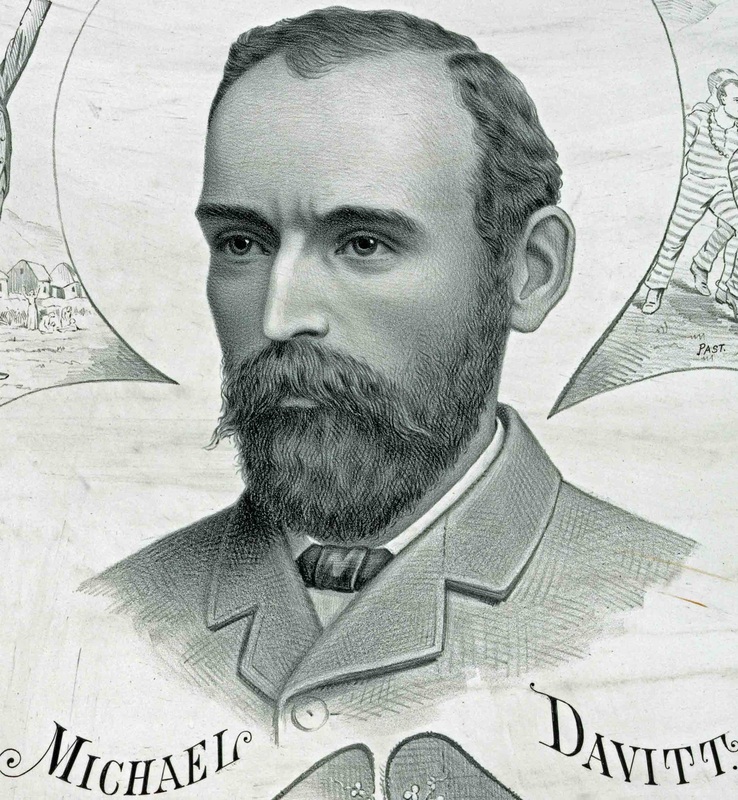
The founder of the Irish National Land League was Michael Davitt. His family had been evicted from their land in the 1840s and forced to emigrate to England. Davitt was sent to work at the local cotton mill in Lancashire. Like many other young boys, he was working in dangerous conditions. At eleven he lost his arm in an accident, and was unemployable. He educated himself, and began seeing the British as being responsible for all of Ireland's problems. He was sentenced to 15 years in prison in 1870 for Fenian activity, but released in 1877. On his release he turned his attention to the landlords, whom he saw as the root of all evil in his native land.
To achieve its aims the Land League attacked the landlords who treated their tenants badly, who charged unfair rents, and who evicted their tenants. Many of these attacks took a physical form, and landlords and their families were beaten. Some, such as Lord Leitrim (a landlord who was notorious for his poor treatment of tenants), were killed.
Boycotts
The greatest tool of the Land League, however, was the boycott. The basic idea was that people would stop doing business or socializing with landlords whom they opposed because of their unfair practices. Farmers would refuse to work for them, and the rest of the community was encouraged to ostracize the guilty party. One of the first targets was Captain Charles Boycott, of Lough Mask House, County Mayo, after whom this strategy was named. The Land League didn't boycott only the landlords, however. They also boycotted those Irish people who chose to take on the land from which others had been evicted. In one speech, the President of the Land League told the crowd that anyone who had taken on the land of the evicted should be:
- Ignored on the roadside when they were seen.
- Ignored when met at the shop counter.
- Ignored at the fair and marketplace.
- Ignored in the house of worship.
The Land Act
The Land League was so effective that the British Prime Minister, William Gladstone, decided to do something about the situation. Rather than squash the protests, he made the decision to actually address the issues. Gladstone's Land Act (which was agreed by parliament in 1870) began a process by which the old landlords were steadily replaced by Irish owners of the land. The process has been called "a social revolution which transformed Ireland." The Land Act finally gave Irish tenants what they had wanted: fair rent, fixity of tenure, and free sale of a tenant's interest.
To stop the disruption caused by the Land League's tactics, Gladstone first restored some kind of order to Ireland by clamping down on the League's activities by passing a series of coercion acts that tried to prevent political activism. However, while the Act was quite revolutionary, it did have shortcomings. Tenants who already owed rent were not covered by the new law, nor were leaseholders. As a result, Land League activity continued, and the Land League initially boycotted the act and told their followers not to pay their rents.
This was a period when demands for some kind of Irish self-determination were becoming very popular. Politicians, the press, and the people began to link the land issue with the question of Ireland's relationship with Britain. Was it possible to solve the land question without also addressing the issue of self-determination? Because of this link between the two questions, the agitation over the land issue became one that was heavily influenced by ideas of Irish nationalism.
Everyone understood that the land ownership question was a key cause of complaint by the Irish. The British general election of 1880 had been fought over the issue, and many commentators also picked up the question. One nationalist even said: "Damn Home Rule! What we're out for is the land. The land matters. All the rest is talk."
Opinions differed greatly in Britain about what to do with Ireland. The Liberals argued that Irish demands should be met, whereas the Conservatives thought that the Irish should not be allowed to be so lawless in the pursuit of their goals. Some historians have argued that land reform was the best option, as it calmed the situation and prevented a revolutionary movement that violently linked the land issue with national freedom. Others have argued that the British, by enacting land reform, deliberately sought to divert Irish attention away from their aspiration for political freedom.
Charles Stewart Parnell

The Irish, although wanting their own parliament, still understood the value — economic and political — of staying in the British Empire. Home Rulers wanted a parliament in Dublin for which the Irish people would elect the MPs and that would have power over all aspects of running Ireland except for imperial and foreign matters, which would still be decided at the British parliament in Westminster. Home Rulers wanted Ireland to remain a part of the British Empire, but the Irish would have the final say in how Ireland was run. Demands for complete separation only became popular in the period after the First World War.
Charles Stewart Parnell was important to Ireland because he made the Home Rule movement a reality rather than an aspiration. Without Parnell's inspirational leadership it's doubtful that the Irish would have been able to voice their demands so effectively. He was, like O'Connell before him, one of the great leaders of constitutional Irish nationalism.
Parnell was born a Protestant to a large landowning family in Wicklow. His family was wealthy, and many of his male relatives, including his father, had served as MPs in the Westminster parliament. Parnell followed their footsteps when, in 1875, he was elected MP for Meath as a supporter of Home Rule.
In the 1870s entry into a political career was still restricted on the basis of class and wealth. Not just anyone could stand to be an MP or vote, and certainly no women. Parnell was the perfect model of a Victorian MP: rich, of the right class, and with no clear career path.
At the time of his election the Irish Home Rule party was led by Isaac Butt. While committed to the cause of Irish independence, Butt was also a believer in the political traditions of Westminster and played by the rules. But Parnell believed that the Home Rulers were unlikely to get what they wanted because the Liberal and Conservative parties were disinterested in Ireland. Also, no matter how many seats the Home Rulers won in Ireland, it was unlikely that they would ever be in a position of power.
In an attempt to draw attention to the Irish cause, Parnell decided to make life difficult for everybody else. Rather than working with the parliamentary system, he decided to disrupt it. The policy of obstructing parliamentary business by making long speeches and adding countless amendments and procedural questions to laws that were going through the House of Commons did have a history, but Parnell was a master of it. He droned on for hours in debates, making one last for 26 hours, and managed to bring everything to a grinding halt. Obstruction intensely irritated the government but made Parnell popular in his party and brought him wide acclaim in Ireland.
Home Rule, the Land League, and the Fenians
The home rulers weren't the only force in Ireland. Although Parnell concentrated on bringing about political change in Westminster, he also made alliances with more radical movements such as the Land League. The Land League was an important popular movement that wanted to reform the system of land ownership in Ireland and ensure that the Irish were able to own or rent land fairly.
Parnell also made an alliance with the Fenians, a more shadowy but equally important group. They were a revolutionary nationalist organization, funded and organized by Irish Americans. But what did they all want?
- Parnell and the Home Rulers wanted a separate parliament for Ireland, which would be based in Dublin, as well as continued parliamentary representation at Westminster where foreign and imperial matters would be decided.
- The people involved in the Land War wanted to end the abusive relationship between British-based absentee landlords and their Irish tenants. Rather than suffering from evictions and increased rents, those involved in the Land War wanted to see Irish people owning the land.
- The Fenians were driven by the spirit of previous rebellions against the British — Wolfe Tone, Robert Emmet, and the Young Irelanders — and wanted to create an Irish Republic: a country totally free of British rule and one that left the Empire as well. To do this they believed that the use of violence, rather than strictly constitutional means, was acceptable.
If the Land League and the Fenians joined with the Home Rulers the combination would make a powerful and potentially troublesome mix. Parnell's success in parliament had come to the attention of both the Land League and the Fenians, and the Home Ruler was only too aware of the power and potential of land agitation and violent republicanism. An alliance was brought together that would both challenge and terrify the British as they sought to control the Irish situation.
In 1879 Parnell was elected the President of the Irish National Land League and although, as befitted a constitutional politician of the Victorian era, he was opposed to the use of violence in the pursuit of political goals, he understood that the land question was one that motivated Irish public opinion. Parnell actively joined public demonstrations by the Land League in 1880 and 1881, and was vociferous in his protests against evictions. In 1879 and into 1880 Parnell toured America in search of support for Home Rule. In doing so he engaged with Irish-American republicans, and won them over to supporting his campaign. While the alliance was never official, the Fenians were active in the more violent aspects of Land League activity, and brought a level of disorder to the Irish countryside.
By 1882 Parnell headed a three-way coalition: the Home Rulers in parliament were backed throughout the countryside by the populist activities of the Land League and this was underpinned by the threat of violence by the Fenians.
In April 1881, the Liberal government sought to undermine agitation in Ireland by creating a new tribunal, the Land Court, to fix fair rents and recognize tenants' rights. While it was a step in the right direction Parnell knew that it wasn't enough for his more radical Irish-American and Land League supporters. It was decided to test the new legislation, and demonstrations were held across Ireland opposing the idea — basically breaking the law by attending proscribed meetings. In the thick of the protests was Parnell, and the British, not understanding his need to be seen fighting for land rights alongside his supporters, were very upset. As far as they were concerned, he had been to a banned meeting and broken the law. So they arrested him.
Parnell was taken to Kilmainham Gaol on the outskirts of Dublin, where generations of political rebels had been held by the British. Throughout his six-month imprisonment, Parnell continued a dialogue with Prime Minister Gladstone. The aim was simple: to ensure that the land reforms were enacted, but with everyone's honor intact. Parnell demanded one last concession — that the government settled all outstanding rental arrears — and in return he would ensure that the level of land agitation and associated outrages would decline. A deal was done between the two men — called the Kilmainham Treaty — and Parnell released. While it didn't solve all Ireland's problems, the Treaty offered a significant step forward on the land debate and brought the two leaders to a closer understanding.
In the 1885 general election, the Home Rulers swept the board in Ireland. With the exception of unionist seats in Ulster and the University seats in Dublin, Parnell's men won everywhere. In all there were 86 Home Rule MPs. Best of all for Home Rulers, the Liberal party had not won a big enough majority throughout the United Kingdom, and were thus dependent on Parnell's votes at Westminster to get any legislation passed.
After some messy political activity during which Liberals and Conservatives took power — both refused to make a deal with Parnell — Gladstone knew he had no choice. If he wanted to form the government he would have to make a deal with Parnell's party. In February 1886 he went to see Queen Victoria, and told her that he wanted to introduce a Home Rule bill for Ireland. While the Irish were delighted, many members in Gladstone's party opposed the idea. In two successive votes, the House of Commons voted the proposed bill down. The Liberal government collapsed, and the Conservatives took over. They hated the whole Home Rule idea, and looked at other ways to win over the Irish without talking about independence. Parnell was left in a vacuum politically.

Parnell And Kitty
Parnell would eventually fall from grace because of his involvement in one of the great scandals of the Victorian age. His relationship with a married woman, and his appearance in the divorce courts, caused the Home Rule movement to fracture. It would take until 1900 before the Home Rule movement reunited under a single leader again.
Despite his political success and popularity, Parnell's personal life was far from straightforward. He became involved with an Essex girl, Katherine Wood. She had been born a year earlier than Parnell and came from a wealthy family with an upbringing that was typical for a woman of her time. When she was 22 she met a young hussar [a member of the light cavalry], William Henry O'Shea, and married him. In 1880 O'Shea entered politics. He won the Clare seat on behalf of the Home Rulers and went to work in parliament. For the sake of appearances, as their marriage was far from happy, Katherine supported her husband in his new career and attended many political functions. At one such gathering she met Parnell, and an affair began. Parnell and Katherine went on to have three children who, upsetting for O'Shea, looked just like their father.
In Victorian society such an open affair was, given Parnell's position, problematic. Although it seems that he had always been aware of the affair between Parnell and his wife, O'Shea decided in 1889 to start divorce proceedings. Given the celebrity status of those involved, the press and the public pored over every detail of the court case. Stories included the regular escape of Parnell from his trysts with Katherine down fire escapes, and a counter claim that O'Shea had committed adultery with Katherine's sister. The divorce was granted, but it was the end of Parnell.
Victorian society valued moral righteousness, and divorce, although legal, was seen as scandalous. Not only did the media focus in on his affair with Mrs. O'Shea, but such immoral behavior from a leading politician could not be condoned by Victorian Britain nor Catholic Ireland. Gladstone, a devoutly religious man, withdrew his support from Parnell on moral grounds, and the Irish party split. Neither did Parnell's behavior win him many friends in Catholic Ireland. Although he married Katherine in 1891, and remained popular with many — especially in Dublin — Parnell's career as leader of a united Home Rule party was over. He remained an MP until October 1891, when he died in Brighton. Katherine survived until 1921, but never again visited Ireland.
After Parnell
With Parnell gone, in body and in spirit, and a huge row left behind, the Home Rulers were in a mess. They continued to be split along the lines of the Parnell divorce case for the best part of a decade. It seems that they just couldn't move on. Accusation and counter-accusation dominated party debates, and rather than worrying about the big questions of Home Rule, or monitoring what the Conservatives were doing, the Home Rulers seemed content to just keep on fighting with each other. During this period the pro-Parnell wing of the party was led by John Redmond and the anti-Parnellites, in the form of the People's Rights Association, was led by T.M. Healy. The Parnell split had been bitter, and this remained the main point of contention between the two groups. They didn't actually disagree too much about the general direction of the Home Rule movement.
The period of the split was bitter, and many of the arguments advanced at the time now seem petty. In the midst of the feud the Home Rulers, although maintaining a degree of efficiency within parliament, lost coherence, and the party organization on the ground suffered. Even Gladstone's introduction of a second Home Rule Bill in 1893 didn't bring the party back together and, once again, the very thing that Ireland wished for was lost.
Although they were eventually brought back together in 1900, the wounds of the split would hamper the party into the 20th century. The different sides remained suspicious of each other. When faced by the threats of a nationalist alternative in the form of Sinn Fein, and the belligerence of the unionists, the Home Rulers' inward-looking self-obsession was revealed. Parnell, it seemed, still dominated the party even from the grave. What kept nationalism going, at least in part, during the years of the split was the broader cultural movement that spread across Ireland during the 1880s and 1890s that made people feel Irish in a way that Home Rule politics had failed to do.
In the end, rather than giving the Irish what they wanted, the Conservatives decided that the way forward was to kill Home Rule with kindness. The Conservatives believed that if they could solve the whole land question the Irish would settle down to peaceful and productive lives, would forget about Home Rule, and would be content with effectively being British. They argued that most small farmers weren't actually concerned with the national question, but had been convinced by unscrupulous nationalist politicians that the constitutional status of the country was somehow linked to their economic well-being. Solve the national question and land reform would follow, the Home Rulers had argued. The Conservatives turned this on its head, and argued that small farmers, left to their own devices and farming their own land, wouldn't care who ruled Ireland.
Whatever the rights and wrongs of Conservative policy in Ireland, it is clear that in the last decade of the 19th and first years of the 20th century, the party introduced the most far-reaching land reforms in Ireland ever undertaken. Under Arthur Balfour in the 1890s, the Conservative government began buying huge tracts of land from large landowners, and redistributed it to the Irish under the terms of a long-running but affordable loan. So while the Irish were in debt to the British government for decades to come, at least they did, for the first time ever, own their individual plot of land. The Land Purchase Act of 1903 meant that 317,000 smallholdings were transferred into the hands of the Irish farmers.
While the Conservatives didn't move the Home Rule issue forward one inch — if anything they forgot about it — they reformed Ireland. In doing so they didn't actually kill demands for Irish independence, but they did remove some of the angst and aggravation that had accompanied the issue of land ownership that had dominated the post-famine decades.
Unionism
While the campaigns of the Land League, the Fenians, and Parnell were all well and good if you were a small Catholic farmer—after all, they were fighting for you—many in Ireland didn't share this enthusiasm. A large number of people in Ireland, especially in Ulster, didn't want any form of Home Rule; they wanted Ireland to remain a part of the British state. Such people, the Unionists, were backed by powerful interests in business, land ownership, the Protestant Church, and the Orange Order. They wouldn't take Home Rule lying down. During the last decades of the 19th century they began organizing and campaigning to ensure that Ireland, or at least some part of it, would always remain British.
The Unionists believed that Ireland was rightfully theirs (and for many, it had been since the plantations) and an integral part of Britain and the Empire. They didn't want Home Rule, and they certainly didn't want to be included in a state where the majority of people were Catholics. They were often well-off or, if they were workers, believed that industrial stability came from their link with Britain. Unionists were contented precisely because of Britain and its Empire, so why change? If Ireland left the union, what would happen to their wealth, influence, and power?
The unionists took matters into their own hands, and set out to oppose Home Rule by whatever means possible. At an anti-Home Rule meeting in Belfast Lord Randolph Churchill, a British Conservative politician, encouraged the crowd to resist any government that might be situated in Dublin with the rallying cry, "Ulster will fight, and Ulster will be right." This famous phrase, though, isn't the whole of the quotation. That's a lot more explicit: ""Ulster will not be a consenting party; Ulster at the proper moment will resort to the supreme arbitrament of force; Ulster will fight and Ulster will be right." The second half of the phrase implies violence; the first half is explicit about it.
Paramilitary Organizations

In the latter decades of the 19th century the Unionists started getting organized. In 1867 the Ulster Defence Association and the Central Protestant Defence Association were formed by elite Unionists in order to fight any moves towards Home Rule. These were followed by the Ulster Loyalist Anti-Repeal Association, the Ulster Defence Union, and many local Unionist Clubs.
By 1912, when the Liberal government in England was again backing Home Rule, over 400,000 Unionists came together in Belfast to sign the Solemn League and Covenant, which pledged them to "use all means necessary to defeat the present conspiracy to set up a Home Rule Parliament in Ireland." In 1913, things really came to a head, when the Ulster Volunteer Force, with 100,000 men and 20,000 rifles, prepared to wage war against their countrymen, if necessary, against Home Rule. The message was simple: while the majority of Ireland might want its freedom, and the Liberals, for their own domestic purposes might be happy to give it to them,Uunionists would fight. The black clouds were gathering.
The Ulster Volunteer Force continued to demonstrate its loyalty to Britain during the First World War when a substantial proportion of the organization enlisted to form the predominantly Unionist and almost wholly Protestant 36th (Ulster) Division. The Division was decimated on the first day of the Battle of the Somme in 1916 and became a potent symbol of the sacrifices made by Unionists in defense of the Union. In 1966 that name—the Ulster Volunteer Force—re-emerged to defend Ulster, and became one of the most notorious Loyalist paramilitary organizations, responsible for scores of murders.
The most important motivation for the Unionists, and their most powerful tool, was religion. They feared enough from Home Rule in terms of economics and politics to motivate them, but what really got them upset was the link between Irish nationalism and Catholicism. Unionists were not only loyal to Britain, but absolutely wedded to their own religion. The trouble really began before the first Home Rule Act had been introduced in 1886. In an attempt to make everyone happy in Ireland and head off more serious demands for reform, Gladstone had passed an Irish Church Act in 1869. For the Catholics the act looked like an equalization of the rights of worship in Ireland. To Unionists, the act lookedd like it was removing the CHurch of Ireland as the official religion of the state. They felt like their way of life was under threat, and the first Home Rule Act didn't do anything to dissuade them from that feeling.
The Orange Order

To combat the attack on their way of life and the threat from Home Rule, the Unionists turned to the Orange Order. The Order, as one historian summed up, "provided the only credible basis for loyalist opposition to both the Land League and the National League." The Orange Order brought together politically-minded Unionists with members of the Church of Ireland and Presbyterians, all of whom felt threatened by an aggressive Catholicism with political goals. What the Orange Order did, with great effectiveness, was link together all various strands of Unionist life. It was an organization that was run by the social elites, but included and welcomed members from all social levels. The Order offered a potent mix of politics, religion, and ritual which transformed the Unionist campaign against Home Rule and the Land League from something that was merely political, into a force that was underpinned by a religious sense of righteousness. The Order dominated the agenda of Unionism and became a central force in the mobilization of Protestant opinion from the late 19th century to modern times. Crucially, it linked the survival of Unionism with the power of a non-Catholic God. If Irish politics weren't complicated enough, the Order brought religion fully and publicly into the equation.
The Orange Order rose to its prominent position in the late 19th century, and has lost none of its vigor today. The movement is still important in Unionist politics in Northern Ireland, and publicly declares its allegiance to Britain and the Crown on July 12 every year by marching to celebrate the victory of Protestant King William over Catholic King James at the Battle of the Boyne.
The Orange Order and the Unionists weren't just concerned with their political and religious freedoms; they also believed that Home Rule would make them poorer. Belfast was at the heart of the British industrial success in the second half of the 19th century. During the American Civil War, and the resultant downturn in cotton exports to the UK, linen came into its own. And where was the hub of the linen industry? Belfast. By 1894, the amount of linen thread produced in Belfast would have circled the earth a staggering 25,000 times, a rate of production that made many people rich along the way. At the same time the railways delivered raw materials and finished goods from Ulster's towns and cities, to the docks that would allow their rapid and cheap transport to the British market. Ulster was booming.

Economics and Empire
Shipbuilding was one of the core industries in Belfast. In the 1890s the Belfast yards made more ships than any other place on earth. Engineering industries grew up that supported the shipyards and all these added to the wealth and skill base in Ulster. They also turned themselves to more self-indulgent products — Belfast became the largest producer of aerated water, made 60% of Ireland's whiskey as well as cigarettes for the whole of Ireland and Britain. It might have been a dirty and noisy city, but it was one of the great Victorian industrial success stories. The high levels of income and work that were available in Ulster made Unionists even more wary of the Home Rulers — if Ireland left the Union, would their profits be threatened?
The Unionists were enthusiastic supporters of the Empire, and their political beliefs were as vociferous in their support of the imperial idea as they were in their belief in State and Crown. They, like the British, were opposed to Home Rule in Ireland because of the impact separation would have on the rest of the Empire. The British felt that if Ireland, a landmass that was so close to Britain, could challenge British rule, this might encourage other colonial nations to also try and leave the club. The British were especially worried about the behavior of separatists in South Africa (the British were fighting a war against the nationalist Boers at the time) and India. If the Irish got what they wanted, who knows what might happen? Also worrying the British was the widespread and vocal support for the Boer cause across Ireland, fearing that it could indicate an emerging union between the oppressed people of Empire.
The Cultural Revival
After the Famine many thinkers, artists, and political activists began realizing that traditional Irish culture was in danger of being lost. Ireland was undergoing a process of Anglicization. Most aspects of Irish life were being replaced by British forms. The Irish were increasingly exposed to British authors, playwrights, newspapers, sports, music, business practices, and laws. There was a fear that unless the process of Anglicization was arrested Ireland would cease to be distinctive. There was also a realization that without an indigenous Irish culture the demands for a separate Irish nation would be meaningless. Ireland had to remain distinctive in terms of its culture to truly be free. If Anglicization continued unchecked, any future freedom would result in an independent nation that was culturally indistinct from the rest of Britain. To confront the challenge of Anglicization a series of movements in art, literature, drama, and sport emerged that would champion traditional Irish culture.
During the 19th century traditional Irish sports, such as hurling, Gaelic football, and handball, went into steep decline. The reasons for this were:
- The loss of population and stability caused by the Famine.
- Legislation that prevented the holding of fairs and other gatherings on holidays and Saint's Days. Traditional sports had been a feature of such days, but the British authorities and the Catholic Church considered them too rowdy.
- The spread of British sports through the schools and colleges of Ireland. It was felt that games such as cricket taught young men how to become gentlemen whilst Irish games were for the savages and not to be encouraged.
Similarly, people felt that the Irish language was being supplanted by English. Although not a dead language, over the centuries it had been replaced by English. The same problem existed with Irish art and culture. People feared that it was either imported straight from Britain or that Irish artists and writers simply copied the styles from across the Irish Sea. The numbers of Irish speakers fell in the decades after the Irish Famine of the mid-19th century, but was preserved by the work of organizations such as the Gaelic League.
The Cultural Revival was a wide-ranging movement that operated in many different areas of Irish society. The work of the cultural revivalists was felt in many disparate areas of life and would play an important role in arresting the spread of English forms of culture. In doing so, the Cultural Revival would play an important role in making people feel more Irish and develop a sense of nationalism.
The Irish Cultural Revival had many different features and motivations. These included:
- A promotion of the language and traditional culture in the arts, literature, theatre, and sport.
- Support for indigenous agriculture and industry.
- A rejection of British forms of culture, which were viewed as destroying the fabric of the Irish nation.
- A realization that the preservation of Irish culture was linked to demands for national independence.
- An overall vision of the Cultural Revival as one that was primarily Gaelic and Catholic.
The Irish weren't being difficult in their demands that they play their own sports, speak their native language, and embrace indigenous culture; they simply wanted to preserve their sense of identity in the face of one of the most powerful empires in the world. Also, the desire to preserve their heritage didn't mean, as many observers in Britain argued, that the Irish were backward or savages. Many sectors of Irish society, such as the middle and upper classes, had embraced British culture. The Cultural Revival aimed at removing the appeal of British Culture and demonstrating how vibrant and important Irish Culture could be.
In fact what they wanted to embrace were traditions of culture that emerged during the pre-British era. These traditions, symbolized by work such as the Book of Kells, were based on high levels of learning. Traditional Irish games, such as hurling, relied on physical and technical skill. By attempting to preserve an Irish culture, the Gaelic League, Gaelic Athletic Association, and others were building on traditions of innovation and excellence. Just because it was different to British culture didn't mean that it was a bad thing.
Two different organizations spearheaded the campaign to preserve an Irish Ireland:
- The Gaelic Athletic Association: Formed in 1884, this sporting organization feared that Irish men were becoming weak and effeminate because they were playing British sports such as cricket, soccer, and hockey, and forgetting the traditional manly Irish games of hurling and Gaelic football.
- The Gaelic League: Formed in 1893, the Gaelic League sought to preserve the Irish language. Its leaders argued that without its own language, Irish — often referred to as Gaelic — Ireland could never be a nation. The League's aim was to arrest the spread of the English language and restore Irish as the native tongue.

The GAA: Hurling and Football
The Gaelic Athletic Association was founded by a school teacher, Michael Cusack (probably the character of The Citizen in Joyce's Ulysses, an ultra-patriot), to preserve and cultivate the Irish national sporting pastimes. The Association not only promoted what were called the native games, but also encouraged the use of the Irish language and supported the demands for national freedom.
While the Gaelic Athletic Association was successful in promoting its native games, English sports were still hugely popular. As late as 1900 the game played most often in Ireland was cricket. A decision was made that would profoundly influence the sporting landscape in Ireland: British sports would be banned. From the 1890s the Gaelic Athletic Association banned its members from playing or even watching what were called the foreign or garrison games (those associated with the British military). These were cricket, soccer, rugby, and hockey. With the support of the nationalist press, who vociferously attacked young Irish men who played such games as unpatriotic, the ban was successful and led to a further upsurge in popularity for the native games.
The Gaelic Athletic Association's ban on foreign games was finally lifted in 1971. However, because of the troubles in Northern Ireland, new rules were introduced that banned members of the British Army or Royal Ulster Constabulary from playing any part in the Association. It also decided that the grounds of the Association should not host foreign games. These were controversial decisions, and in recent years have dominated debates within Irish society. As part of its commitment to the peace process the Association dropped its ban on members of the security forces in 2001, and in 2005 agreed that soccer and rugby could be played at Croke Park.
The sports of the Gaelic Athletic Association are still hugely popular today. The Association's national stadium, Croke Park (named after its founding patron, Archbishop Croke), is the largest in the country. Every September it is full to capacity — 85,000 people — for the hurling and Gaelic football finals. All the counties of Ireland — north and south — dream of winning the All Ireland final, and the players who win the title (all of whom are amateurs) become local heroes.
Cusack claimed that the organization spread across Ireland like a prairie fire. This probably overstates the levels of success that the Association achieved. At the time of its establishment the Association forged a close link with the Catholic Church, and based its club structure around the parish. In principle all parishes had a club and the local priest was the President of the club. In practice, clubs often struggled to establish themselves. It wasn't until the period of the ban, and the promotion of the Association by the press as a patriotic act, that the fire really started to burn. The keys to success though were that the games were good to play and watch, were well organized, and, because of the parish organization, they forged a real sense of local community.

The Gaelic League: Language and Letters
The Gaelic League was the brain child of Eugene O'Downey, a Professor of Irish, and two other academically minded gentlemen, Douglas Hyde and Eoin MacNeill. Hyde focused everyone's mind in a famous lecture titled "The necessity of de-anglicizing the Irish people." He argued that English linguistic and cultural forms were taking over, and unless something was done to change things, the Irish, as a culturally distinct people, would disappear forever. To encourage the work of the League and to spread its message branches were set up across the country. By 1908 there were 599 separate branches in Ireland, and every county was represented. The League organized speakers to travel the country promoting its work. They published books and plays, and through its branches encouraged people to learn Irish and to take part in events and gatherings that promoted traditional culture. They even encouraged people to wear, whenever possible, Irish-made clothes.
Douglas Hyde was a Protestant, as were many of the members of the Gaelic League. Although the League argued that Ireland was a distinct nation because of its culture, this did not initially equate to demands for political separation from Britain. Hyde always argued that the work of the League was politically neutral and that love of the Irish language and culture was something that could bring all Irish people together — whatever their religion. By the time of the First World War this had changed, and the League became an organization that saw itself as one that promoted an identity that was Irish and Catholic. This did not mean however that it was closed to Protestants: it also appealed to them as it was a patriotic movement.
Those engaged in the cultural revival, for all their good ideas, had a big problem. How to actually implement their ideas and make Ireland Irish? However they may have felt, Ireland, in the late 19th century, had a close political, economic, and culture relationship with Britain, the world's largest trading and economic power. They couldn't simply ignore Britain and hope that it would go away. What the Gaelic League and the Gaelic Athletic Association tried to do was to convince people to embrace their own culture, to make them proud to be Irish, and through their various branches and clubs, to let people enjoy themselves in words, songs, music, and play.
As well as promoting Irish Culture amongst the Irish people, the period of the Cultural Revival allowed for the emergence of many of Ireland's most notable artists in the fields of literature, drama, and the arts. Everyone it seemed was an artist, working on their latest poem, play, or painting. The very presence of such high levels of quality work appeared to make real the old adage that Ireland was the country of saints and scholars. As well as men such as Douglas Hyde and Eoin MacNeill from the leadership of the Gaelic League, the period from the 1880s through to the 1920s witnessed the arrival of such luminaries as the writers W.B. Yeats, James Joyce, Maude Gonne, Oscar Wilde, and Samuel Beckett, the playwrights J.M. Synge and Sean O'Casey and the artists Jack Yeats, William Orpen, and Sean Keating. These people defined Ireland during an age of change. They turned to Ireland — especially the West of the country and its ancient folklore — for their inspiration, and their work still finds an audience today.
The writers and artists of the Cultural Revival drew their inspiration from Ireland's past. In the search for an authentic representation of this, many of them turned to the West of Ireland for inspiration. The West of Ireland — particularly counties Kerry, Clare, Galway, and Mayo — attracted these arty types as it was seen to be unspoiled. The region had not modernized greatly, and it still contained a large Irish-speaking population who made their living off the land and lived traditional lives. Particularly important were the Aran and Blasket Islands and Connemara, as it was there that oral traditions of folklore and history were dominant. In effect the West was a living museum, full of Irish-speaking people whose past had been passed down to them in oral form from generation to generation. In them, and in the landscape, the writers and artists found a living version of the Ireland that they felt defined the aims of the Cultural Revival.
It always seems as if the writers of the Cultural Revival were obsessed with fairies. Lots of their books and poems feature the little creatures, and there's even a famous cartoon of W.B. Yeats meeting one. But the use of fairies in the literature of the Cultural Revival did have an important point. It gave them a focus for linking together the old traditions of Ireland with the time that they lived in.
In some ways it was a man called Standish O'Grady who started it all. He wrote a book in 1878 called The History of Ireland. It dealt not with recent history, but Ireland's ancient past: old sagas, folk tales, and myths. For the readers of his work there was the realization that what O'Grady had found, and they were reading, were stories about Ireland's ancient Gaelic tradition. The stories dealt with ancient Irish characters — superheroes if you like — who were chivalrous and made old Ireland a better, more heroic place. Douglas Hyde followed O'Grady into the ring in 1889 when he published a collection of folk stories based on fairy tales and folk lore. These were published in Irish — what was felt by many to be the true language of the Cultural Revival — and drew on the oral memories and traditions of the residents of the West of Ireland. What Hyde brought to life was a world of superstition, mythology, and morality tales that hit a nerve. The traditions and people of the West were seen as romantic and truly Irish. The writers believed in the oral tradition they had discovered and Ireland that was, as one historian has noted, "miraculously preserved from the contaminating influences of civilization."
What the fairies, the ancient legends that inspired them, and the old people who still told the tales gave to the Cultural Revival was great raw material to work with, and a subject matter that was distinctly Irish. Although the writers who worked during the Cultural Revival were inspirational, and provided Ireland with a unique and distinctive literature, the people involved were mostly from elite Anglo-Irish backgrounds and were Protestants. But, due to their position as members of the gentry, many of them were close to the land. Many of them had estates or properties in the West of Ireland. So while they were distinct from the traditions they wrote about by virtue of their class, they were familiar with them by virtue of living amongst them.
The Literary Revival
There are a whole host of writers that can be connected to the Cultural Revival, and many more who were inspired by it. But all that is really needed are the main players. The ones who really drove things along at the end of the 19th century, and who, by associating together often, can be seen as the inspirational core for the whole movement.
- W.B. Yeats (1865-1939). The giant of the Cultural Revival, and a writer who subsequently developed even finer work after the period of the First World War. Awarded the Nobel Prize for Literature in 1923, he also served in the Irish Senate from 1922--28.
- Lady Augusta Gregory (1852-1932). With Yeats she was the guiding light of the Cultural Revival. Famous for her role in establishing the Abbey Theatre and known for her one-act plays such as "The Gaol Gate" (1906) and "The Rising of the Moon" (1907).
- George Russell (1867-1935). Known by his pen name, AE, Russell spent his life understanding the spirit world. He was a playwright and poet, and helped develop the talents of others.
- George Moore (1852-1933). Moore divided his time between London and Dublin, and a writer fascinated by the potential of art and the work of artists. His impact in Ireland was highest at the turn of the century and his The Untilled Field was published in both Irish and English (1903).
- Douglas Hyde (1860-1949). Famous for his folklore writing, Hyde's greatest impact was as an organizer and scholar. He was founder of the Gaelic League, the first Professor of modern Irish at Trinity College (1909-32), and first President of Ireland (1938-45).
- John Millington Synge (1871-1909). Synge had been working in Paris in the 1890s when he met Yeats, who convinced him to travel to the Aran Islands. His works The Aran Islands (1907) and Playboy of the Western World (1907) capture best his observations of Irish life.
The writers of the Cultural Revival were a small and select group. They knew each other well and often collaborated on their works with others from the group. They drew their inspiration from a wide range of contemporary intellectual fashion, and duly dabbled in occultism, mysticism, magic, and folklore. What they were searching for were new and exciting ways to present literature that was about Ireland, and inspired by things Irish.
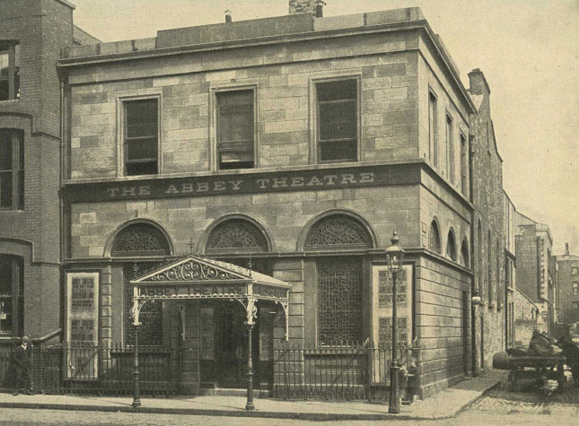
The Abbey Theatre
When all the writers started to get together, meeting at various times at gatherings hosted by Lady Gregory at Coole Park, the conversation inevitably moved on from what they were working on, to where it might be staged. While all the writers had conceived and began producing a national literature for Ireland, they had a problem. No national theatre. It was Yeats and Lady Gregory who really drove the idea of a national theatre along. Initially the idea of a national theatre was delivered at various venues, and the most important fact was the performance of plays with an Irish character. In 1904, six years after its initial foundation, the national theatre idea found a permanent home at the Abbey Theatre. The original structure was destroyed in a fire in the 1940s, and the current theatre opened in 1966.
The first play that was performed under the auspices of a national theatre was Yeats's play The Countess Cathleen, which was problematic. The problem was that the play featured Cathleen preparing to sell her soul to the devil to feed the starving Irish (remember, this is only a few decades after the famine). While good theatre, the idea that the good Catholic Irish would ever consider selling their soul was abhorrent, and the critics had a field day. But like any art form, controversy is good news. The work that was staged by the national theatre movement was mostly high quality and met a need within people to engage with Irish-inspired plays. The Irish Literary Theatre, as it was called, went from strength to strength.
The plays that were staged mixed those in English with others in Irish, such as Hyde's The Twisting of the Rope. It also constantly dealt with the thorny issue of the Irish nation. There had been one in the ancient myths and tales, so could there be one in the future? Yeats certainly thought so. His landmark play, Cathleen ni Houlihan, focused on an old woman who represented Ireland. She talked to her audience of those who have assisted her in the past, and might die for her in the future. It struck a chord with the public, and was a very popular play.
The Irish Literary Theatre was renamed the Abbey Theatre in 1904. For the quality and range of work that has been produced there, it is one of the most important places in Irish history. While it was important for allowing the writers of the Cultural Revival a place to stage their work, it also gave them the means to communicate their ideas with the public. It wasn't always a place of consensus, and there were regular controversies over the works that were performed. But that in itself was a sign of its success. It showed that the public was engaging with the debates that were being put forward.
The National Style
There were three very broad categories of Irish art that emerged in the late 19th and early 20th centuries that defined the national style. They were:
- Paintings of the landscape.
- Depictions of peasant people and their lives.
- Sculptures and paintings of the great historic and contemporary figures in Irish life.
All this work often came together in exhibitions that were explicitly designed to showcase Irish art, and was also driven by the teaching at Dublin's Municipal School of Art. From there a group of artists emerged, tight-knit like their literary counterparts, who explicitly set out to create a national art.
Hugh Lane And His Collection
All this art was all very well, but in the same way that the writers needed a theatre, so the artists needed a national gallery. There had actually been a national gallery in Dublin for ages, but it was traditional. It displayed the great art of Europe, and had little inclination to embrace Irish art. What the artists needed was someone who wished to embrace their project, and understood the need for a gallery and a collection that was avowedly Irish in content and intent.
Sir Hugh Lane was an art dealer and collector who became interested in Ireland and the Cultural Revival through his aunt, Lady Gregory. He commissioned Irish artists such as Jack Yeats to undertake commissions, and worked closely with others in the Cultural Revival movement to open an art gallery for Irish art. He finally achieved this goal in 1906 when the Dublin Municipal Gallery opened. He gave lots of his own collection to the gallery, and convinced many others to do the same. The gallery was quickly established as one of the most important in Ireland.
Lane also offered to leave the Gallery his collection of French paintings, the so-called Lane bequest, on the condition that a permanent gallery was built to house them. Dublin Corporation (the city's political structure) failed to do this, and the paintings went instead to the National Gallery in London. This was a cause of great controversy, as these Irish works were now in the possession of the colonizers.
Lane died in 1914, traveling on the Lusitania when it was torpedoed by the Germans off the coast of Cork. The issue of the Lane bequest became a source of disagreement between London and Dublin, and didn't get resolved until 1959. It was agreed that the paintings would be shown alternatively between the two cities. The Lane Gallery is still open in Dublin, and contains, as it was supposed to, a great collection of national art.
Rumors had it that Lane was traveling with paintings by Monet, Rembrandt, Rubens, and Titian on board the Lusitania. These were supposedly insured for £4 million. But there are questions about whether or not these paintings were on board when the Lusitania was sunk. The wreck site—about 12 miles off the southern coast of Ireland—is now protected as a national monument, but those who have seen the wreck claim to have seen sealed tubes within the wreckage that might contain the pictures.
Preserving Irish Nationalism
Many historians have argued that the Cultural Revival bridged the gap between the fall of Parnell and the rise of Redmond. For a decade Irish nationalism was without a strong leader and lacked political cohesion. Into the void stepped the Cultural Revivalists. They ensured that the Irish people, when lacking political leadership, remained active and engaged with the idea of what it was to be Irish.
The main reasons why the Revival has to be seen as important are:
- It allowed for the creation of sporting, literary, and theatrical forms that were, by definition, Irish.
- The revival stemmed the flow of British forms of culture into Ireland.
- By playing games, reading books, attending the theatre, or using the language, the Revival allowed people to think of themselves as Irish.
- Although not explicitly political in its aims, the work of the Revival linked the promotion of an indigenous culture with the aspiration for an independent Ireland.
The various movements associated with the Revival spurred on many Irish men and women to become activists. Many of the leading figures of the revolutionary period cut their teeth in the organizations such as the Gaelic League and the Gaelic Athletic Association.
The simple question in relation to the cultural revival is, did it work? Clearly the Gaelic League and the Gaelic Athletic Association did have successes. The cultural revival attracted mass memberships, and in both the cultural and sporting arenas their work in the late 19th century laid the foundations for a vibrant Irish culture that still exists today. However the clock couldn't be turned back. While the Irish language was preserved it never replaced English as the main vernacular of the Irish people. The influence of Britain was simply too great. Alongside a burgeoning native culture, the Irish continued to be affected by the media, arts, and sports of its near neighbor. But what the later decades of the 19th century had shown was that Ireland could be Irish. This might seem an obvious statement, but an important one. By making people think of themselves as Irish, and treasure their language and heritage, the Cultural Revival ensured that people didn't become British. Ireland would remain distinct, and not simply a geographic unit of Britain which, in its habits, was no different to London or Manchester. For all its success, the Cultural Revival didn't convince everyone. Many people simply went about their daily lives and remained untouched by everything that was happening. Many unionists and Protestants understood that the Revival was challenging their values, and so ignored it, preferring instead to play cricket, watch plays written by English writers, and dismiss the Irish peasant as backwards rather than noble.
Home Rule

In 1898 huge celebrations were held across Ireland to mark the centenary of Wolfe Tone's rebellion. These events brought together various strands of nationalism in Irish life, and allowed for a very public display of the enthusiasm for an independent Ireland. At the turn of the century there was a renewed interest in the idea of Irish nationalism. The nationalist spirit had never gone away, but because of the split following the fall of Parnell, its voice and focus had been lost. The 1898 celebrations encouraged people to begin voicing their demands for independence.
In this atmosphere, the Home Rulers finally managed to put aside their arguments, and pulled themselves together. In the mid-1890s, William O'Brien had formed the United Irish Land League in Mayo. The League was brought together to fight for the rights of smallholders in the West of Ireland (and proved that no matter how far reaching the government land reforms, more was always needed). O'Brien also had another agenda. He understood that the land issue had always been central to Irish politics and a point of consensus and he aimed to use the League to bring the Home Rulers together around an old point of agreement.
In 1900 the League was formally integrated into the Home Rule party, and a popular dimension restored. No longer was Home Rule politics to be dominated by political infighting amongst its leaders — it had real work to do. Later the same year, John Redmond was elected to the Chair of a reunited party. By virtue of the League's popularity, and its ability to refocus everyone on the real issues, rather than the legacy of Parnell, the Home Rule movement came back together. The real question was whether the damage of the split would hamper it as a political force.
Although the Home Rulers had got back together, there was still a lot of bad blood. Not only did the party fail to forget all the animosity that surrounded the Parnell split, but during the period of division a host of strong and opinionated men had risen to the fore. Redmond's leadership of the party has been called by one historian, "at best, a balancing act." In many ways he was more like a juggler, trying to keep all the different demands and pressures in the air without dropping anything. One half of his party expected him to be aggressive, and to challenge the British government at every turn, while the other encouraged him to accept reforms such as the Land Purchase Act without criticism, and to consider them as positive actions. While the Conservatives were in office, and maintaining their hostility to any talk of Home Rule, there was little he could do anyway.
Redmond had a series of problems in trying to stamp his authority on the Home Rule movement:
- He believed in doing things the "right" way, or as a contemporary said of him, he had a "prejudice in favor of the truth that was almost English." As a result Redmond was committed to strictly parliamentary means for most of his career, and did not build the broader nationalist coalition that Parnell managed to bring together.
- Other main figures in the party, who had been active during the period of the Parnell split and perhaps imagined themselves as the leaders of the Home Rule Movement, such as James Dillon and William O'Brien, while accepting him as leader, spent a lot of time publicly criticizing him and offering alternative suggestions — not good for party cohesion.
- Although small in scale, a nationalist alternative, in the shape of Sinn Fein emerged in 1907 to challenge the Home Rule agenda. By 1918 they overtook the Home Rulers in terms of popular appeal.
While the Conservatives were in power, and trying to kill Home Rule with kindness, Redmond could only have a limited impact on politics at Westminster.
Redmond had to keep this difficult juggling act up for some time as he had no real power in Parliament until the election of 1910 when, despite their confidence, the Liberals only managed a two-seat majority. Suddenly Redmond was the king maker. He promised the Liberal leader, Asquith, his support in whatever he wanted, so long as an Irish Home Rule bill was brought before parliament. The problem Asquith faced, as had reformists in British history before him, was that the House of Lords didn't really appreciate reform, and had an annoying habit of blocking anything that they didn't like as they could hold bills back and sometimes veto them. Asquith decided to act. He went to the country in a second election in 1910 with this simple agenda: If elected, Asquith and the Liberals would curtail the powers of the House of Lords to veto bills from the Commons; instead, the Lords would only be able to delay a bill for two years. The electorate supported the Liberals and Asquith was able to convince the Lords that their day had passed.
Asquith and the Liberals were more interested in their own agenda than that of Home Rule. The House of Lords had rejected the Liberal Party's reforming budget in 1909, so the 1910 election had been fought on the issue of the powers of the Lords. Having won the popular vote (just), Asquith announced a plan to limit the powers of the House of Lords, threatening to create enough new pro-reform peers to swamp any opposition. The resulting Parliament Act, passed in August 1911, ended the Lords' veto over financial legislation passed by the House of Commons. This in turn paved the way for the passage of the Home Rule Bill through the Lords in 1912.
In 1912, and true to his word, Asquith placed a Home Rule bill before parliament. Redmond and the Home Rulers would get their reward. After much acrimony, vicious debate, and aggressive campaigning against the bill by unionists, the bill was passed in the Commons. The bill was unsuccessful in the Lords, but as they no longer had a veto, the bill would only be delayed for two years. Home Rule would become a reality on 18 September 1914. The Irish rejoiced. Many people thought that Redmond had delivered to Ireland what it had always wanted: Home Rule. But in the months before the outbreak of the First World War, the government watered down the proposals. Redmond was convinced that he should allow the six counties of Ulster with majority Protestant populations to be excluded from the Home Rule Act for six years. So while Redmond had won Ireland its independence, he quickly allowed parts of it to opt out because of the power of the unionists within British politics. Had Redmond achieved freedom for Ireland, or had he been outmaneuvered by a combination of unionist and British politicians? Some historians feel that Redmond had put too much trust in the British political system and was duped by more powerful forces, while others think that he got the best deal he could.

Nationalists v. Unionists
The Home Rule Bill, which created an independent Irish parliament, had been passed by the British parliament in 1912 and was due to be enacted in 1914. Under this bill, Ireland would have its own parliament, but certain big issues, such as foreign policy, would remain in the hands of the parliament in London. Ireland would also remain a full member of the British Empire. This was a form of self-government that worked wholly within the constitutional sphere, and did not create a separate Irish state that was in any way a Republic.
Constitutional nationalism, in the form of John Redmond's Irish Parliamentary Party, was not the only nationalist force in Ireland, however. Other nationalist forces, including such groups as Sinn Fein and the Irish Republican Brotherhood, existed outside of Parliament and pursued their own ends. In addition to the various nationalist groups were the unionists — those who opposed the idea of Home Rule altogether.
This crowded political landscape meant that the pressures on the custodians of constitutional politics were huge. If any concessions were made in the passage of the Home Rule Bill, or if the unionists took military action to prevent the enactment of Home Rule, then a welter of political, and armed, opposition would be unleashed. In short, Ireland was becoming increasingly restless and difficult to manage. And this situation was happening at the same time that German intentions in Europe were becoming increasingly troublesome.
The "Advanced" Nationalists
It was clear to many nationalists that the unionist population, those who wished Ireland to remain part of Britain, would not meekly accept Home Rule. Sinn Fein and other nationalist movements that existed outside of parliament understood this and readied themselves for action. The various groups, often referred to as advanced nationalists, and their agendas were as follows:
- Sinn Fein: Meaning "ourselves alone", Sinn Fein had been formed in 1907. Rather than accepting continued British involvement in Irish affairs and membership of the Empire, as would be enshrined in the Home Rule Bill, Sinn Fein argued for complete and total independence from Britain. Initially the party did not advocate the use of violence to achieve its aims. Sinn Fein was always a fringe political movement until after the Easter Rising of 1916, when it rose to electoral prominence.
- Irish Republican Brotherhood (IRB): The IRB was a secret movement advocating physical force for the purpose of creating an Irish Republic and drawing its inspiration from the Fenians of the 19th century. The IRB believed in the use of violence to attain its aims. While ideologically highly committed, at its height the IRB's could claim only around 2,000 members.
- The Irish Volunteers: Formed in 1913, the Volunteers were a direct response to the formation of Protestant paramilitary groups in Ulster that would oppose Home Rule by force. Their aim was to guarantee the rights and liberties of Irish people. By the outbreak of the First World War the estimated membership of the Volunteers was 180,000.
- The Irish Citizen Army (ICA): The ICA was formed in 1914 as a socialist worker's army. Although committed to the ultimate creation of a socialist state in Ireland, the ICA acknowledged that, without independence from Britain, the workers' republic it dreamt of could not be achieved.
- Cumann na mBan: Meaning the "Association of Women", Cumann na mBan emerged from the suffragette struggle. Its aim was to assist in the arming, equipping, and support of Irishmen in the defense of Ireland.
These advanced nationalists (with the exception of the Irish Volunteers) did not receive much support from the Irish population. However, they weren't completely without funds and resources. Many Irish-Americans believed vehemently in the complete rejection of British rule in Ireland, and were happy to fund movements dedicated to that goal. American money was used to support the political campaigns of the advanced nationalists, and from 1914, these funds were regularly used to secure arms and ammunition.
The Unionists and the Ulster Volunteer Force
Unionists were appalled by the idea of Home Rule for Ireland, and believed that their way of life, economic security, and their very safety was under threat from the idea of a nationalist and Catholic-dominated Ireland. In 1914 the Ulster Volunteer Force was formed by the Unionist leaders to defend the union by force if necessary. By 1915 the police estimated that the Force had over 100,000 members and could muster up to 53,000 rifles for combat.
Civil War Looms
As the date for the enactment of Home Rule came closer, it became clear that the Unionists would not meekly accept their fate. They would, through the Ulster Volunteer Force, fight against the creation of an independent Ireland. Ranged against the Unionists were the various nationalist groups above,who were also willing to take up arms to ensure that Home Rule did become a reality.
The mood in Ireland at the time was ominously reflected in two speeches in 1914. In January of that year, the Conservative Andrew Bonar Law made clear his belief that Ireland was "drifting inevitably to civil war" and that Home Rule would be resisted "by force if necessary." In July, the king acknowledged that "the cry of civil war is on the lips of the most responsible and sober minded of my people." Ireland was, in the summer of 1914, undoubtedly on the verge of a major conflict.
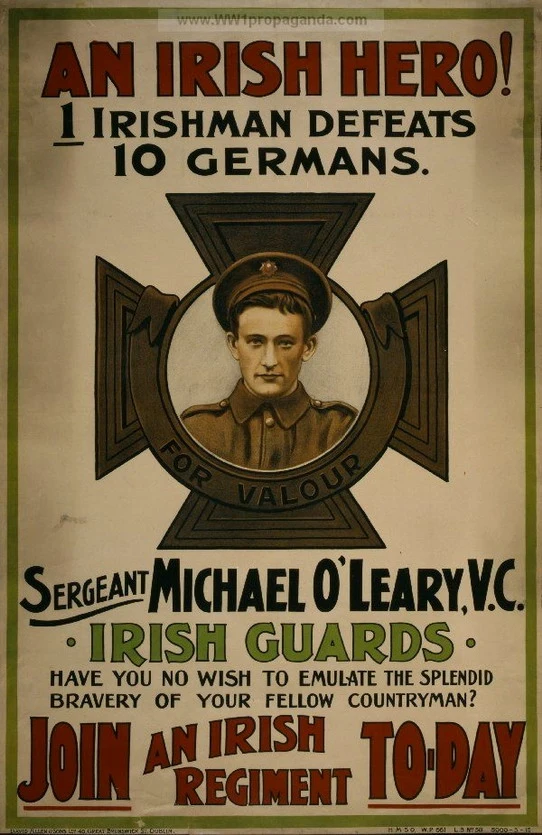
World War I
For Irish Nationalists at least, 1914 should have been a great year. The self-government they had so long dreamt of was due to be enacted in September, and they would finally have control over their own affairs. It was clear early on that Unionists would not stand idly by when the Bill was enacted. The forces of nationalism, particularly the Irish Volunteers, were prepared to take up arms against Unionist intransigence and would, in all likelihood, be supported by the forces of advanced nationalism who would use any struggle to promote their own agenda. But then, in August, one month shy of Home Rule being enacted, the Germans this great transition was pre-empted by Germany, and the whole thing was called off.
For the British the situation was a complete nightmare. As storm clouds gathered in Europe and a war against Germany became a possibility, they didn't know what would happen in Ireland. Would events there spiral out of control and undermine the war effort, or would the various groups in Ireland postpone their struggles for the greater good?
The arrival of WWI in the summer of 1914 shelved all the problematic permutations of what might happen in Ireland. There was a war to be fought in Europe, and everyone was briefly off the hook. In all likelihood the outbreak of the WWI prevented a potential civil war in Ireland between Unionists and Nationalists. The avoidance of such a struggle was desirable, but the events of WWI changed the political landscape in Ireland, and led to the ascendancy of radically minded and non-constitutional forces. If the World War had not happened, the British would have been forced to involve themselves in support of Home Rule as it had been drafted in 1912. The British declaration of war on Germany in August 1914 caused the Home Rule Bill to be suspended until the conflict was over.
While WWI postponed the Unionist/Nationalist fight in Ireland, there were various reactions to the conflict.
- The Unionists, who saw themselves as integral parts of Britain and Empire, fully supported the war effort. The Ulster Volunteer Force became the bedrock of the 36th (Ulster) Division as a unit in the British Army. The 36th were allowed to retain their distinctive Unionist identity, and their uniforms featured the recognizable insignia of Ulster.
- The Nationalists, led by Redmond, also threw their weight behind the war. Redmond argued that the war against Germany was a struggle for Ireland as much as it was for Britain, and that Nationalists should take part to defend their own freedoms. Although over 170,000 Volunteers entered the British army, they were not granted their own division in the same way as the Unionists.
- The Advanced Nationalists, led by Sinn Fein, opposed the war as an imperial struggle in which Ireland had no part. They called for Irish men to leave the Volunteers and join a new force, the Irish or Sinn Fein Volunteers, whose role would be to defend Ireland in the face of aggression from any nation. By 1915, only 11,000 men had answered that call.
Unlike the rest of Britain, Ireland, whether Unionist or Nationalist, was never subject to conscription of its men into the armed forces. This meant that all Irishmen who fought in the war, including the thousands that died, were volunteers. The British believed that enforcing conscription in Ireland would be too difficult. When the idea was discussed in Parliament in the spring of 1918, the Chief Secretary of Ireland informed the cabinet that they "might almost as well conscript Germans." Nevertheless, the British did attempt to force a draft in Ireland. This had severely negative consequences for the British, and directly contributed to the rise of Sinn Fein.
Ireland suffered greatly during the war. As a rough estimate some 35,000 of the 140,000 men who volunteered to fight were killed. For the Unionists the sacrifice was most marked on the first day of the Battle of the Somme when the 36th (Ulster) Division went into action. Their numbers were decimated by the Germans, and the sacrifice is annually marked in Ulster on July 1 each year.

The Easter Rebellion
While everyone's attention was turned to the battles against Germany the advanced nationalists began plotting. A long-held belief in the nationalist tradition was that England's difficulty was Ireland's opportunity. What could be more difficult than a World War? So in 1915 the IRB began plotting a rebellion against the British. The plan was for a nationwide rebellion by the IRB forces which would lead, in turn, to a popular uprising. The date was set for Easter Sunday 1916.
Sir Roger Casement was enlisted to gather arms and support for the Rising from Irish allies — who better in a time of War than the Germans who had their own reasons for destabilizing Britain by supporting havoc in Ireland? The Germans donated 20,000 rifles and ammunition to the cause. On Good Friday 1916 Casement was delivered to the coast of Kerry by submarine and awaited the delivery of the weapons from the German ship, the Aud. The rebellion was under way.
The British became aware of a strange German ship off the coast of Ireland, and attempted to intercept the Aud. Its captain, rather than be caught with his cargo, scuttled the ship. The rebellion had suffered its first, and maybe fatal, blow. Despite attempts to call off the rebellion in face of the loss, the decision was made by IRB leaders, such as Patrick Pearse, to go ahead with it on Easter Monday.
While the citizens of Dublin enjoyed a public holiday and many members of the British forces were at Fairyhouse races, the rebels, a combination of IRB and Irish Citizen Army members, captured, or rather walked into, key buildings across Dublin and declared a Republic in the name of the Irish people. The British were slow to react, but once they did their answer was swift and brutal. Within a week the rebellion was crushed, much of central Dublin was destroyed and 500 from both sides killed. All the leaders were arrested, and 14 were executed, including the seven who had signed their names on the Proclamation.
The insurgents of 1916 were led by the IRB, a secret organization. The British had no clear-cut image of who was leading the Rebellion, and in the aftermath the press began referring to the event as the Sinn Fein Rising. Although this led to many Sinn Fein members and other nationalists being arrested in the wake of the Rebellion, whether involved or not, it fixed the party at the forefront of the public mind as the leaders.
The Proclamation of the Republic
Although the Rebellion failed, the reading of the Proclamation outside the General Post Office was one of its most important moments. Read by Patrick Pearse, the newly appointed President of the Republic, to a small and probably bemused crowd of people, the Proclamation defined the nature of the Irish Republic and gave future nationalists an ideological blueprint. It declared the "Irish Republic as a Sovereign Independent State," promised universal suffrage and guaranteed civil and religious liberty for all. The Proclamation also acknowledged the assistance of Ireland's "gallant allies in Europe" — the Germans — and ensured that everyone involved was guilty of treason.

The Fallout
The Rebellion changed everything. Although the insurgents gained little support during Easter week, the executions and the introduction of martial law to Ireland, the constant sacrifices on the Western front, and the lack of movement on the issue of Home Rule turned the public towards the spirit of revolution. The executions of the leaders of the Rebellion also created martyrs for the Irish nationalist cause, as did the imprisonment, in British prison camps, of some 3,000 Irish people. Sinn Fein moved quickly to capitalize on the situation and in 1917 fought and won its first parliamentary by-election. Support for Sinn Fein mushroomed. By October 1917 the party had 1,300 clubs across the country with a membership of some 250,000.
What happened next:
- Sinn Fein kept winning by-elections.
- Eamon de Valera, the only surviving commander of the 1916 Rebellion, became President of Sinn Fein.
- In March 1918, John Redmond died and the constitutional Irish Parliamentary party was left in tatters.
- The British passed, but never enforced, a Conscription Act for Ireland in April 1918. It was opposed by Sinn Fein, the constitutional nationalists, and the Catholic Church.
- In May 1918 all Sinn Fein leaders were arrested for treasonable activity, and organizations such as the Gaelic League and Cumann na mBan were banned.
- The First World War ended, and in the 1918 General Election Sinn Fein won 73 of the 105 Irish seats.
Ireland had been transformed. From the heady days of the passing of the Home Rule Bill in 1912, the Irish had been through a Rebellion and a World War that radicalized the situation and left Sinn Fein in the ascendancy.
The War of Independence
With Sinn Fein in power and the Home Rule Bill dead, what would happen next? The unionists were still opposed to any agreement that took them away from Britain, and the British government was just as vehemently opposed to the demands of Sinn Fein for an Irish Republic that had been proclaimed during the Easter Rebellion. For its part, Sinn Fein refused to attend Westminster, as it did not recognize British rule, and it established its own parliament, Dail Eireann, in Dublin. It organized ministries and courts, raised funds, and declared the Irish Republican Army (IRA) as the defenders of the self-proclaimed state.
Sinn Fein wanted to create the Republic that had been proclaimed in 1916. Clearly neither the British nor the unionists would accept this. A war seemed inevitable. The Irish wanted their freedom, but the arguments of unionists to remain British were equally powerful. Also Britain had to think about its authority across the Empire: If it was seen to be weak in Ireland would it risk rebellion in India or South Africa?
In January 1919 two members of the Royal Irish Constabulary (the Irish police force) were shot dead by members of the IRA. The War of Independence had begun. The struggle between Britain and Ireland would last until the summer of 1921. It was a brutal war between the forces of the British Army and some 3,000 young men and women of the IRA who used guerrilla tactics and were organized as highly mobile flying columns. The catalogue of the war is full of tales of daring and heroic operations, but also willful murder and terrible cruelty on both sides.
The Combatants
The War of Independence was mainly concentrated in the southern half of Ireland. The War had little impact in Ulster, although unionists were deeply suspicious of the nationalist communities and several attacks took place. The War was effectively a struggle between the British and the forces of Irish Republicanism with the unionists remaining on the sidelines. The British government constantly argued that it was fighting a rebellious mob and that there was no popular support for the IRA or the War. While not a mass popular movement, it is clear that Sinn Fein, and by proxy the policy of fighting the British, did have popular support. Without the assistance of the Irish public, the Irish Republican forces could not have been as effective as they were.
The IRA, the IRB, and Michael Collins
While the IRA fought the War across Ireland, the IRB, which had been rebuilt and reorganized by Michael Collins after 1916, was instrumental in undermining the British security and intelligence system in Ireland. Collins was a brilliant strategist and effectively made Ireland ungovernable. It was a War that the British could never win, but then neither could the Irish Republican forces.
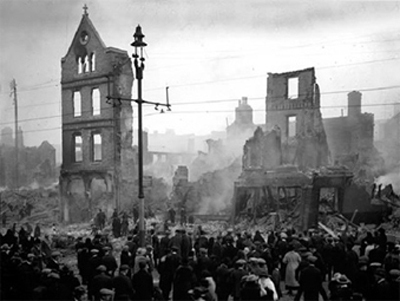
The Black and Tans
The most controversial aspect of the War of Independence was the decision to introduce an additional force to Ireland to supplement the Royal Irish Constabulary. Known as the Black and Tans because of the color of their uniforms, the force of 8,000 men was recruited mainly from ex-servicemen. They were a ruthless force who sought to defeat the Irish Republican forces and also terrorize the Irish population. The arrival of the Black and Tans in Ireland brought a sickening new dimension to the War. Each attack or killing by Irish forces was met by a Black and Tan assault on people and property. House burnings, murder, rape, and assault became the weapons of the Black and Tans, and they sought to convince the Irish public that support for the Irish cause was untenable.
The Black and Tans were responsible for some of the most notorious killings of the War. In March 1920 they murdered the Lord Mayor of Cork in front of his family, and in November that year they killed a young Catholic priest, Michael Griffin, in Galway after luring him from his home on a bogus sick call. In December 1920 they also played a part in the wholesale burning of large parts of Cork city center in response to the killing of eighteen members of British forces by the IRA at Kilmichael.
Truce — Part I: A divided Ireland
In 1920 the British sought to end the conflict by offering Home Rule parliaments to both Dublin and Belfast. Belfast accepted. The 1920 Government of Ireland Act created a separate parliament in Belfast that would govern over the six counties of Northern Ireland. For unionists this allowed them to remain part of the United Kingdom and the Empire, while also having control of its own affairs. Dublin, however, in the form of Dail Eireann, refused.
With these events, the British granted the unionists their own parliament in Belfast and created a six county Northern Ireland. Although the Irish aspiration was a 32 county Republic, the Government of Ireland Act had already created a divided Ireland. In any negotiations, a united Ireland was unlikely to return to the agenda because of unionist opposition to the idea. In all probability the Irish would have to settle for less than they had fought for.
Truce — Part II
By the spring of 1921 the War of Independence was getting ever more bitter, with more death and destruction. By July 1921, 1,400 people had been killed (624 British military personnel, 552 IRA members, and 200 civilians) and much of the Irish infrastructure was damaged (key buildings such as the Custom House, which was attacked in 1921, took a decade to be rebuilt). Yet neither side was making any headway.
The Irish had to make a decision: continue fighting the war with little chance of outright victory and ever depleting resources, or enter negotiations with the British and try to secure the Republic through negotiation. They chose the latter. When the British Prime Minister offered the Irish another truce in July 1921, work began on finding a permanent solution for Ireland. Preliminary discussions took place during the summer, and the official peace conference began in October. The Irish were represented at the peace negotiations by five men who carried the authority to act on behalf of Dail Eireann. Although key figures such as Michael Collins and Arthur Griffith were included, de Valera chose to stay in Dublin. The negotiations lasted until December, and the Irish delegation kept Dublin constantly informed on their progress. The main themes of discussion were:
- What the future relationship of an independent Ireland would be to the British Crown and Commonwealth.
- The question of partition and the future of Northern Ireland.
- The right of Britain to retain certain navy ports in Ireland to protect its security needs.
David Lloyd George, Prime Minister, and the British negotiators refused to move on the issue of partition, and Northern Ireland was left out of the agreement. The Treaty that was signed on 6 December 1921 created a new nation, the Irish Free State, which comprised the 26 southern and western counties of Ireland. The new state remained a member of the Commonwealth in line with the Canadian model of dominion status. All members of the new state's parliament would also have to swear an oath of allegiance to the British Crown. To seal the agreement it had to be ratified by the British and Irish parliaments. In Britain that posed no problems, but in Ireland, war clouds gathered. Again.
Civil War and a Free Ireland
Dail Eireann debated the Treaty during December 1921 and early January 1922. It was a rancorous and bitter debate. While Collins argued that the Treaty was the best deal possible, giving Ireland the freedom to achieve freedom and all that it had wished for over seven hundred years, De Valera argued that Ireland had fought the war to create a republic, and anything less was untenable. And so the Dail split, as did the country and even many families. De Valera led the anti-Treaty side with Collins and Griffith leading the pro-Treaty side. The Dail voted on 7 January, 64 in favor of ratifying the Treaty, 57 against.
On 28 June, 1922 the Irish Civil War began. Collins now led the forces of the Irish Free State and had all the machinery of government at his command. The anti-Treaty forces fought the War in the same way the Irish had fought against the British. Fighting was largely restricted to the south-west of the country.
The losses during the War were highly damaging to the future of Ireland:
- In August 1922 Arthur Griffith died of a heart attack, and days later Michael Collins was killed in an ambush. Ireland was left without the future leadership skills of two of the political heavyweights who had signed the Treaty and argued in favor of accepting it.
- To ensure order in the country the state forces introduced military courts with wide powers. Between September 1922 and April 1923, 77 anti-Treaty personnel were executed. These executions left a bitter legacy and opened the pro-Treaty forces to accusations of cruelty.
- By the end of the War 12,000 anti-Treatyites were in prison, 800 Free State troops had been killed, and possibly as many as 5,000 of their opponents. The cost of the war was terrible and demonstrated starkly how bitter the divisions of Civil War were. All these wounds would have to be healed in future decades.
The War ended in April 1923 when de Valera ordered his forces to end the fighting. The Free State forces had won the day, and an independent Ireland had come into being. Freedom had been won at a terrible price, and many believed that a partitioned Ireland that belonged to the Commonwealth wasn't even free.
The Free State: 1920s-1930s
One of the great joys of having a new country is that you get to do things your way. For the government of the Irish Free State, they had the opportunity of making a new state. They could develop it as they wished, and let the whole world know what it would mean to be Irish in the new Free State.
First, they had to make decisions on everything involved in running a country: what form of government they would have, whether their police force would be armed or unarmed, what the national anthem would be, what kind of currency they'd use, and so on. If that wasn't enough, because of the Civil War, not everyone in Ireland actually agreed with the idea of the Free State, and so controlling that faction became an issue, too. Also, there was the Protestant minority that remained. Many of them remained in the civil service jobs they had previously occupied, landowners stayed on their estates, and the Protestant working class communities of Dublin and Cork carried on in their old jobs.
The first party to govern the newly independent Ireland came from the pro-Treaty side of the Civil War. They organized themselves under the name Cumann na nGaedhal ("the League of the Gaels"), and were led by W.T. Cosgrave. The opposition from the Civil War period, Sinn Fein, refused to recognize the legitimacy of the new Free State and abstained from parliament. (Many of its leading members were still in prison anyway because of their part in the Civil War.) Effectively, Cumann na nGaedheal ran a one party state, and could get on with the business of government without worrying about a sizeable parliamentary opposition.
Cumann na nGaedheal stayed in office from 1922 to 1932. In that decade they organized the mechanisms of government, law and order, and finance that are essential to any nation. Their main acts were:
- Produced the first national constitution in 1922.
- Worked within the terms of the Treaty of 1921 and established good working relationships with Britain and the Commonwealth.
- Established a functioning civil and legal service (admittedly based on the British model), and an unarmed police force, the Garda Síochána.
- Designed postage stamps and a currency for the Irish Free State, and successfully created an identity for the new nation.
Britain was watching what the Irish were doing very carefully. The Irish Free State was one of the first countries (since the Americans) who dared to challenge the British and go their own way. The British were aware of their commitments to Northern Ireland, and didn't want to see the Free State become an unsettled nation. How Ireland coped with independence would set precedents for other nations in the Empire. The British wanted everything to go smoothly.
While state building was a great adventure for the Irish, the reality was far more complex. Not only did they have an internal group, those in Sinn Fein, who disagreed with the very concept of the Free State, but they also had the perceived legacy of centuries of British rule to deal with. And of course the border issue and the very presence of Northern Ireland in what they considered their country.
Creating An Independent Irish Identity
At the beginning the leaders of the Free State engaged in many symbolic acts. For a start they painted all the postboxes green. Now that doesn't sound like a big deal, but it was hugely important. It announced to everyone who lived in the Free State that they no longer posted their letters into red British postboxes that would be processed by the Royal Mail. Instead they put their letters into green, Irish postboxes, and their letters would be dealt with by the postal service of the Free State.
In the same vein the Free State began issuing its first postage stamps, and introduced its own coinage and bank-notes. Strangely the coinage, although featuring depictions of Irish animals, was actually designed by an Englishman.
Landmark buildings in Dublin that had been destroyed during the 1916 Rising, the War of Independence, and the Civil War were rebuilt. By the late 1920s the Post Office, Custom House, and Four Courts had all been rebuilt and were open for business again.
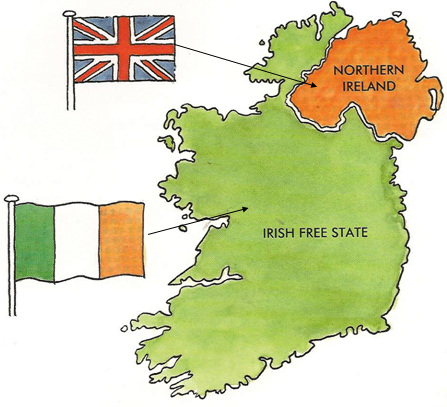
Unfinished Business: The Legacy of Partition
In the arguments over the Treaty that created the Irish Free State, Michael Collins acknowledged that it wasn't the 32-county Republic that people had fought for during the revolution. He argued that the Treaty, and the Free State it gave birth to, allowed Ireland "the freedom to achieve freedom." In other words, one of the great hopes for those who had supported the signing of the Treaty between Britain and Ireland was that partition wouldn't be permanent; that is, that some day, Ireland would be reunited. Article 12 of the Treaty had paved the way for a boundary commission to sit, and the Irish hoped that this would change the border in their favor.
The boundary commission finally came together in 1925. In the years between the signing of the Treaty and the boundary commission sitting, unionists had become increasingly hostile to the idea. Rather than take part in a body that they believed intended to shrink Northern Ireland, the unionists refused to send a representative.
In the event, the boundary commission suggested that the border be shortened by 51 miles, and some 31,319 people would end up as citizens of the Free State as a result. The news was leaked to the press, a political crisis followed, and in the end nothing was done. Rather than adjust the border, and risk upsetting everyone, the representatives of Northern Ireland, the Free State, and the British government agreed it would be simpler to leave things alone. They all signed an agreement that Article 12 should be forgotten, and the border should remain fixed as it had been drawn up in 1920.
So, for all of Michael Collins' "freedom to achieve freedom," the border wasn't up for redrawing. The partition remained a contentious issue, and politicians in the Free State were happy to use it as a propaganda tool. In real terms however, there was never any suggestion after 1925 that the border could be changed.
Building the Free Irish State: 1930s
The Cumann na nGaedheal government of the Irish Free State spent their first decade in office establishing the workings of the state. They had clear successes, and achieved great acclaim for their vision with projects such as the Shannon Dam. Their real problem was the resentment that lingered after the Civil War.
Sinn Fein had refused to accept the Treaty and had fought against it during the Civil War. They had refused to enter parliament, and worked against Cumann na nGaedheal. By the mid-1920s the government was sick of this kind of opposition from outside parliament and demanded that Sinn Fein take their seats in the Dail.
The history of the first government in the 1920s has been quite contentious. Some historians applaud Cumann na nGaedheal, and argue that they made the best of a difficult situation. They managed to put all the major institutions of state in place, and avoided a renewed flare up of the Civil War. Others argue that the government wasn't aggressive enough, that it worked too closely with the British and didn't create a stridently independent Ireland.
One issue of contention was whether Cumann na nGaedheal failed to deliver on the promises of the revolution. Rather than creating a socialist Republic, as suggested in the 1916 proclamation of an Irish Republic, the government of the 1920s was, by its own admission, the most conservative bunch of revolutionaries ever.
Enter the Fianna Fail
The leader of Sinn Fein, Eamon de Valera, decided he had to act. In 1926 he set up a new party, Fianna Fail ("Soldiers of Destiny"). Shortly afterwards they entered the Dail, and genuine two-party politics began in the Free State.
Fianna Fail and Cumann na nGaedheal weren't simply two parties who disagreed with each other in the way of normal politics. Both parties had emerged directly from opposing sides in the Civil War. They deeply distrusted each other. People in each party blamed their opponents for deaths in the Civil War, and remained ideologically opposed to each other over the workings of the Treaty. Throughout the late 1920s and early 1930s there were regular rumors that elected officials were entering the Dail carrying firearms as they were convinced that their personal safety was under threat from the other side.
Despite having opposed the Treaty and staying out of parliament during the early years of the Free State, de Valera and his Fianna Fail party were very popular among those who had opposed the Treaty and the working classes.
There was a belief that Cumann na nGaedheal were only acting in the interests of big farmers and landowners. By the time of the 1932 election Fianna Fail were able to win by a minority and form a government.
Given the bitterness between the two parties, it has often been argued that Cumann na nGaedheal would fail to recognize the election result, and would choose to stay in office through the use of force. Instead, they adhered to the rules of democracy and allowed their former Civil War enemies to take power, less than a decade after the ending of that war. Most historians acknowledge that Cumann na nGaedheal acted selflessly in accepting the popular vote and allowing their erstwhile enemies into office. In doing so they stabilized Irish democracy at a time when it could have easily fallen back into a state of war.
Whereas the Free State of Cumann na nGaedheal had operated under the terms of the Treaty, and had co-operated with Britain and its Commonwealth, the agenda of de Valera and Fianna Fail was far more radical. De Valera had a very particular vision for Ireland.
On St Patrick's Day 1943, in one of his most famous and most quoted speeches, de Valera said:
That Ireland which we dreamed of would be the home of a people who valued material wealth only as a basis for right living, of a people who were satisfied with frugal comfort and devoted their leisure to the things of the spirit — a land whose countryside would be bright with cosy homesteads, whose fields and villages would be joyous with sounds of industry, with the romping of sturdy children, the contests of athletic youths and the laughter of happy maidens.
The speech summed up what de Valera wanted, essentially a self-sufficient, rural, and Catholic Ireland. His vision was radically different than that of Cumann na nGaedheal, which had wanted to work within the terms of the Treaty and follow economic orthodoxy. It was popular though, as he stayed in office from 1932 until 1948.

The Free State under de Valera
Once in office de Valera acted quickly. He passed a whole load of legislation aimed at turning back the clock on the Treaty and turning the Irish Free State into the kind of country that he envisaged. He secured a full majority in an election in 1933, and this ensured that he was in office, with a majority, until well after the Second World War.
His main achievements in the 1930s were:
- Abolition of the Oath of Allegiance: This meant that members of the Dail no longer had to swear allegiance to the British Crown.
- Getting rid of the post of Governor-General: This post had been a contentious, albeit symbolic part of the Treaty. The Governor-General had originally been able, in principle, to reserve or deny royal assent to any Dail legislation. By abolishing the post, de Valera meant that all lawmaking power was fully in the hands of the Irish.
- Return of the Treaty ports: In 1922 it had been agreed that Britain needed to retain control of certain coastal ports in Ireland to protect itself. In 1938 de Valera convinced the British that they no longer needed them, and they were all returned to Ireland.
- Debt cancellation: The Treaty had made the Free State liable for a whole series of monies that were owed to Britain. De Valera disagreed, and after fighting a tariff war with Britain in the 1930s, he secured a scaling down of the debt to a one-off payment of £10 million.
What de Valera did effectively, and very controversially, was to rewrite the terms of the Treaty — or at least those parts he objected to. This gave the Free State a greater degree of freedom and control over its own affairs. He didn't withdraw from the Commonwealth however: that step wouldn't be taken until 1948.
The Treaty ports are the best illustration of how de Valera was able to relinquish the hold that Britain had on the Irish state. By getting the ports back in 1938 he ensured that there was no British army or navy presence within the Free State. Most historians argue that this is why Ireland was able to be neutral during the Second World War. If the Treaty ports had still been occupied by British forces they would have been a justifiable target for the Germans.
As it was, Ireland could claim neutrality and there was no reason for the Germans to attack.
Fighting Over The Beef
When de Valera took office in 1932, he had some hard battles ahead of him before he could create the kind of Ireland he wanted. His goal was to free Ireland from its commitments to Britain that had been agreed in 1921. One of de Valera's biggest gripes was the amount of money that the Free State was supposed to pay Britain every year. The British had argued that the purchase of land, by the Irish, in the late 19th and earlier 20th centuries, had been done with money borrowed from London. In the 1920s the Irish government had collected the money from farmers in the form of land annuities, and this money had been passed over to the British.
De Valera thought it was ridiculous that Irish farmers should pay money to Britain for Irish land. So he stopped paying. The British retaliated by placing import duties on a whole raft of Irish goods, especially agricultural imports. De Valera, never one to back down, retaliated by putting import duties on British products. The economic war had begun.
The economic war would last until 1938 when it was finally resolved by a one-off payment from Ireland to Britain to settle the debt. In the meantime the Irish economy suffered. It couldn't replace the British export market, and so the national income dropped. De Valera took cows that couldn't be exported from the big farmers (who voted Cumann na nGaedheal anyway) and distributed the meat to his own supporters for free.
While free beef was great for Fianna Fail voters, de Valera's actions in the early 1930s demonstrated how he mishandled the economy and brought about strong opposition from his detractors which would take shape as the Blueshirt movement.
The battles of the Civil War had only been over for a decade when de Valera took power. While anything he did was bound to create opposition from those who had fought against him in the Civil War, he had to act without destabilizing the country. He had to use much of the machinery of the new state — the legal system, the police force, and the army — that he had previously detested to ensure that he stayed in power.
Reaction to de Valera: The Blueshirts
Many people were deeply suspicious of de Valera and Fianna Fail. They worried that the new government would use their power to settle old scores.
Many believed that a simple parliamentary opposition in the form of Cumann na nGaedheal wouldn't be up to the job of stopping de Valera. So in the early 1930s, a new organization, the Army Comrades Association, was formed. The organization wanted to protect the rights of ex-army officers who feared that their pensions would be under threat from the new government that it had fought against a decade earlier. They decided, in line with similar movements in Europe at the time, to wear a colored shirt as a uniform. Ireland now had the Blueshirts.
One of de Valera's first acts in power was to dismiss the head of police, General Eoin O'Duffy, as he didn't trust him. The sacking of O'Duffy proved to de Valera's opponents that he couldn't be trusted to act fairly. O'Duffy became a martyr for the anti-de Valera movement, and he was asked to head the Blueshirts.
O'Duffy would take the Blueshirts deeper into the world of European fascism. He adopted various fascist ways of thinking about politics and the economy (such as plans for a corporate state and a restricted electorate) that he borrowed from the Italian Duce, Mussolini, and began acting like a dictator at the head of his movement. He even convinced Cumann na nGaedheal that he was the future. The party disbanded, and reformed, with the Blueshirts at their side as a new party: Fine Gael.
The battles between the Blueshirts and the government became increasingly violent. Blueshirts died in political clashes, and it looked for a time as if the whole situation would turn into civil war again. De Valera held firm and used the full weight of the law against the Blueshirts. By 1935 the movement was in disarray, and O'Duffy quit. By 1936 the Blueshirts were history.
Once O'Duffy was gone and the Blueshirts stood down, Fine Gael continued as the main parliamentary opposition. They formed the government on several occasions in the second half of the 20th century. Although completely committed to parliamentary democracy, Fine Gael's roots have never been forgotten, and they are still regularly referred to in the Irish media as the Blueshirt party.
A New Ireland and a New Constitution
Having got through the first few years in office, and seen off the opposition, de Valera turned to enacting his real dream for Ireland. The greatest step towards a more concrete sense of independence came in 1937. De Valera didn't like the constitution that had been created in 1922, so he decided to write his own. The new constitution — Bunreacht na hÉireann — which is still in force today - contained the following key points:
- The title "Irish Free State" replaced with "Eire".
- The recognition that the island of Ireland (all 32 counties) was a natural territorial unit, and Northern Ireland an artificial creation.
- The British Governor-General to be replaced by a new head of state, the President of Ireland.
- Recognition of the special place of Catholicism in the state.
- Irish recognized, along with English, as the official language of the state.
The constitution brought to life the kind of Ireland that de Valera had fought for during the revolutionary years (see chapter 21), but had not been delivered by the 1921 Treaty with Britain. The constitution was very inward looking and concerned with the internal state of Ireland rather than its place in the contemporary world. De Valera had long argued that Ireland should be self-sufficient and the spirit of the constitution, and the handling of the economy, ensured that the country stagnated until the 1960s. Until the 1960s the Irish economy failed to develop a strong industrial base or entice inward investment into the country. Emigration numbers remained high, and the rate of modernization low.
The 1930s saw the Free State slowly remove itself from its legal obligations to Britain that had been established under the 1921 Treaty. Ireland really came into its own as an independent nation, and was a key member of the League of Nations during the 1930s. De Valera even became President of the Assembly of the League of Nations in 1938 and was involved in many of the discussions that tried to avert World War II.
The Troubles: 1960s-1970s
The roots of Northern Ireland's conflict became apparent in the 1950s and 1960s. These were:
- An economic downturn in traditional industries such as shipbuilding weakened the Protestant community's sense of security.
- A belief grew amongst the Catholic community that they were being discriminated against by the unionist government controlling the Stormont parliament.
- Protestants became suspicious that the Catholic population was seeking to take over by promoting a united Ireland with the subsequent domination of the Catholic religion.
- A rising educated Catholic middle-class demanded reform of a political and social system that discriminated against them.
- Concern grew within the British government and civil service that Northern Ireland was a state lacking modernization and equality.
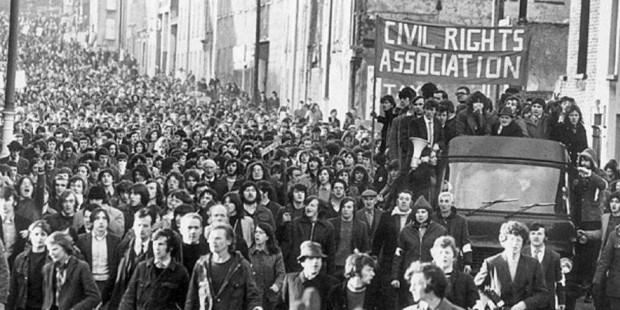
Then, in 1968, the Northern Ireland Civil Rights Association (NICRA) was formed. It was a movement that demanded equal rights for Catholics in Northern Ireland, and its appearance marked the beginning of a mass movement that would galvanize politics and lead to a series of street demonstrations that gave birth to 30 years of violence
NICRA and other civil rights organizations (e.g., the Campaign for Social Justice) argued that Northern Ireland was a discriminatory state that only served the interests of the Protestant community. Despite attempts at reform by the unionist Prime Minister Terence O'Neill, there was a feeling of too little, too late
NICRA made a number of demands to make Northern Ireland a fairer society for everyone to live in. These were to:
- Defend the basic freedoms of all citizens including access to housing, jobs, and welfare.
- Protect the religious and political rights of the individuals.
- Highlight all abuses of power.
- Guarantee freedom of speech, assembly, and association.
- Inform the public of their lawful rights.
NICRA's initial demands related specifically to equality for the Catholic population. They were not attempting to destroy or undermine Northern Ireland and break the relationship with Britain.
The Violent Response
NICRA took to the streets in a series of public marches to promote their cause. These marches met with counter-demonstrations from Protestant and unionist groups that often turned violent. Fearing an escalation in street violence, the Stormont government banned NICRA marches
In 1968 and 1969 Northern Ireland spiraled towards violence. A civil rights movement that sought social, rather than explicitly political, changes that would threaten the territorial status of Northern Ireland, had been met with a violent response from a Protestant and unionist community who feared their motivations. Riots, arson attacks, and physical assaults became common
The police force was stretched, and did not have the support of the Catholic community. The difficult question was how the situation could be brought under control.
Troops — British Occupation
On August 12, 1969 a traditional Apprentice Boys parade took place in Derry. Such parades were seen as inflammatory by the Catholic community not because they celebrated the victory of Protestant King William over Catholic King James in the 17th century, but because the marchers insisted on parading through the only areas of the city where Catholics were allowed to live. Imagine a parade of Nazis through Jerusalem, or a parade of white supremacists through Watts. The parade led to intense rioting, and an escalation of sectarian violence in Derry and across Northern Ireland that the police could not contain. In an attempt to restore order the decision was taken, on 15 August 1969, to send British troops onto the streets of Northern Ireland
Initially, both Protestants and Catholics welcomed the troops because:
- The police force, the Royal Ulster Constabulary (RUC) was exhausted and could no longer contain the situation
- There existed a belief amongst the Catholic population that the RUC was no longer a neutral force, as many of its members were also members of Protestant paramilitary organizations.
- Acts of violence were not restricted to street rioting, but were taking on a sectarian dimension. Many Catholics and Protestants were burnt out of their homes by arsonists from the opposing side.
- It was felt, especially amongst Catholics, that the troops would protect Catholics from Protestant rioters, and that they would be politically neutral as they did their job.
The troops did initially calm the situation and violence reduced in intensity for a while. The political situation did not stabilize however. The voice of nationalism became stronger, and their demands for reform louder, with the formation of the Social Democratic and Labour Party (SDLP). At the same time the ruling unionist government began to fracture. While some in the party argued for further social and political reforms that would produce a fairer society, others clung to their belief that unionists had a right to rule Northern Ireland without reference to the Catholic minority.
Violence returned to the streets in 1970 and 1971, and the troops quickly lost the support they had initially received from the Catholic community. Rather than appearing as their protectors, they were rapidly transformed into another force that was seen as enforcing unionist rule.
The Paramilitary Forces
During this period paramilitary forces came into being that would make the violence in Northern Ireland more organized and focused. Both communities developed paramilitary movements. These were:
- The Provisional Irish Republican Army (Provisional IRA, or The Provos). Formed in 1970 after splitting from the Official IRA, the Provisional IRA emerged from the streets of Northern Ireland specifically to defend the Catholic community from attack.
- The Ulster Volunteer Force (UVF). Formed in 1966, they were sworn to defend Northern Ireland's relationship with Britain in the face of Catholic demands for change.
- The Ulster Defence Association (UDA). A more public force than the UVF, with similar aims, the UDA claimed 40,000 members by 1972.
Internment of Catholics
August 1971 witnessed a further upsurge of violence across Northern Ireland. In Derry four days of rioting culminated in two men being shot by the army. The government at Stormont decided to act to calm the situation, and decided that if they took known troublemakers off the streets, the situation would be calmed. On August 9, 1971 the army arrested 342 men, and the process of internment without trial began. Rather than producing calm, internment only inflamed the situation. Those arrested were all from Catholic communities, and the use of the army to arrest suspects reinforced the perception that they were a far from neutral force
The response to internment was swift and violent. Rioting erupted across Northern Ireland, and in three days 22 people were killed, and 7,000 driven from their homes by sectarian acts of arson. The government at Stormont seemed to have completely lost control. With the failure of government and widespread violence on the streets, more young people, on both sides, were convinced that the only way they could secure their future was by joining and supporting the paramilitaries.
Bloody Sunday
The civil rights movement campaigned against internment, which they considered another example of injustice in Northern Ireland. In January 1972 a march was organized in Derry to protest against the ongoing policy of internment. The march was well-attended and was supposed to be a peaceful gathering.
As such protests had often led to rioting, the march was heavily policed by the British army, including the paratroop regiment that was brought to Derry from Belfast for the day. The march ended in terrible bloodshed. The army claimed that they had come under attack from Provisional IRA snipers, and had only returned fire. The marchers contended that the Paratroopers had fired without provocation on unarmed demonstrators. In the event the Paratroopers fired 108 rounds of live ammunition into the crowd, and by the end of the day 13 unarmed protestors were dead
Bloody Sunday is seen as one of the key events in the history of Northern Ireland, and one of the most contested. Although an initial investigation, the Widgery report, found the army blameless, many argued that they were guilty of firing without provocation. The story of what happened on that day was regularly revisited. The pressure to discover conclusively what had happened led to the creation of the Saville Inquiry by the British government in 1998.
The Saville Inquiry
The Saville Inquiry was designed to supercede the Widgery report, and address the charges of whitewashing which accompanied that earlier report. The inquiry took the form of a tribunal established under the Tribunals of Inquiry (Evidence) Act 1921, and consisted of Lord Saville, the former Chief Justice of New Brunswick William L. Hoyt and John L. Toohey, a former Justice of the High Court of Australia.
The results were published on 15 June 2010. British Prime Minister David Cameron addressed the House of Commons that afternoon where he acknowledged, among other things, that the paratroopers had fired the first shot, had fired on fleeing unarmed civilians, and shot and killed one man who was already wounded. He then apologised on behalf of the British Government.
Cameron described what British soldiers had done as "both unjustified and unjustifiable, it was wrong". He acknowledged that all those who died were unarmed when they were killed by British soldiers and that a British soldier had fired the first shot at civilians. He also said that this was not a premeditated action, though "there was no point in trying to soften or equivocate" as "what happened should never, ever have happened."
These findings, and the public reaction by Cameron, finally gave voice to what had been obvious from the day of the incident, and openly communicated in British government circles for decades. The following 1992 statement from John Major, writing to John Hume, participates in that vein:
The Government made clear in 1974 that those who were killed on "Bloody Sunday" should be regarded as innocent of any allegation that they were shot whilst handling firearms or explosives. I hope that the families of those who died will accept that assurance.
Direct Rule From London — Again
The killings on Bloody Sunday led to another upsurge in violence and a rapid growth in support for the Provisional IRA. The British government realized that they could no longer support the Stormont government in Northern Ireland. Despite some attempts at reform since the late 1960s, the situation had spiraled out of control, and the two communities were more divided than ever. The decision was taken in March 1972 to suspend the government of Northern Ireland and govern directly from London.
The IRA Attacks
In the late 1960s and early 1970s many in the Catholic community in Northern Ireland became completely dissatisfied with the state of affairs there. They felt economically and socially discriminated against and did not believe that the unionist government at Stormont represented their interests. While many supported the initiative of the civil rights movement and nationalist political parties such as the SDLP, the situation did not improve. They felt under attack from loyalist paramilitaries, and had lost faith in the ability of either the RUC or the army to protect them. Instead, many felt that events such as Bloody Sunday simply illustrated the fact that the forces of the state were being used against them.
In such a situation they looked for someone that would protect their interests. In seeking to defend themselves and take action against their attackers, many turned to the Provisional IRA as a force that could serve their interests. The Provisional IRA offered:
- Protection from attacks by loyalist paramilitary and security forces.
- A vehicle for disenfranchised and disillusioned young men and women to take action against their attackers.
- Political arguments linking the problems in Northern Ireland with the unfinished business of 1922.
- A belief that Northern Ireland could not be reformed internally, and that only the creation of a reunited 32-county Ireland could give the Catholic community safety and prosperity.
Initially the Provisional IRA was concerned with the defense of the Catholic community, but as the months passed by, they developed a strategy of bombing economic targets in order to destabilize British rule in Northern Ireland.
While this was an effective strategy, 1971 witnessed another change in direction. On February 6, 1971 Gunner Harris became the first regular solider to be killed by the Provisional IRA. The list of legitimate targets was widened to include members of the British Army, and the officers of the RUC.
No Winners
In the 1970s and 1980s killings and bombings were a regular feature of life in Northern Ireland. The forces of the state, the Army and the RUC, had to contend with sustained and organized violence from Republican forces, the Provisional IRA, and a range of different Loyalist paramilitary organizations. But what did these different groups want and what did they hope to achieve?
- The Provisional IRA believed that a violent struggle would eventually force the British to decide that they should leave Northern Ireland, and that a 32-county Republic would be created as a result.
- The various loyalist paramilitaries were dedicated to the protection of Northern Ireland and its sovereign relationship with Britain. They argued that the use of violence was justified to support the state and to attack its enemies in the Provisional IRA.
- The British worked on the principle that they had to protect the democratic will of the majority in Northern Ireland, namely the unionist population, who wanted to remain as part of Britain. They used the full force of their political, security, and legal systems to try and achieve this.
All these different aims were clearly contradictory, and the upshot was a situation where various people were killed by the different sides in the conflict. Between 1969 and 1989, 2,761 people were killed as a result of the conflict in Northern Ireland. Of these:
- 623 were killed by loyalist paramilitaries, namely Catholic civilians (72 %), Protestant civilians (18 %), other loyalist paramilitaries (5 %), republican paramilitaries (3 %), and members of the security forces (2 %).
- 1,593 were killed by republican paramilitaries, namely members of the security forces (53 %), Protestant civilians (25 %), Catholic civilians (12 %), other republican paramilitaries (9 %), and loyalist paramilitaries (1 %).
- An estimated 150 were killed by members of the security forces.
In an attempt to control the violence the British introduced the Prevention of Terrorism Act in 1974, which allowed suspects to be detained without access to legal representation, and authorized the elite SAS to operate in Northern Ireland against Republicans. By December 31 2001 the number of deaths attributed to the Northern Ireland troubles had risen to 3,523, and over 40,000 have been injured.
Clearly such rates of deaths, and the associated high level of injuries, were a tragedy for Northern Ireland. Such levels of violence meant that Northern Ireland ceased to be a normal democratic society. All aspects of life, from housing, education, and sport, through to business development, employment, and culture were all affected. It was clear that the situation could not go unchecked. But by the end of the 1970s, all attempts at finding a political solution to the troubles had failed. No one would concede their core demands, and an embrace of violence appeared more effective than searching for peace.
Stalemate
By the late 1970s the Northern Ireland conflict appeared to many observers to be an intractable problem. While strategies had been used by the British to try and reduce the levels of violence (higher security force numbers on the street, the Prevention of Terrorism Act, and better use of intelligence information) they could not make the paramilitaries disappear. There was also an acknowledgment within British government and military circles that they could never defeat the paramilitaries. If a solution was to be found it would have to be a political one. But how could this be managed when the demands of the nationalists and republicans for self-government and Britain's withdrawal were in complete contrast to the demands of the majority unionist population of Northern Ireland who wanted to remain part of Britain? It appeared at the end of the 1970s as if a point of stalemate had been reached, and there was no alternative to an ongoing sectarian conflict.
The Troubles: 1980s-1990s
The 1980s would see a new upsurge in violence. Events would lead to intense periods of rioting, and for the first time, the numbers killed by loyalist paramilitaries would outstrip the figures of those killed by republicans. The Provisional IRA's campaign of bombing, in Northern Ireland and beyond, would lead to ever larger scale bombs and sustained attacks on the economic infrastructure of Britain. Despite all this, the 1980s witnessed political developments that would sow the seeds of the 1990s peace process.
The Hunger Strikes

In the early 1970s the British government withdrew special category status from paramilitary prisoners which, until then, had meant that they were not subject to prison rules that applied to ordinary criminals. The paramilitaries, especially the republicans, objected to this. They claimed they were not criminals but prisoners of war and deserved to be treated differently while in prison. Their demands were:
- The right to wear their own clothes
- No prison work
- Freedom of association with other prisoners
- Extra recreational facilities
- More letters and parcels
In 1978 republican prisoners refused to wear prison clothes and began wearing only their bed blankets by way of protest. They complained that because of this protest they were regularly attacked by prison staff, and they intensified their campaign. They refused to leave their cells, wash, or use the toilet facilities. This campaign, the dirty protest, led the prisoners to live in cells covered with their own excreta and other waste. Despite the campaign, and the sympathy that their plight earned, the government was unmoved. In March 1981 the dirty protest was transformed into a hunger strike.
A group of prisoners began refusing food. As the condition of each prisoner deteriorated, new prisoners would also begin fasting. On May 5, 1981, the first hunger striker, Bobby Sands, died. His funeral was attended by 100,000 people, and the British government was criticized across the world for having done nothing to end the dispute.
Shortly after Bobby Sands began his protest, Frank Maguire, an MP in Northern Ireland died. Sands, although fasting in prison, stood in the ensuing election, and won the seat. The first hunger striker to die was then not merely a protestor, but a member of the British parliament.
Although Bobby Sands was elected specifically on the prison protest issue, his victory demonstrated to the republican movement that it could win elections. Sinn Fein had always refused to fight in British parliamentary elections. However, if they could win, as Sands had demonstrated, it would make their demands more legitimate as they would have popular electoral support. Through elections, Sinn Fein understood that it could gain a popular mandate for its policies. From the 1980s Sinn Fein fought, and was successful in, a host of national and local elections.
The response to the hunger strikes in Northern Ireland was violent. In the period of the protest 61 people died in violent incidents. Thirty members of the security forces were killed by the Provisional IRA, and seven civilians were killed by plastic bullets that the security forces fired into the crowds during rioting.
By the time the hunger strikes were called off in October 1981, ten hunger strikers had starved themselves to death.
Bombing Britain
The Provisional IRA conducted a long war in Northern Ireland against those they considered their enemies on the ground. They understood, however, that such attacks, as they became a daily incident, did not grab the headlines in Britain. If they were to succeed in driving the British out, they had to make the people of Britain question why their government supported the rights of the unionist majority. To do this, the Provisional IRA developed a strategy that was designed to sicken the British people into questioning the government. The policy never worked, but it led to a series of spectacular and devastating attacks on Britain, including:
- 1974: An attack on a coach carrying army personnel in Scotland kills twelve. Pubs in Guildford and Birmingham kill 24 people. The famous London shop Harrods is also bombed, but no one is killed.
- 1976: A Provisional IRA bomb kills the newly-appointed British ambassador to the Irish Republic.
- 1979: The first cousin of the Queen, Earl Mountbatten, is killed while on holiday off the Irish coast. On the same day 18 British soldiers are killed in Newry.
- 1982: The Household Cavalry is targeted as it undertakes ceremonial duties in Hyde Park, London. 2 cavalrymen and 7 horses are killed.
- 1983: Harrods is again targeted and 6 people are killed during the Christmas shopping period.
- 1984: The Conservative party conference in Brighton is attacked, and 5 killed. Prime Minister Margaret Thatcher escapes.
- 1989: In an attack on the base of the Royal Marine band at Deal, in Kent, 10 bandsmen are killed.
- 1992: The City of London is targeted. 3 are killed, and leading financial institutions are destroyed.
- 1993: Bombs planted in garbage cans in Warrington explode, killing 2 children.
- 1996: Major attacks on economic targets in Manchester and London's docklands destroy shops and offices.
The use of violence in pursuit of political and ideological goals is always a difficult and emotive issue. While in no way did the Provisional IRA tactics lead them to winning their struggle and driving the British out of Northern Ireland, the high and sustained levels of violence kept the situation in the public spotlight, and brought about political talks aimed at a lasting and peaceful settlement to the problems of all communities in Northern Ireland.
American Involvement
As so many Americans claimed Irish roots, the ongoing struggle in Northern Ireland was of great interest to many of them. While physically detached from the conflict on the streets of Northern Ireland, many of them felt that the IRA was fighting a justifiable struggle that would finally expel the British from the island of Ireland.
The largest single group in Northern Ireland that supported the nationalist cause was NORAID (Irish Northern Aid), which was founded in 1971. Its stated aim was to provide humanitarian assistance to political prisoners and their families, although many in the unionist community have argued that it directly funded the activities of the IRA.
At the political level the Northern Ireland conflict has been a constant feature of life in Washington. Democrats with Irish ties, such as Edward Kennedy and Tip O'Neill, worked to keep Northern Ireland on the American political agenda. Under the Presidency of Bill Clinton (1993--2001) Northern Ireland, and the associated peace process, became a major government initiative, and Clinton was a key element in driving the process forward.
The Political Players
By the start of the 1990s there was a growing feeling in Northern Ireland that some form of resolution to the troubles had to be found. The difficulty was to find some way in which the demands of the different groups could be reconciled. The main political parties involved were:
- SDLP: The main nationalist party, led by John Hume, who believed that a constitutional resolution was the best way forward. They also argued that the Irish Republic had to be included in any solution.
- Sinn Fein: The leading republican party, Sinn Fein had close ties with the IRA. Led by Gerry Adams, Sinn Fein argued that the British should leave Northern Ireland.
- Ulster Unionist Party (UUP): Led by David Trimble, the UUP believed that Northern Ireland should be part of Britain and that the rights of the unionist majority should be respected. However, they also understood that some resolution was required, and that nationalists and republicans who renounced violence should be involved in the governance of Northern Ireland. Until 2005, the UUP was the largest unionist party.
- Democratic Unionist Party (DUP): The DUP has always argued that Northern Ireland is part of Britain and that position is non-negotiable. Led by Ian Paisley, the DUP has consistently argued against Sinn Fein's inclusion in government until the IRA has been disbanded. The DUP has recently become the largest unionist party in Northern Ireland.
Peace Comes Dropping Slow
In 1993, John Hume and Gerry Adams began talks to try and see if they could jump-start some form of peace process. They issued a series of statements aimed at getting all the other parties to join in and start a debate. The British and Irish governments tried to assist the fledgling peace process with a number of joint agreements. The rapid progress of twists and turns in the road to peace included:
- The Downing Street Declaration, 1993. It stated that Britain no longer had any selfish interest in Northern Ireland, but would protect the will of the majority. The Irish Republic recognized that any Irish self-determination had to have the consent of the majority of the population, including unionists. Both nations committed themselves to peaceful means and the ending of paramilitary violence
- The IRA ceasefire, announced August 1994, and reciprocated by loyalist paramilitaries two months later.
- The Joint Framework document, February 1995. Signed by the British and Irish governments, established a program for the creation of new cross-border institutions and a new government for Northern Ireland.
- November 1995 saw a visit by President Clinton to Northern Ireland to bolster the peace process, and the direct involvement of Senator George Mitchell as head of an international body to oversee decommissioning of paramilitary weapons.
- By January 1996 the IRA believed that the process was stalling and that Sinn Fein were being denied entry to talks. They ended their ceasefire and major explosions were detonated in London.
- During 1996 talks continued between the two governments and the major parties in Northern Ireland. The DUP refused to attend, and Sinn Fein were excluded because of their close links with the IRA.
- In May 1997, Tony Blair was elected Prime Minister in Britain, and immediately authorized talks with Sinn Fein to see how they could be brought into the peace process.
- The IRA announced, in July 1997, the resumption of their ceasefire.
The road to peace in the 1990s was long and hard. The difficulty was to get all the parties involved, and to resolve the issue of the paramilitaries and how they could be turned away from violence. The decommissioning of IRA weapons, and whether this should take place before any talks, was a stumbling block. Also, the refusal of the DUP to join any talks meant that there was a vocal opposition to the process.
Getting Everyone To Talk
In the summer of 1997 all party talks on the future of Northern Ireland began. The DUP still stayed away, but Sinn Fein took their place at the table for the first time. To bypass the tricky topic of decommissioning, an Independent International Commission on Decommissioning was formed that would oversee the destruction of weapons by the paramilitary forces.
The talks were tense, and various parties very uneasy about progress. At various times parties with paramilitary associations, such as Sinn Fein, were excluded for a period of weeks because of renewed acts of violence. To instil confidence in the whole process bodies such as the Parades Commission were established to judge on the routes of contentious marches in Northern Ireland, and in January 1998, Tony Blair announced a new investigation into the events of Bloody Sunday (The Saville Inquiry).
By April 1998 things had reached crisis point. There was a deadline of April 9 for an agreement, and it was unclear for several hours that a deal could be done. On April 10, 1998, Good Friday, it was announced that the Belfast Agreement had been signed. It was endorsed by the majority of Northern Ireland's political parties, and promised a bright new future for everyone.
The Good Friday Accord
The Belfast Agreement created the following mechanisms to allow Northern Ireland to move away from its troubled history:
- A Northern Ireland Assembly with legislative powers.
- Power sharing formula that would allow the main parties to nominate ministers.
- A North-South Ministerial Council that allowed for cross-border cooperation.
- Release of all paramilitary prisoners from organizations observing the ceasefire.
- A two-year target for paramilitary decommissioning.
- Reform of the Royal Ulster Constabulary.
- The demilitarization of British army bases in Northern Ireland.
Drumcree and the Parades Issue
Orange Order parades are a long-standing feature of life in Northern Ireland, but have always been contentious. Many Catholics have objected to the parades passing through their neighborhoods and the sectarian supremacy that they associate with such displays. One of the most contentious parades during the years of the peace process was that at Drumcree. The Catholic residents of the Garvaghy Road objected to its passing through their neighborhood, and staged a sit-down protest to block the parade in 1995. The standoff lasted three days and led to riots across Northern Ireland. In 1996 the parade was initially ordered to be rerouted, but was sent down the Garvaghy Road after a standoff between Orangemen and troops. The parade has remained contentious ever since, although since 1998 its route has been changed by the Parades Commission. Four Catholic deaths in the surrounding area were attributed to loyalist paramilitaries supporting the Orange Order stand between 1995 and 1998.
The Agreement initially got off to a great start when it was ratified by large majorities in referenda that were held in Northern Ireland and the Irish Republic. Since then however the deal has been plagued with problems. Although there have been acts of IRA decommissioning, these have not been enough to satisfy unionist critics. On September 26, 2005, the IRA announced that it had decommissioned all its arms.
The police force was reformed, and the Police Service of Northern Ireland brought into being in 2001. However, the new force has failed to gain the support of many nationalists and criticisms remain in some quarters that policing in Northern Ireland is still not serving both sides of the community.
The Assembly has sat at various times, but has now spent more months in a state of collapse than it has sitting. With a steady polarization of politics between Sinn Fein and the DUP, a division that was reinforced in the 2005 British general election, the successful implementation of the agreement looks a long way off. Since becoming the largest unionist party, the DUP has constantly argued that the whole agreement should be renegotiated. The Assembly has been suspended on several occasions, the longest suspension being from October 14, 2002 until May 7, 2007, a period of over four and a half years. When the Assembly was suspended, its powers reverted to the Northern Ireland Office. Following talks that resulted in the St Andrews Agreement being accepted in November 2006, an election to the Assembly was held on March 7, 2007 and full power was restored to the devolved institutions on May 8, 2007.
Decommissioning The Provos
One of the main aims of the whole peace process was to remove the paramilitaries from the streets. It was argued that while such organizations, whether republican or loyalist, existed there could be no development of a peaceful democratic society.
Nobel Prizes
The Troubles in Northern Ireland have led directly to the awarding of two separate Nobel Peace Prizes. The first was awarded in 1977 to Betty Williams and Mairead Corrigan, the founders of the Northern Ireland Peace movement. They had come together in response to the death of Corrigan's niece and nephews. They were killed when a car driven by a member of the Provisional IRA was shot dead by the Army, and the car ran into them. The women staged a series of rallies across Ireland and Britain demanding peace in Northern Ireland. The second award was made in 1998 to John Hume of the SDLP and David Trimble of the Ulster Unionist Party for their role in the peace talks that led to the signing of the Belfast Agreement (which is also often referred to as the Good Friday Agreement; the day on which it was signed).
It is clear that many involved in the different paramilitary organizations have embraced the peace process and do want to create a peaceful Northern Ireland. However, there is much suspicion. Many people, on either side, are wary of the motives of the paramilitaries as they moved into the political sphere. While the number of deaths, bombings, and attacks has reduced significantly, there is a feeling that the work of the paramilitaries is ongoing. Both sides have engaged in punishment beatings, and there is a constant suspicion that some have been involved in criminal activity.
The IRA made a major move on the decommissioning front in October 2003 and began putting weapons beyond use, but this was not the complete end to the armed struggle that unionists wished to see. In July 2005, the IRA formally announced the end of its armed campaign, and stated that it would pursue exclusively peaceful means. While Gerry Adams called the move a "courageous and confident initiative" and Tony Blair said it was a "step of unparalleled magnitude," the unionists were less convinced. They stated that they would not allow entry of Sinn Fein into government and the restoration of government in Northern Ireland until they had seen evidence of complete decommissioning.
The Impact of 9/11
The attacks on America in 2001 had a profound effect on the politics of Northern Ireland. Whereas the IRA had found some support in the United States for their struggle, the announcement of a worldwide war on terror after 9/11 altered the status of the IRA. In August 2001 three Irishmen were arrested in Colombia on suspicion of training the Revolutionary Armed Forces of the country's Marxist rebels. Although originally acquitted, the Irishmen were found guilty after an appeal court reversed the earlier verdict. While on bail, the men fled Colombia, and re-entered the Irish Republic in 2005. In the context of American foreign policy after 9/11 the Colombian-Irish link was troubling. The Irishmen were identified as either Sinn Fein or IRA members and, if the charges were true, their presence in Colombia represented part of the American defined network of terror. The changing global politics after 9/11 have meant that the IRA is viewed with suspicion in America, and there has been great pressure on the IRA to move quickly into the political arena.
The Celtic Tiger & Beyond
For most of its existence, the Irish Republic had been a relatively poor, undermodernized nation. Although joining the European Union in 1973 bolstered its economy, the 1980s saw another period of downturn and high levels of emigration. In the 1980s the Irish unemployment rate was 18%. In the 1990s the Irish Republic underwent a staggering period of economic growth and became one of the fastest growing economies in Europe.
In 1994 economist and broadcaster David McWilliams, drew analogies between the situation in Ireland and what had happened in countries such as Hong Kong and South Korea a decade earlier, and coined the phrase, "the Celtic Tiger." This shorthand way of describing the boom in Ireland became a popular term for summing up what was happening in the country.
Along with the economic modernization, Ireland also underwent many social changes. For the first time since the Great Famine, emigration stopped. People began turning away from the Church, and began demanding more liberal attitudes towards divorce and abortion. With higher disposable incomes, the Irish also became big consumers, and city centers, especially Dublin, were transformed by the opening of an endless array of restaurants, bars, and nightclubs.
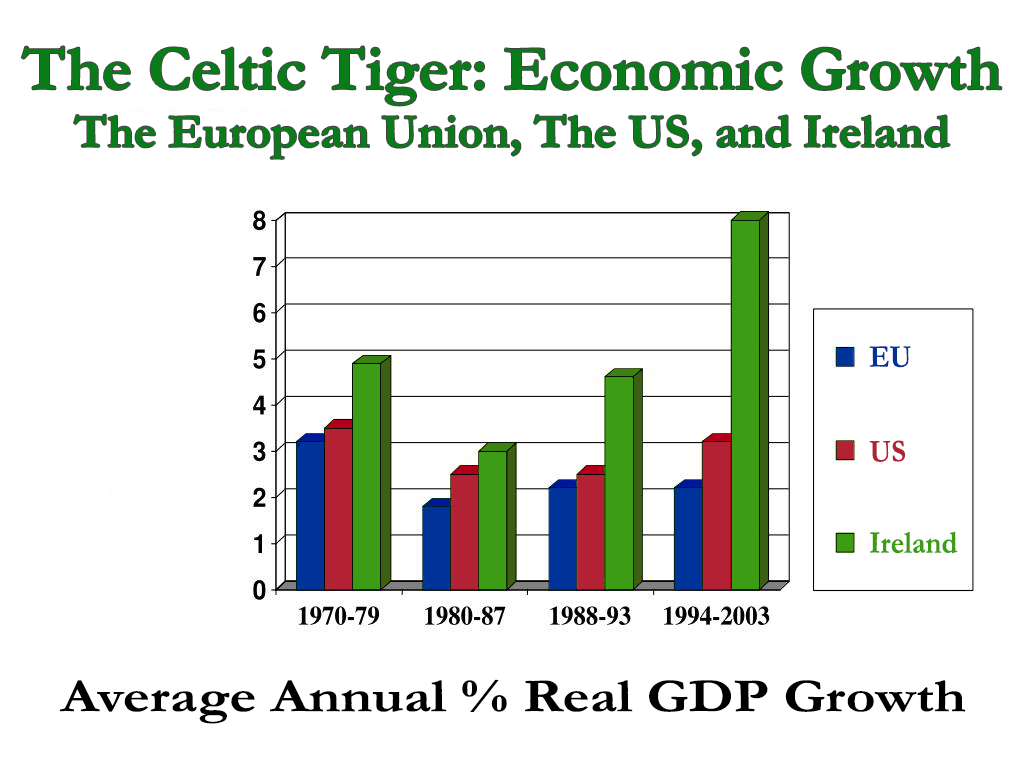
Ireland Gets Rich
Between 1991 and 2003, Ireland's economy grew by an amazing 6.8% per year, and Irish living standards became amongst the highest in Europe.
Ireland got rich by having a very low corporate tax rate, and by encouraging a whole series of multinational companies to locate in the country. Ireland was particularly successful in attracting high technology companies, and was one of the biggest producers of computers in Europe. It also helped that Irish workers were relatively cheap to employ, but very highly skilled.
The success soon became apparent, and then the boom became a bubble. During the 1990s the property market soared, consumer spending boomed, and by 2005 unemployment was a mere 4.2%. As the government was careful to use its new-found wealth to cut public debt, it was also able to invest money in major renewal projects such as the Luas tramway system in Dublin. But low interest rates and reckless lending, abetted by dozy regulation, pushed up land values and caused Ireland to turn into a nation of property developers. Between 2006 and 2009 in County Leitrim, housing construction outstripped demand (based on population growth) by 401%, according to one estimate.
Few minded. The Irish became, by one measure, the second-richest people in the European Union. "The boom is getting boomier," said Bertie Ahern, Ireland's Taoiseach (prime minister), in 2006. The government began exporting the Celtic Tiger model, telling other small countries that they, too, could enjoy double-digit growth rates if they followed Ireland's lead. People splashed out on foreign holidays, new cars and expensive meals. "We behaved like a poor person who had won the lottery," said Nikki Evans, a businesswoman.
A Popular Place
While the Irish are famous for having emigrated to the four corners of the world, with the advent of the Celtic Tiger, large numbers of immigrants began arriving in Ireland.
The new Ireland looked attractive to outsiders. When the country opened itself to new EU members after the 2004 eastward expansion, Poles and others poured in looking for work. Immigrants from African and Eastern European nations sought to benefit from the wealth of the country. Rather than resenting the newcomers, many Irish were proud that their country had become a place people wanted to enter rather than leave. "The country was welcoming, open, easy-going," says Monika Sapielak, a Pole who began to visit in 2001 and now runs a contemporary-arts centre in Dublin. "There was a sense that anything was possible."
While there were many positive aspects to this inward movement of people, there was also a rise in racism among many sectors of the Irish population.
The Myths Of Success
While many people in Ireland got rich during this period, there were still areas of high social deprivation in the country. Poverty and unemployment, along with high crime rates and drug use, persisted in many Dublin city suburbs. Government programs attempted to equalize the spread of wealth throughout the country, but it was clear that not everyone benefited from the Celtic Tiger.
Nor did everyone welcome the changes that prosperity brought. Kevin Barry, a writer who had been living abroad, returned home to find that "people only spoke about two things: property prices and commuting times. It was extremely boring." Business owners complained that some of their younger staff acquired a sense of entitlement which made them hard to motivate.
As Ireland grew richer, one form of exceptionalism — the fatalistic belief that Ireland was destined always to be western Europe's poor outpost — gave way to another: the myth of the Celtic Tiger. "We're very narcissistic," says Ms Enright. "We believed our boom was better than anyone else's." The twin articles of independent Ireland's faith, Catholicism and nationalism, were eclipsed by material ambition: the desire to get on, to improve one's station in life. The Abbot of Glenstal Abbey (near Limerick), bemoaned, "People lost interest in the other world while they were so successful in this one."
Death of the Tiger
Property prices started sliding in 2006-07, leaving Irish banks hopelessly exposed. Morgan Kelly, an economist at University College, Dublin, and one of the few observers who predicted the crash, said, "What happened in Ireland was very boring. There were no complex derivatives or shadow banking systems. This was a good old 19th-century, or even 17th-century, banking collapse."
When the 2008 banking collapse shook the entire world economy, Ireland was not in a position to survive it. As the share prices of Irish banks were in free fall, the Irish givernment took the fateful decision to guarantee liabilities worth €400 billion ($572 billion) at six financial institutions. But losses grew, and in 2010 Ireland became the second country in the euro zone to accept a bail-out from the EU and the IMF.

The first casualty of the downturn was Fianna Fail, the political party that presided over the "boomier" years and, in coalition with the Greens, the subsequent crash. In the 2012 general election, voters booted the party out in favor of Fine Gael and the Labour Party.
"I can't tell you how depressing it is here now," said the novelist Anne Enright at the time. Unemployment shot up to 13.4%, wages fell, and the economy was still flatlining. David Begg, general secretary of the Irish Congress of Trade Unions, said, "It's very demoralizing that this thing has happened when we thought we had arrived at a modern industrialised society."
Political Problems
As a small country, Ireland is a hard place to hide in. There were plenty of stories about disgraced bankers being hounded out of pubs by burned investors, or Fianna Fail candidates having dogs set on them. While it might be part of Irish culture to allow citizens to vent their anger directly rather than take to the streets, it also makes Irish politics so very local. National candidates tout achievements that in other countries would be considered the domain of local councillors. This goes along with a proportional voting system that forces candidates of the same party to compete for votes, turning elections into intensely personal contests. "If you're not seen to be helping your constituents, you will not be re-elected," said Martin Ferris, Sinn Fein TD (member of parliament) for Kerry North.
But this focus on the local means ambitious types do not want to spend their careers promising to fill in potholes and deliver passports, so they avoid politics. Moreover, the endless focus on local issues distracts from the business of running the country.
The radical transformation of Ireland into a globalized economy left some old attitudes untouched. Voters continued to tolerate levels of misbehavior and, in some cases, outright corruption in their politicians that in other countries would have ended careers. Cronyism flourished, as businessmen, politicians and bankers sealed themselves off in a cosy world of golf matches, fine dining and the Fianna Fail tent at the Galway races.
Fond, But Not In Love
When Ireland had to negotiate a bail-out from the EU, the Irish Times ran a lachrymose editorial asking if this was what the national heroes of the 1916 Easter Rising had died for. Outsiders saw this as a sign of resentment from a proud nation that was once again having its affairs run by foreigners. Yet the editorial went on: "The true ignominy . . . is that we ourselves have squandered [our sovereignty]." Having seen their leaders make such a mess of things, most Irish welcomed the arrival of technocrats.
Still, one long-term effect of this crisis was a cooling of Ireland's love affair with the EU. When the country joined what was then the European Economic Community in 1973, children danced in the streets. Agricultural subsidies and infrastructure funding flooded in from Brussels. Equal membership in a club of nations was a seal of sovereignty. Ireland was certainly more positive about the EU than most other members. But the Irish began to suspect that the "solidarity" they heard so much about from European leaders didn't apply to their troubled economy.
Ireland was not about to adopt the Euroscepticism that ruled Britain, but it did become more pragmatic. The Irish government fought hard for permission to impose bank losses on creditors , rather than continue to force taxpayers to eat those losses. Damian Loscher of Ipsos MRBI, a market-research agency, noted that "The attitude has shifted from 'We want to be part of Europe' to 'We need to be part of Europe.'"
The New Emigration
There was a growing fear that a number of young people would not be part of Europe at all. Lack of prospects would drive them to America, Canada or Australia. For at least 150 years, emigration was the instinctive Irish response to hardship. , said The generation that came of age in the Celtic Tiger years was the first that did not feel it had to move abroad to thrive. But those days were over.
Emigration is to the Irish what inflation is to the Germans: a trauma formed by economic wounds inflicted decades ago that still runs deep in the collective memory.
— Alan Barrett, The Economic and Social Research Institute
It was estimated that a net 100,000 people would leave Ireland between 2010 and 2012. While it pales in comparison to the number who left immediately after The Great Famine (an average of 180,000 to 200,000 per year, from 1850 to 1854), that's still a big number. At its peak, the net annual outflow in the 1980s was 44,000. Work-placement and visa-assistance companies advertised widely. Election candidates reported that emigration was a big issue on the doorstep.
Still, many argued that a population willing to move to where the jobs are is exactly what a country in Ireland's predicament needed. Historically, labor mobility has helped to keep a lid on unemployment. And there have been other benefits: the diaspora, particularly in the United States, has proved a useful asset for Ireland, politically as well as economically. Also, a move abroad in the 21st century is not the one-way ticket it was for many in the 19th century. When Ireland started to boom in the 1990s many émigrés returned home, bringing with them much-needed skills and capital.
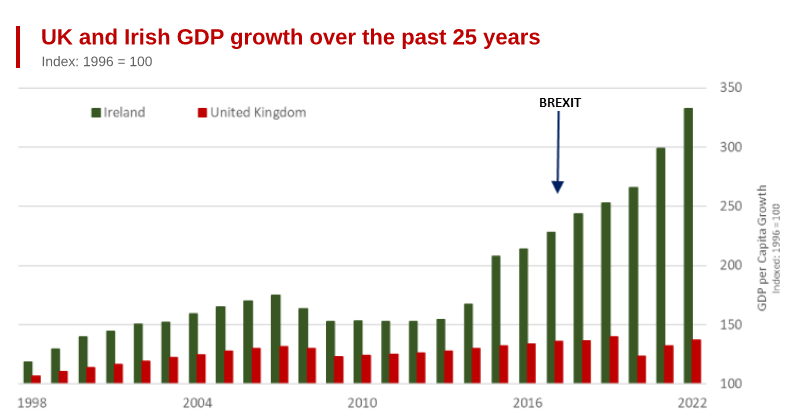
The Dead Tiger, Resurrected
The doomsayers who were saying their prayers at the grave opf the Celtic Tiger turned out to be wrong. Aligning with the EU, and staying there, was the best thing Ireland could have done. Look at what's happened to their former colonizers since they decided to leave. The UK chose to go their own way, and their economic growth has remained consistently poor. The British are only made all the more aware of their poor choices when they look next door, and see Ireland's meteoric rise within the EU.
Meanwhile, Ireland Moves
Ireland's growth has not been merely economic. As the Catholic Church continues to lose its authority, as population demographics shift and as economic opportunities rise, Ireland has become a bellwether for positive change in significant areas addressing human rights.
The battle for LGBT rights in Ireland has had many significant moments, with the decriminalization of homosexuality in 1993 and the Gender Recognition Act of 2015 among them. None though, was perhaps as impactful on a global level as the May 2015 vote where Ireland became the first country to legalize same-sex marriage on a national level by popular vote. The decisive referendum result saw 62% of voters back the amendment, while 38% voted against it. Article 41 of the Constitution of Ireland now explicitly protects the right to marriage irrespective of sex.
The Republic’s vote was preceded by a difficult personal debate that saw gay people speak about their own lives and others joining in with the campaign. Ireland's Health Minister, Leo Varadkar (who later served as Taoiseach from 2017 to 2020 and from 2022 to 2024), may have swayed the referendum when he came out publicly:
It’s not something that defines me, I’m not a half-Indian politician or a doctor politician, I’m not a gay politician for that matter, it’s just part of who I am.
BTW, Varadkar has a special connection with Georgia Southern.
And that wasn't the only big cultural move for the island. When Pope Francis visted Ireland in 2018 it was the first by a pontiff since the visit of Pope John Paul II in 1979. In the intervening 40 years, Ireland had confronted its painful history of clerical abuse, and the influence of the church had waned significantly.
Half a million people had signed up to attend the Pope's mass in Phoenix Park outside Dublin, but estimates put the crowd at closer to 150,000. The Irish media outlets publicly criticized Francis’ keynote speech in Dublin Castle on the first day of his visit, when he did not make a direct apology to the Irish victims of clerical sexual abuse.
For a country that James Joyce called "priest-ridden, God-Forsaken," to move so boldly away from centuries of undue religious influence seemed like a true sign of growth.
Sources
"After the Race: Ireland's Crash" The Economist vol. 398, no. 8721 ( 19 February 2011), pp. 25-28, www.economist.com/briefing/2011/02/17/after-the-race.
Campbell, Stephen J. The Great Irish Famine. Famine Museum, Strokestown Park, County Roscommon, Ireland.
Clark, Dennis, The Irish in Philadelphia. Temple UP, 1973.
Cronin, Mike. Irish History For Dummies. Wiley and Sons, 2006.
Curtis, Liz. Nothing But the Same Old Story: The Roots of Anti-Irish Racism. 6th edition. Information on Ireland, 1991.
Duffy, Rónán. "Reeling in the 2010s: 10 Events that Defined the Irish Decade." The Journal, 27 December 2019, www.thejournal.ie/relling-in-the-2010s-4925209-Dec2019.
Gallagher, Michael & Thomas. Paddy's Lament. Harcourt Brace & Company, 1982.
Gray, Peter. The Irish Famine. Harry N. Abrams, Inc. 1995.
The Great Irish Famine. Irish Famine Curriculum Committee, New Jersey Commission on Holocaust Education. Updated edition by The Irish Famine Education Institute, 2014. www.irishfamineeducation.org/uploads/2/1/2/9/21291242/the_great_irish_famine_curriculum.pdf
"Ireland is Now Significantly Wealthier than the UK." World Economics, www.worldeconomics.com/Thoughts/Has-Union-with-Britain-Been-an-Economic-Calamity-for-Northern-Ireland-V2.aspx.
"Ireland's Crash: After The Race." The Economist 17 February, 2011.
Meade, Geoff. "Irish People 'are second richest in European Union.'" Irish Examiner, 4 December 2024, www.irishexaminer.com/news/arid-10102056.html.
Kinealy, Christine. This Great Calamity: The Irish Famine 1845-52. Roberts Rinehart, 1995.
Litton, Helen. Ireland Before and After the Famine. Wolfhound Press, 1994.
Mangan, James, editor. Robert Whyte's 1847 Famine Ship Diary. Mercier Press, 1994.
Ó Heithir, Breandán. A Pocket History of Ireland. The O'Brien Press, 1989.
Ó Gráda Cormac. Ireland Before and After the Famine: Explorations in Economic History 1800-1925. 2nd edition. Manchester UP, 1989.
Poirteir, Cathal. Famine Echoes. Gill and Macmillan, 1995.
Ranelagh, John O'Beirne. A Short History Of Ireland. 2nd edition. Cambridge UP, 1994.
Scally, Robert James. The End of Hidden Ireland: Rebellion, Famine, and Emigration. Oxford UP, 1995.
When Ireland Starved. Celtic Video Inc., Radharc Films / Celtic Video / RTE, 1992.
Woodham-Smith, Cecil. The Great Hunger: Ireland 1845-1849. Penguin, 1991.